Resources - by Audience:
Resources - by Category:
Search our site:
View Cart Donate Follow Us: Sandra on Twitter   RSS Feed   Sandra on Facebook

Teaching About Pathology

May 18, 2009 by sandra  
Filed under Tips to Start Teaching

Comments Off

TIPS FOR GETTING STARTED

by Carol A. Lee Mooney, M.S., ICCJP

I had the pleasure of attending The Institute’s first therapist training in September 2007. I thought, finally, I met a program and professional who had in-depth knowledge, experience and training on the subject of pathology.

Sandra’s fiery passion for creating public awareness on the topic sparked a burning desire in me to teach about pathology in my own community. Capturing as much knowledge as I could on the topic of pathology was the first step to becoming a healer and a voice in what has become coined as the ‘number one public health issue’ in this country.

My passion was generated because I am a survivor of a pathological relationship myself. So I was eager to learn all I could and while at The Institute’s Retreat Center I read and absorbed all the books, CD’s, DVD’s, E-Courses, books, and workbooks Sandra made available. She also encouraged her students to read the work of other specialists in related areas.

With a certification in the Aftermath of Pathological Relationships from The Institute I shaped my private practice and community presentations around the topic of prevention and healing from pathological relationships. I enhanced my qualifications by becoming a Certified Life Coach through the Professional Woman Network in Louisville, KY. This helped develop a program structure for my clients. (Since that time The Institute now offers their own Certification in Life Coaching through Change Points Coaching so you can get all the training you need through The Institute.)

Sandra’s “How to Spot a Dangerous Man Before you get Involved provided an explosive basis for coaching clients across the United States who were involved with men or women who damaged them physically, emotionally, financially, spiritually or sexually. My clients were either involved in pathological relationships, in the process of leaving, or in the aftermath of the relationship.

It was my job to meet each individual where they were and help lead and guide, educate and support them, while helping to provide local referrals for assistance. To date, I have had many clients across the United States: California, Texas, Florida, Michigan, Georgia, New Mexico, Mexico, North Carolina, Kentucky, New Jersey, Virginia and New York. I’m always amazed that no matter where the client is located, the dynamics of the pathological relationship experience seems to be the same in the area of intensity of attachment and associated psychic injuries.

There are a number of ways you can get involved in Teaching Pathology to Your Community: Public education, small groups or one-on-ones.

Since my training with The Institute, I have been involved in all three avenues. I began giving Pathology Workshops at the community level. For most of my community events, I use The Institute’s PowerPoint presentation specifically designed to educate the general population. This simple to use outreach tool has opened up many opportunities for community discussions.

Facilitating small groups is another avenue to create public awareness in a more personalized way. My most treasured experience is with my weekly group of teenage girls which is always a fun experience. It’s a great feeling to see them be able to identify different pathological relationship types from movies, pop culture, music, and their daily lives.
My one-on-ones are personal coaching sessions with women who help them not only learn to identify pathology in future relationships, but help them with their day to day symptoms of the aftermath.

Working in the field of Pathological Love Relationships has been a fascinating and fulfilling experience and one that many people could be doing in their own communities. You can make a difference right where you’re at! If you are interested in teaching about pathology to your community here are some tips:

1. Get as much training on the topic as possible through The Institute’s products (Books, DVD’s, etc.)

2. Get certified in The Institute’s Coaching or Therapist Programs

3. Set up a weekly Pathological Love Relationship Support Group—The Institute can train you how to run Support Groups.

4. Get connected with large groups or associations so you can network with others and build your coaching program through these affiliations.

5. Get and utilize The Institute’s PowerPoint presentation in your community.

6. Set up speaking engagements with woman’s groups and shelters

7. Become an expert on your own niche of clients, i.e. the legal field, church congregations, PTA groups and/or government agencies.
Know what the impact of pathology is in these areas.

8. Write magazine or newspaper stories that position you as an expert in your field. Start your own website or blog about the issue of pathology. Write for your own local community when pathology is in the news. Make public awareness your first goal!

Every new generation needs to understand the permanence and the damage of Pathological Love Relationships. There is an open market in every community for someone to provide public speaking and awareness, support groups, or coaching. If we can help you become a resource in your community, please let us know how! Email us at saferelationships (at) yahoo (dot) com.

Writing for Happiness and Healing

May 14, 2009 by sandra  
Filed under Journal to Joy Column

Comments Off


penicon

Part II

By Lynn Ellyn Robinson

Ira Progoff, the original journal guru from the 1960s, recommended journaling on notebook paper. His method recommends that you insert your writing into a 3-ring binder behind one of a couple dozen of pre-made category tabs. That’s great for some kinds of journaling, especially if you’re working your way through historical events or figure out complex relationships. It also allows for cross-referencing (useful if you plan to write a memoir). For theme-based journaling (gratitude, prayer/meditation, health, travel, pets, food, etc.), I usually prefer a real book of some sort, with nice, heavy paper.

  • Check out the bound journals at a book store, which can run from $2 to $150. The look and feel of each volume is different. Handle them.
  •  A writer pal uses bright 79¢ spiral notebooks from the drugstore; they fold back and lie flat. She uses them as a “parking lot” for random thoughts that crowd her mind when she is starting her day and needs to clear the decks so she can focus.
  •  Consider the composition books so many of us used in school. Their pages are still stitched in place, but the price has gone up to about $2.00. They are a nice size and easy to carry.
  •  I prefer the “college rule” line width, but most of the journalers I know like wider lines. I also do a lot of creative and developmental writing on graph paper. The grid lines help me segment different ideas and sort out materials, lists and sequencing.
  •  If you are creative and artsy or just hate being limited by margins, check out the art supplies. Nicely bound sketchbooks with unlined pages are available in a wide range of sizes and are often made with acid-free paper that lasts for a long, long time.
  •  Use some leftover wallpaper, wrapping paper or fabric to make a cover for your journal. Customize it to suit yourself.

Grab a pen and start your own, personal, custom-made, one-of-a-kind journal. Use the power of ink to unearth old longings and make new discoveries. Writing offers a way out of the darkness and into the sunshine. Ink is your voice. When writing to meet your own needs, something wonderful happens: YOU emerge.

It’s never too late to live a life you love.
 
  Part I 

In this new column, Journal to Joy, we will be talking about the many aspects of using pen and ink to write your way toward glowing good health. Using your pen to ink thoughts and feelings on the pages of a private journal can promote healing from past hurts and write yourself into a brighter future – no matter where you start. Over the coming months this column will address ways to use writing to deal with topics such as depression, anxiety, and intrusive thoughts.  Journal to Joy will offer tips and techniques for handling tough issues as well as the fun of delving into your own Internal Archaeology and designing a Dream Life for yourself.

Journal to Joy is the preamble to an Online Therapeutic Journaling Group. The kick-off will be a tele-seminar followed by an intensive Journaling Retreat later on, so be sure to check here for the details. You won’t want to miss the interactive sessions or the opportunity to take a break from your everyday life and do some focused, internal work.

Many who have come through a long, dark tunnel have often asked for instruction and support in telling their own, unique stories. In response, Journal to Joy will address ways to get started on your Personal Life History or Memoir. There are many different approaches, so we will look at several of the main formats and offer suggestions about tailoring the approach to suit your needs and ideas.

Journal to Joy will investigate different types of writing and journals. Many years ago a friend proudly showed me the “diary” his pioneer great-great-grandmother had kept while homesteading out west in the 1800s. Her daily entries faithfully recorded weather conditions and who was born, died, or married, but very little else. By contrast, structured journaling is a powerful tool that is much more than just a list or diary of activities. Disciplined writing is highly effective when sifting through a barrage of thoughts which threaten to overwhelm.

Many people have never thought of themselves as writers. Far too many among us endured humiliating experiences in school or had our early efforts critiqued by well-meaning family members. Even more of us agonized silently over spelling, grammar and punctuation. My own grandmother, a teacher, sent my childhood letters back to me all marked up with blue pencil corrections. Believe me; I know whereof I speak. Despite all that unpleasantness, there is good news. Fast forward to this very day – right where you are at this very moment.

Here’s the good news: Your journal does not care how you write.

It makes no difference to the page whether you know the rules. Handwriting and spelling are never graded. You can doodle if it suits your mood; use colored markers or crayons. Draw pictures and glue in cut-outs from magazines. Pen words around the pictures and ink in pretty loops and spiky angles. Scribe your feelings in words using colors and shapes. Decorate your pages. Your journal is yours and yours alone. In it, like nowhere else in your life, you can express yourself ANY WAY YOU WANT! Say anything you like – laugh, cry, scream, swear, or whisper. It is YOUR voice – the voice always inside of you, but maybe rarely used. Now is the time for YOUR voice to be heard and your journal is the place for it to speak.

It’s never too late to live a life you love.

Sandra Says

March 10, 2009 by sandra  
Filed under Sandra’s Current Article

LATEST ARTICLE

3/9/2010

The Gift of Fear/The Curse of Anxiety

Is it Fear Or Is it Anxiety?

Women who have been in pathological relationships come away from the relationships with problems associated with fear, worry, and anxiety. This is often related to Post Traumatic Stress Disorder (PTSD) or what we call ‘High Harm Avoidance’– being on high alert looking for ways she might get harmed now or in the future.

PTSD, by its own nature as a disorder, is an anxiety disorder that is preoccupied by both the past (flashbacks and intrusive thoughts of him or events) and by the future (worry about future events, trying to anticipate his behaviors, etc.). With long term exposure to PTSD, this anxiety and worry begins to mask itself, at least in her mind, as ‘fear.’ In fact, most women lump together the sensations of anxiety, worry, and fear into one feeling and don’t differientiate them.

Fear is helpful and safety-oriented whereas worry and anxiety are not helpful and related to phantom ‘possible’ events that often don’t happen. To that degree, worry and anxiety are distracting away from real fear signals that could help her.

In the book which is now a classic on predicting harmful behavior in others, Gavin deBecker in ‘The Gift of Fear’ delineates the difference between what we need fear FOR and what we DONT need anxiety and worry for. In some ways, the ability to use fear correctly while stopping the use of anxiety and worry may do much to curtail PTSD symptoms.

deBecker who is not a therapist but a Danger Anaylst has done what other therapists haven’t even done–nix PTSD symptoms of anxiety and worry by focusing on true fear and it’s necessity versus anxiety and it’s faux meaning to us.

The term fear was used by Freud (in contrast to anxiety), to refer to the reaction to  real danger. Freud emphasized the difference between fear and anxiety in terms of their relation to danger:

~ Anxiety is a state characterized by the expectation and preparation for a danger–even if it’s unknown ~
~ While fear implies a specific object to be feared in the here/now. ~ (Anxiety is: ‘He MIGHT harm me’ where fear is: “He IS harming me with his fist, words, actions, etc.”)

If you heard there was a weapon proven to prevent most crimes (including picking a dangerous partner) before it happened, would you run out and buy it?  World-renowned security expert Gavin deBecker says this weapon exists, but you already have it. He calls it “the gift of fear.”

The story of a woman named Kelly begins with a simple warning sign. A man offers to help carry her groceries into her apartment—and instantly, Kelly doesn’t like the sound of his voice. Kelly goes against her gut and lets him help her—and in doing so, she lets a rapist into her home.

“We get a signal prior to violence,” Gavin says. “There are preincident
indicators. Things that happen before violence occurs.”
Gavin says that unlike any other living creature, humans will sense
danger, yet still walk right into it.

“You’re in a hallway waiting for an elevator late at night. The elevator door opens, and there’s a guy inside, and he makes you afraid. You don’t know why, you don’t know what it is. And many women will stand there and look at that guy and say, ‘Oh, I don’t want to think like that. I don’t want to be the kind of person who lets the door close in his face. I’ve got to be nice. I don’t want him to think I’m not nice.’

And so human beings will get into a steel soundproof chamber with
someone they’re afraid of, and there’s not another animal in nature that would even consider it.”

Gavin says that “eerie feelings” is exactly what he wants women to pay attention to. “We’re trying to analyze the warning signs,” he says. “And what I really want to teach today and forever is the feeling of the warning sign. All the other stuff is our explanation for the feeling. Why it was this, why it was that. The feeling itself IS the warning sign.”

What happens over and over again is that women dismantle their OWN internal safety system by ignoring it. The longer she ignores it, the more ‘over rides’ it receives and retrains the brain to ignore the fear signal. Once rewired women are at tremendous risks of all kinds…risks of picking the wrong men, of squelching fear signals of impending violence, shutting off alarms about potential sexual assaults, shutting down red flags about financial rip offs, squeeking out hints about poor character in other people…and the list goes on. What is left after your whole entire safety system is dismantled? Not much….

Women, subconsciously sensing they need to have ’something’ to fall back on, swap out true and profoundly accurate fear signals with the miserly counterfeit and highly unproductive feeling of worry/anxiety.

LADIES– WRONG FEELING!

Then they end up in counseling for their 4th dangerous relationship and wonder if they have a target sign on their forehead. No they don’t. They have learned to dismantle, rename, minimize, justify, or deny the fear signals they get or got in the relationship.  As if their ability to ‘take it’ or ‘not be afraid’ of very dangerous behavior is some sort of win for them. As if their ability to look danger in the face and STAY means they are as tough or competitive as he is…

No–it means they have a fear signal that no longer saves them. Their barely stuttering signal means it’s been over-ridden by her. She felt it, labeled it, and released it all the while staring eye-to-eye with what she should fear most.

Then later, or another day or week passes and she has mounting anxiety–over what she wonders? She has a chronic low grade worry, whisps of anxiety that waife thru her life. She can’t put 2+2 together to figure out that ignoring true fear will demand to be recognized by her subconscious in some way—an illegitimate way through worry and anxiety that does nothing to save her from real danger. Her real ally (her true fear) has been squelched and banished.

When coming to us for counseling she wants us to help her ‘feel safe’again when actually, we can’t do any of that. It’s all in her internal system as it’s always been. Her safety is inside her and her future healing is too.

She will sit in the counselor’s office denying true fear and begging for relief from the mounting anxiety she is experiencing. She doesn’t trust herself, her intuition, her judgments–all she can feel is anxiety.  And with good reason! True fear is her true intuition…not anxiety. But she’s already canned what can save her and now on some level she must know she has nothing left that can help her feel and react.

Animals instinctively react to the danger signal–the adrenaline, flash of fear, and flood of cortisol. They don’t have internal dialogue with themselves like “What did that mean? Why did he say that? I don’t like that behavior—I wonder if he was abused as a child.”

An animal is trained to have a natural reaction to the fear signal–they run. You don’t see animals ’stuck’ in abusive mating environments! In nature, as in us, we are wired with the King of Comments which is the danger signal. When we respond to the flash of true fear, we aren’t left having a commentary with ourselves.

“The future is not some place we are going to, but one we are creating. The paths are not to be found, but made, and the activity of making them, changes both the maker and the destination.” – John Schaar


2/24/2010

Are Feelings Facts?

Women don’t know whether to trust what they feel or not. Are you confused over whether feelings are factual or if they are fiction? You’re not alone. Women struggle where to draw the line between believing what they think and questioning it.

On one hand, feelings can be red flags in the beginning or in the midst of the relationship. Red flags can be emotional, physical, or spiritual warnings of what is happening or what is yet to be.

Emotional red flags are feelings you get while in the relationship–constant worry, dread, wondering, suspicion, anxiety, depression, or obsession. Often the emotional red flags are quickly noticed by other people in your lives who point out that you have changed since the relationship–and not for the good. Lots of times women don’t want to ‘hear’ about their emotional changes since being in the relationship. Other times, women already KNOW they are having emotional red flags about him or aspects of the relationship. In either case, it’s important to know that emotional red flags can be GOOD PREDICTORS OF THE POTENTIAL LONGEVITY OF THE RELATIONSHIP. Many women notice that the red flags they had at the beginning of the relationship ARE the reasons the relationship eventually end. Emotional red flags can be great tools and often accurate.

Waiting for feelings to become ‘facts’ before you act on them can be very dangerous. In the case of emotional red flags (and your intuition), responding NOW instead of later can help you exit the relationship quickly. By the time a feeling IS A FACT, many things could have happened. (For more info on red flags, see the first few chapters of the Dangerous Man book).

ON THE OTHER HAND (there’s always ‘another hand’ isn’t there?)–women wonder if the intense feelings they are having are an indicator of ‘true love’ or why would they be having them? Women often experience confusing emotions when trouble starts in the relationship. She either becomes confused when the relationship turns bad or she becomes confused when she has ended the relationship. This confusion takes the form of “if he was so mean to me, why do I still have feelings for him? I must still love him if I can’t stop thinking about him even if he did bad things. Do my feelings mean I should go back with him?”

In these cases ‘feelings’ are not facts. It is human nature to seek attachment and bonding. When that is ripped away there is an emptiness that happens. Women often think that ‘means’ that they were in love if they experience the aftermath of ‘loss.’ It just means you are feeling the loss.

Women often think that since they ‘miss the good times of the relationship’ they must miss him. What women actually often are missing is the ‘feelings’ that were generated in the relationship when it was good. Women miss feeling of being ‘in love’ or ‘attached’ or ‘wanted and desired’ or ’safe and secure.’ When women can separate out what they really ‘miss’ they often can see that ‘he’ represented those feelings she was having. She misses the feelings of the illusion of being in a good relationship. Missing ‘him’ might not really be ‘missing him.’ Who is ‘him’ – the dangerous man/cheater/liar/or pathological? You miss that ‘him’? No. You miss the feelings of being in love.

Tell yourself — “What I am missing are the ‘feelings’ of being in a good relationship.” Remind yourself of that when you misinterpret those feelings as meaning you ‘want him back.’ Often that isn’t the case. Recognize that this very ‘feeling’ thing is what propels women right back out there seeking to ‘feel loved’ again and attach to those missing feelings. It places women very ‘at-risk’ of repeating the same mistake.

Here—try this. Draw a line down the middle of the page. On one side, list the feelings you miss having. On the other side, list the dangerous man traits/behaviors/incidents.

Now take a look. Which do you really miss?

Feelings can be accurate when we are getting red flags in the relationship. Feelings can be inaccurate when we are gauging whether to return to relationship because we think we ‘miss’ him when in fact, what we miss are the feelings that were generated in the relationship. Feelings can be inaccurate when we are gauging the intensity and equate that with love or something healthy in the relationship. Understanding the importance of ‘feelings’ in all stages of a relationship can help you recognize just ‘what’ your feelings are telling you and when to heed them and when to be a little suspicious of their messages to you!


2/16/2010

HEALTHY LOVE – WHAT IN THE WORLD IS THAT?

by Sandra L. Brown, M.A.

The last week or so we have been talking about the difference between attraction and love. Since Valentine’s Day was upon us, I thought it would be a great discussion about what happens in Pathological Love Relationships— that attraction is on over-drive while love (from a pathological) is lingo-bling.

But what about real love, healthy love? People write all the time and say ‘When are you going to write How to Spot a Healthy Partner because with as many bad relationships that I’ve been in, I can hardly tell the difference between what should be obviously toxic and what should be obviously healthy.’

The opposite of healthy love is what we often call ‘toxic’ love. Sometimes understanding what toxic ‘looks like’ helps us to see what real ‘love’ should look like too.

Here is a short list of the characteristics of Love vs. Toxic Love (compiled with the help of the work of Melody Beattie & Terence Gorski).

1. Love – Development of self first priority.  Toxic love – Obsession with relationship.

2. Love – Room to grow, expand; desire for other to grow. Toxic love – Security, comfort in sameness; intensity of need seen as proof of love (may really be fear, insecurity, loneliness).

3. Love – Separate interests; other friends; maintain other meaningful relationships.  Toxic love – Total involvement; limited social life; neglect old friends, interests.

4. Love – Encouragement of each other’s expanding; secure in own worth.  Toxic love – Preoccupation with other’s behavior; fear of other changing.

5. Love – Appropriate Trust (i.e. trusting partner to behave according to fundamental nature.) Toxic love – Jealousy; possessiveness; fear of competition; protects “supply.”

6. Love – Compromise, negotiation or taking turns at leading. Problem solving together.  Toxic love – Power plays for control; blaming; passive or aggressive manipulation.

7. Love – Embracing of each other’s individuality.  Toxic love – Trying to change other to own image.

8. Love – Relationship deals with all aspects of reality. Toxic love – Relationship is based on delusion and avoidance of the unpleasant.

9. Love – Self-care by both partners; emotional state not dependent on other’s mood.  Toxic love – Expectation that one partner will fix and rescue the other.

10. Love – Loving detachment (healthy concern about partner, while letting go.)  Toxic love – Fusion (being obsessed with each other’s problems and feelings).

11. Love – Sex is free choice growing out of caring & friendship.  Toxic love – Pressure around sex due to insecurity, fear & need for immediate gratification.

12. Love – Ability to enjoy being alone. Toxic love – Unable to endure separation; clinging.

13. Love – Cycle of comfort and contentment.  Toxic love – Cycle of pain and despair.

~ ~ ~ ~ ~ ~ ~ ~ ~ ~ ~ ~ ~ ~ ~ ~ ~ ~ ~ ~ ~ ~

Love is not supposed to be painful. There is pain involved in any relationship but if it is painful most of the time then you are probably in a Pathological Love Relationship because the end result of these relationships is ‘Inevitable Harm.’  Let’s be clear that there is nothing wrong with wanting a relationship – it is natural and healthy. If we can start seeing relationships not as the goal but as opportunities for growth then we can start having more functional relationships. A relationship that ends is not a failure or a punishment – it is a lesson. And these lessons are mostly about pathology, its permanence, and the lives it affects without discrimination.


2/9/2010

REAL LOVE NOT JUST REAL ATTRACTION

by Sandra L. Brown, M.A.

So many people confuse the feeling of ‘attraction’ with the emotion of love. For some who are in chronic dangerous and pathological relationships, it’s obvious that you have gotten these two elements ‘mixed up.’ Not being able to untangle these understandings can keep people on the same path of unsafe relationship selection because they keep choosing the same way and getting the same people!

Attraction is largely not only unconscious but also physical.  There is actually something called an ‘erotic imprint’ which is the unconscious part that guides our attraction. (I talked about this in the Dangerous Man book). Our erotic imprint is literally ‘imprinted’ in our psyches when we are young–at that age when you begin to notice and be attracted to the opposite sex. As I mentioned, this is largely an unconscious drive. For instance, I like stocky dark-haired men. When ever I see that type of image, I immediately find that man ‘attractive.’ I can ‘vary’ slightly on my attraction but I’m not going to find Brad Pitt attractive. I might forego the full ’stocky’ appearance but I’m not going to let go of some of the other traits that make men appealing to me. We like what we like. For instance, I am attracted to Johnny Depp or George Clooney. I don’t like any of the blondes or overly tall and lanky body types.

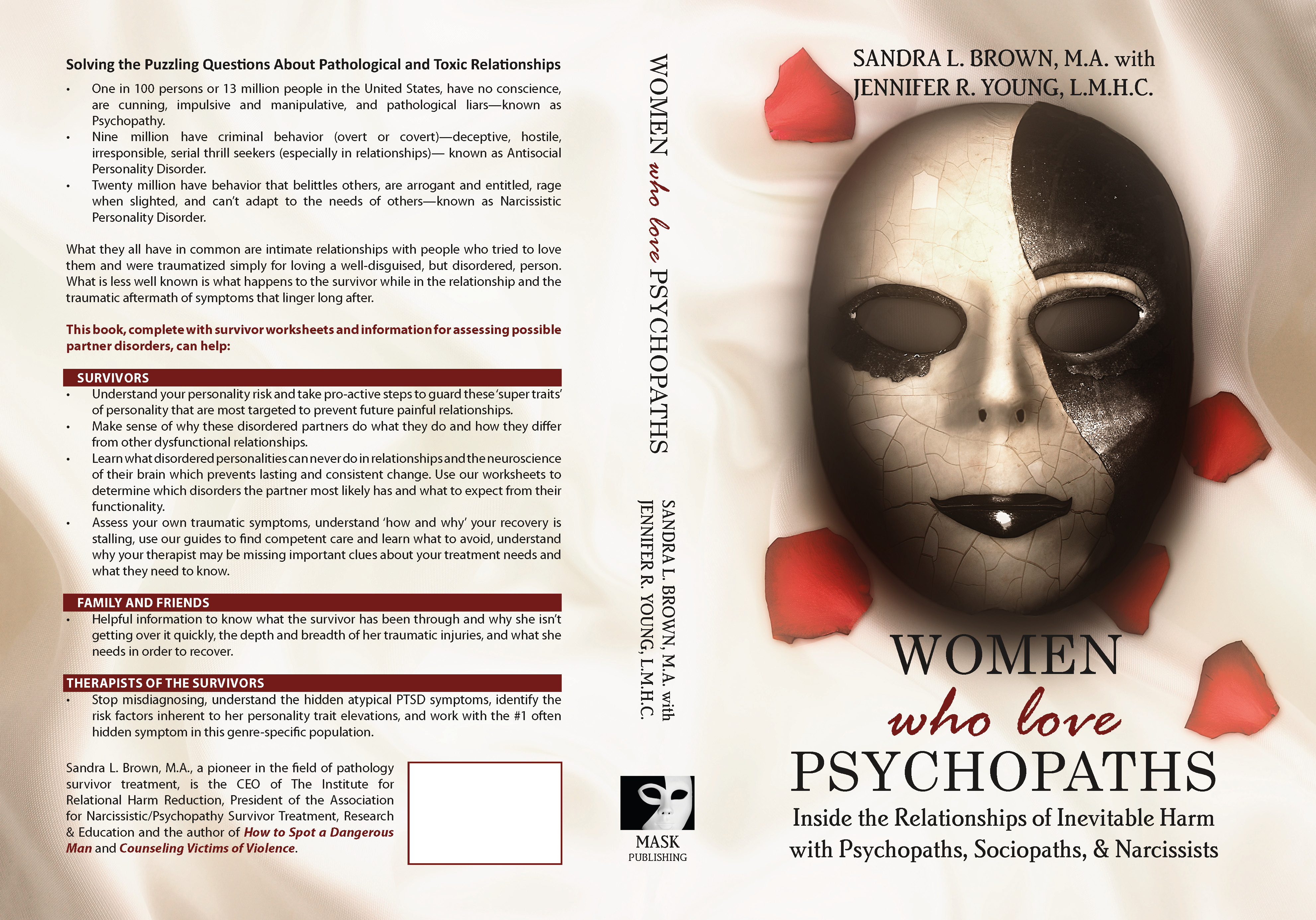
If you think back to what your ‘attraction’ basis is, you may find some patterns there as well. Attraction, however, can also be behavioral or based on emotional characteristics. For instance, some women are attracted to guys with a great sense of humor. The attraction is based on that characteristic. Other women may be attracted to athletic guys–not because of what sports do to their bodies, but because of the behavioral qualities of athletes.  Attraction can be subtle–like the unconscious erotic imprinting that makes us select men based on physical attributes OR attraction may lead us to choose relationships based on behaviors or emotional characteristics like displays of empathy, helpfulness or friendliness. (I discussed your own high traits of empathy, helpfulness and friendliness in Women Who Love Psychopaths.)

Although these traits might guide our relationships selection, this is not the foundation of love. It’s the foundation of selection.

Often, our relationship selection comes more from attraction than it does anything else. So knowing ‘who’ and ‘what types’ you are attracted to will help you understand your patterns of selection. Some people choose characteristics–helpfulness, humor, gentleness or another quality that they seem to be drawn to. Other people are more physical in their attraction and find the physicality of someone either a ‘go’ or a ‘no.’ Maybe you like blondes or blue eyes. This may also drive your pattern of selection.

Also in the area of attraction–sometimes it’s Traumatic Attraction that seems to drive our patterns of selection. People, who have been abused, especially as children, can have unusual and destructive patterns of selection. While this may seem the opposite of what you would expect, these patterns are largely driven by unresolved trauma. People who were raised in alcoholic, dysfunctional, or abusive homes are likely to repeat those exact patterns in their selection of a partner. They often select individuals who have similar ‘characteristics’ to the abusive/neglectful/addicted adult they grew up with or were exposed to. The characteristics could be physical (how they look) or behavioral (how they act) or emotional (how they abuse/neglect).  In any event, the unresolved abuse issues drive them to keep selecting abusers for relationships. Today, they are mystified as to why they keep picking abusive/neglectful/addicted people for relationship partners. That which remains unresolved, revolves–around and around thru our lives until it is resolved.

So, when you have no idea that attraction (good, bad, or dysfunctional) is guiding your selections, you just keep picking the same way and getting the same thing. But because the world keeps using the word ‘love’ you use it, too. And you label your attraction-based-choices (that are largely dysfunctional) as ‘love’ and then become confused about the nature of this thing called ‘love.’ Your attraction is NOT love. It is merely attraction. What DOES or DOES NOT happen IN the relationship may be more reflective of ‘love’ than anything else.

Remember the Bible verse, “Love is patient, love is kind, love does not seek it’s own…”? it helps to reflect how love is ‘other centered’ not in a codependent and frantic needy way but in a way that helps others be interdependent in relationships. Love is often attributed to positive ‘attributes’ such as:

Joy – love smiling

Peace – love resting

Patience – love waiting

Kindness – love showing itself sensitive to others’ feelings

Goodness – love making allowances

Faithfulness – love proving constant

Gentleness – love yielding

Self-control – love triumphing over selfish inclinations

–Source Unknown

(Now, think about if ANY of those traits described the Pathological Love Relationship? I didn’t think so….)

“As long as we believe that someone else has the power to make us happy then we are setting ourselves up to be victims” (From: Codependence: The Dance of Wounded Souls).

This Valentine’s Day be very clear with yourself about love and attraction. This is a time when you might be likely to want to recontact him. Let me remind you, NOTHING has changed. His pathology is still the same. And on February 15th you could hate yourself for recontacting him for one weak illusionary moment on Feb 14th–in which the world is focused on love but he is focused on manipulation, control or anything OTHER than love. If you open that door, then you will have weeks or months of trying to get him out and disconnect again.

Instead, plan ahead for your potential relapse by setting up an accountability partner AND something to do! Go to a movie with a friend; go out to dinner, so SOMETHING that takes responsibility and action for your own loneliness at this time of year. Whatever you do, don’t have a knee jerk reaction and contact him. One day on the calendar about love is just an ILLUSION!


2/2/2010

LOVE! LOVE! LOVE! Will I Ever Find MINE?

by Sandra L. Brown, M.A.

February is Valentine’s Day month–a trigger month for many women who want to just ’slip back into the fantasy’ of everything we associate as a culture with Valentine’s Day.

It’s one of those trigger months like Thanksgiving and Christmas where women want to ‘look the other way’ in order to have a nice day or time with him. Just for 24 hours she wants to pretend he really isn’t pathological. She wants the chocolates, a dinner out, dancing, a little romance–and 24 hours of normalcy. But at midnight, the Cinderella dress turns back to what it was; the carriage that carried the handsome prince is now a pumpkin with field mice.

Pink and red hearts does not make his pathology ‘turn off’ for the convenience of a lover’s holiday.  Women get frustrated and want to know “Will I Ever Find MY Love? When Will It Be My Turn To Find Someone Worth Loving?”

I don’t know…can you:

~Stop focusing on him?

~Be willing to manage your intrusive thoughts of him?

~Redirect your obsessions from him to your own self care?

~Create a full life so you aren’t lonely?

~Build a foundation of support that doesn’t include ‘having to be’ in a relationship?

~ Learn to find fulfillment in activities that don’t only include intimate relationships?

~Treat your symptoms of anxiety, depression and Post Traumatic Stress Disorder?

~Heal your sexuality?

~Embrace spirituality?

~Learn to be attracted to guys who aren’t proverbial bad boys?

~Dig deeply to see what all your relationships have in common so you don’t repeat the pattern?

~Memorize what pathology is and stop looking for loop holes?

~Take a year or maybe even two years OFF from dating to nurture all those places in you that are wounded and broken?

~Will you take time to learn what your trait proclivities are (read Women Who Love Psychopaths) so you know how to safe guard yourself in the next relationship?

~Seriously UNDERSTAND how your traits and his traits are a magnet to each other?

~ Realize YOU ARE ENOUGH FOR YOU! If another relationship DOESN’T come along…you will survive. If you’re really determined, you’ll even THRIVE.

~ Get grounded–sink your feet into the earth of your soul and declare you’ll never be uprooted again…no matter what–you’re grounded in you and reality–not fantasy.

~Be willing to challenge old belief systems, old assumptions, old patterns, old preferences.

~ Most of all…can you LOVE yourself?

This month is Valentines Day…you’ve fallen in love with all sorts of things and people…you’ve fallen in love with illusions, with dreams, hopes, and pathology.

It’s time to fall in love with you! I know who you are…you know why? Because after all that research we know EXACTLY who you are–you deeply attach and love, you are loving to the 9th degree, loyal, trusting, sensitive, and very invested in relationship happiness. You’re a TERRIFFIC woman that any NORMAL man would be blessed to have.

No one is alone during the month of Love. We stand hand in hand, bridging the gap for each other–connected and bonded by a sorority of shared experiences, pain, and yet hope. If you need a hug for Valentines Day, there are plenty of cyber hugs floating thru here.

Learn to love you. Nothing happens and no one else does until you do. Give to the world that part of your self that is so rich and deep. There are lots of ways to be loved–be loved by giving back, by reaching others. Valentines Day is for lovers. Be the lover of your own soul. We celebrate that with you…


1/26/2010

Pacing and Planning Your Own Recovery
Becoming Part of The Institute’s Path to Recovery

by Sandra L. Brown, M.A.

Since the beginning of the year, we have been focused on discussing your recovery in great detail. That is because the power of pathology saws people off at the knees. In order to heal, you have to have a plan for your own recovery.

We consider this so important that a portion of all of my counseling including phone, in person, or at the retreats is focused on how to pace and plan your own recovery.

Women fantasize that ’somehow’ getting over this pathological relationship will just ‘happen’ and don’t know they should be planning their recovery or even how to go about planning it.

In fact, most women have done -0- to pace, plan, or facilitate their own healing process. Those of you who have found the website are much further ahead than the woman who has not even begun reading about the topic of her relationships yet! So finding the information is a great first step. But, it’s only a first step and too many women stop there only to relapse and get into yet another pathological relationship.

Last year’s newsletters spent a lot of time examining the depth of damage done at the hands of your pathological. We have looked at PTSD, The Cracked Vessel, the need for Living the Gentle Life, about intrusive thoughts and obsessions, healing spiritually, healing sexually and about fantasy and hatred. We have spent almost 52 weeks looking very deeply at the issue of how this relationship has hurt you emotionally, physically/medically, spiritually, sexually and financially.

There will always be those women who will not do anything about their lives except continue to be a victim of it. How do I know this? I get the same emails from the same people week after week asking me the same ‘loophole-based’ questions about ‘do I think she should leave him because after all, he SAID he would change.’ Week after week the same people with the same questions who haven’t read the book, who have not spent time in the workbook, who haven’t listened to one mp3 or CD, who haven’t spent 1 hour in counseling….keep asking the same questions and getting the same results.

Any 12 Stepper knows that the only way they can stay away from something so life-gripping like drugs, alcohol, gambling or sex is with a concerted daily focused recovery on themselves and the behaviors, habits and beliefs that lead them to the life-damaging events that have altered them. Women who will recover from pathological relationships are those who take the same serious and focused approach to the life-gripping and life- damaging relationship that has altered her life.

40+ hours a week is spent at The Institute developing ways to strengthen YOUR recovery–after all, this isn’t about US! This is done by writing books, e-books, making mp3s and CDS and other products, giving workshops and conferences, training therapists so they can do phone counseling with you, opening a retreat center so you can get specific and unique treatment for your issues, and intense research so we understand WHAT you need to heal from this.

We hope that 2010 is the year you really knuckle-down and focus on your own recovery–taking the steps you need to take to heal from the life-damaging experience.

Why? First of all, we don’t want pathology to win by destroying the lives of strong and wonderful women. We exist to kick butt on this issue! Secondly, WE NEED YOU!

~ If you don’t teach the woman you sit next to, how will she learn to spot and avoid pathology?

~ If you don’t heal and recover, who will be a teacher to others?

~ Who will run support groups?

~ Who will give community lectures?

~ Who will operate an outreach?

It is not us! Our focus is to educate YOU. Your job is to reach others! 2010 can be the year that you heal and reach others. Let us help you reach your recovery goals, and then the world!


1/19/2010

Are You Really As Far Along As You Think You Are?

by Sandra L. Brown, M.A.

For the New Year, the month of January we have been discussing recovery and finding your path to emotional wellness from Pathological Love Relationships in 2010.

When women get mild relief from the unrelenting symptoms of the aftermath with a pathological, it can be palatable to them. The relief from intrusive thoughts, obsessions, PTSD, poor sleep, hyper-vigilance, or any other problematic symptom can feel ‘healing’ to them. But it doesn’t always mean they ARE healed.

Over and over again, I have learned how damaging, how unrelenting the aftermath is from pathological relationships.

For some women, it reaches all the way back to childhood with pathological parents. For others, however, it has been only in their intimate relationships during adulthood yet has left its distinguished mark.

Mild relief can often be mistaken for recovery. Recovery is a life long journey of self care. Recovery can begin at the moment you recognize the damage done to you by pathologicals but it doesn’t end with a counselor or a group. For many women, the symptoms have crept into their worldview, how they see others, their environment, and themselves.

Weekly, I learn again and again as I meet with women that the damage is widespread. This isn’t a quick fix or often even a quick treatment. While her mild relief of symptoms instills relief or hope, it isn’t the end of her recovery journey. It’s the beginning.

Like peeling an onion, each layer shows a level of damage that needs care. All the way down to the core are layers of unperceived and unrecognized aftermath symptoms. At the core are boundary issues–those necessary limits that show someone understands what’s hers, someone else’s, or God’s. From the center of boundaries are developed gates which serve as limits saying what one will tolerate and will not tolerate.

Boundaries are the bedrock of all recovery. Anything that is built will be built from the issue of healthy or unhealthy boundaries. Many women don’t realize that pathologicals target women with poor boundaries.

They test it out early in the relationship and when small violations are not managed, they proceed on with bigger violations. Every violation is a green light. Boundaries are the first step in recovery.

In other layers of the onion lays hyper-vigilance issues. High harm avoidance from PTSD weaves a level of distrust in new environments, people, and situations. It affects fear of the future and even fear of now.

Another layer of the onion is communication–the ability to listen in the midst of upset. Since pathologicals have skewed communication, this area is often seriously affected. Long term exposure to pathologicals produces the same type of skewed communication patterns and linguistics in women who have normalized abnormal behavior.

A layer of emotional regulation is most assuredly part of the aftermath–anxiety, depression, irritability, the overflow of pent up emotions and the inability to control the emotions.

Layer after layer are aftermath symptoms that must be peeled and treated in recovery. Everyone knows how many layers are in an onion. While it may be disconcerting to see all those layers, the layers are translucent and show the wounding on each level that recovery must touch.

Women who have begun recovery may be surprised at what feels like the un-ending layers of the onion and wonder when they will reach the core. A mild relief from anxiety or sleeplessness is welcomed but should not be viewed as more than it is. Reaching to the core is deep work and should be respected for the lengthy process it is likely to be. What other choice is there?

Whether you begin at the core with boundaries, or start at the outer edge with symptom management and work into the onion core, allow the process because there is not healing without it.

We must never underestimate the damage done by pathologicals at a deep emotional and even spiritual level.


1/12/2010

Why a Focused Recovery is Necessary -
Beginning 2010 in a Completely Different Mindset

by Sandra L. Brown, M.A.

Last week I began the New Year by talking about the issue of healing, recovery,
and moving forward. In fact, all of January we are going to look at why starting 2010
‘differently’ can help you move forward in recovering from the aftermath of a pathological love relationship.

The past few years at The Institute has been a trememdous time of developement.
(Don’t mind me as I wander down memory lane of all that has happened this year at The Institute….)

A mere two years ago the newsletter started. We now have nearly 35,000 subscribers
each week. That created a snowball effect and the phone counseling and coaching
began. More e-books were written. Then the CDs, mp3s, DVDs, and tele-seminars were created.

Research commenced and the Women Who Love Psychopaths book was written. 2nd Edition is coming out soon. The retreat program started, we trained therapists and
coaches, and started the Inpatient Treatment Center. Sandra began to do more keynote speaking at other organizations conferences including law schools and victim organizations.

All this development because of realizing how uniquely damaged you became at the hands of a pathological. All this research because of realizing there was really something to ‘the temperament’ of women who end up in pathological relationships. All this phone counseling, therapist training and retreat/treatment center creation because so few people ‘get it’ about you, him, and the mind-blowing relationship dynamics. For the FIRST time there really is a concrete program designed about you and in some ways, by you, and definitely for you.

The one thing that does stand out in the research and what I have been eye-balling closely about healing and recovery is that this level of damage by him is profound. If there were lots of ‘hims’ then it’s even more profound. What this does to you over the long haul is take some strong, fabulous women out of the game of life by destroying you.

Untreated symptoms, get worse. Symptoms that get worse effect your life functioning and your children.

Worsened effects then contaminate your partner selection. And if you do get a healthy one,
you don’t like him or you’re too messed up from the pathological relationship to be in a healthy relationship so he leaves.

Untreated symptoms make intrusive thoughts worse so obsessions increase. Friends abandon you because they are tired of hearing about the obsessions so you isolate.

Isolation makes you at risk of recontacting him and recontacting him lowers your coping skills.

As your coping skills drop your bad habits increase (drinking, medication over use, eating, hibernating).

As your coping skills lower your fantasizing increases ‘Maybe he ISN’T pathological’ “Maybe he WILL stop cheating, etc.’ and your minimizing begins ‘At least he …..’

More contact with him increases your Post Traumatic Stress symptoms of flashbacks, fear of the future, unbridled worry, depression,and insomnia.

Is any of this sounding familiar? There is a typical decompensation pattern that most of the women go through. Recovery can stop that decompensation and begin rebuilding your life.

By December 31 of this year (2010) how many of you will be in the same situation, with the same man, having the same symptoms?

On the other hand, how many of you will be ‘pathology free?’ — symptoms reduced,
a new vigor for life, insight about how this happened and how to avoid it in the future?

How many of you will be less depressed and anxious, more active, lost weight, have more friends,
have a better job, have happier children, got more self esteem so a better job or gone back to school, and have potential to have a healthy relationship…?

I’m not a resolution type person so I don’t make them but I AM an advocate for complete life changes. Not tiny habits, big overhauls. Let’s face it, if you have dated a narcissist or a psychopath, you NEED a big life overhaul. Something malfunctioned in your life that created this
huge blind spot under which really sick people flew into your life, camped there, and overtly destroyed you. That’s not a little issue—take a look at the condition of your life and see if you think it was ‘little.’ Ask others if they think it was little.

2010 is going to be a great year here at The Institute–I can just feel it. We spent the last three years laying a solid ground work for super programming next year.

For the first time ever, everything is in place to heal for the women who have loved
pathologicals. I believe we have covered all the bases with phone support (coaching
and weekly support groups), in person counseling (retreats, 1:1s, and inpatient
treatment), portable products (ebooks, books, DVDs, CDS) and community outreach
through workshops in your area. We have removed the barriers to assistance by creating
our program in as many formats as possible. I recently found out that the Dangerous Man book
is now in almost every country of the world!

I hope in 2010 instead of being a mere name on our email list, you’ll be a very active part of The Institute beginning by working on your own healing. Then we hope you will run support groups in your community, give powerpoint presentations for other women in your area, or start an advocacy group. Instead of emailing me and telling me what ELSE I should be doing (I’m tired enough!), how about you step out and be the powerhouse in your own community?
How about you take it to the streets and pass it forward? How about you turn your life
around so you can be a role model to other women?

All of this begins when you start healing yourself…and moving forward.

The truth is, there is only us to educate others. You don’t see a multi-million dollar ad campaign with billboards on the highways that announce how to spot pathological relationships do you? That’s because it doesn’t exist. Sadly, no one has funded a national campaign to
warn and educate others. However, what exists is The Institute + You = Education For Others.
It’s you and me, babe!

As Gandhi said ‘Be the change you want to see in the world.’

Join us in 2010 for Healing Your Heart! We’re here.


1/5/2010

Finding Effective Help in 2010!

By now if you have been trying to heal from a pathological love relationship and can’t find effective and knowledgeable counseling you have probably figured out what we have…that the pathological love relationship is NOT widely understood.

Frustrated women hear unhelpful advice from family, friends and even therapists who label their attachment to pathological men as “codependent” or “mutually addictive” or merely “emotional abuse.” Women jump from counselor to counselor and from group counseling experience-to-group counseling experience looking for someone, ANYONE, who understands this intense attachment to a dangerous and pathological man.

She looks for some understanding at ‘what’ is wrong with him. Labeling him an ‘abuser’ doesn’t quite cover the extensive array of brilliant psychopathic tendencies he has. Why was SHE targeted by him? Why does she feel both intense attachment and loathing for him at the same time? Why do her symptoms more resemble ‘mind control’ than mere ‘abused woman syndrome?’ Why is the bonding with this man more intense and unshakeable than any other man? Is it abuse if he never physically harms you but has the mental infiltration of a CIA operative?

What we are finding out from our research about women who have been in pathological love relationships is that all the normal dynamics of regular relationships DON’T apply to these types. All the normal dynamics of addictive relationships, codependent relationships and dysfunctional relationships DON’T apply to these types either. No wonder women can’t find the help they need…it hasn’t been taught YET! Our research is pointing towards women who DON’T fit into the stereotypes of women we normally see in shelters, counseling centers and in other abuse situations. These are not women who have the kinds of histories we normally associate with abuse nor do they have the kinds of current lives that fit the demographics of most counseling programs and shelters. Their personality traits and behaviors fit no other ‘typologies.’ And their current symptoms don’t match the simply ‘dysfunctional’ love relationship.

Could it be that the dynamics in a pathological love relationships really ARE different than other types of relationships? Could this be why women in these types of relationships aren’t helped by the more prevalent types of intervention offered to other types of abusive relationships? Why does the Power & Control Wheel model seem ineffective with these types of women? Why are these women LESS likely to seek traditional counseling? And if they do, why are they less likely to be helped by it? Why are these women’s personality traits so vastly different then shelter women? Or abused women?

Too many women have been through the ringer of counselors-not-understanding-psychopathology/family-lumping-all-relationship-types-together/ friends-saying-’just-get-over-it’/ and counseling-programs-telling-she’s-just-codependent. Too many women have stopped seeking help because they are tired of too many people ‘not getting it.’  Psychology has to allow itself to grow beyond a one-size-fits-all approach when dealing with women emerging from pathological love relationships because all relationships are not created equal especially when one of them is pathological. Not understanding the effects of pathology on relationships, self concept, and recovery deters a woman’s ability to heal. Understanding the DIFFERENCES in these types of relationships is critical.

The Institute developed programs and materials exactly for this reason. We developed our telephone counseling program for women in immediate need of validation of their experiences, our retreat programs specifically geared to ‘Healing the Aftermath of the Pathological Love Relationship,’ our Therapist Affiliate Program training which provides other therapists nationwide the clinical training to help women heal from these types of relationships, our inpatient treatment center for those needing crisis help, and our 40+ products all developed to teach pathology to others.

Why? Why all the effort in treatment related issues? Because the absence of trained counselors is screamingly evident. Our mailing list writes us week after week asking “Can you recommend someone in Florida, Michigan, the United Kingdom, Canada, California, Oregon…? Why don’t other counselors understand this? Why can’t anyone explain to me what is going on! If one more counselor or family member suggests I am codependent or a relationship addict, I’m going to scream! Why is this so hard to understand?”

Much like the beginning phases of the addiction field, the pathological love relationship field is feeling the same ‘misunderstanding phase’ that other theories of counseling have gone through. When the field is new or the knowledge is groundbreaking, there is an overt lack of trained responders. Unfortunately, those that suffer the new phases are the victims/survivors that wish there were more trained service providers.

The Institute operates as a public psychopathy education project which means we try to train anyone and everyone in the issues of pathology–that includes the women in the relationships AND those who are likely to be emotional supports to women recovering from these relationships. Please bear with an entirely new emerging field of psychology that is trying to race to catch up to the knowledge of what is needed for this population of people. After all, until us no one had even bothered to STUDY the female partners of psychopaths and partners of other pathological types. No one created research projects to study the personality traits, histories and chronic vulnerabilities of women who have been in these relationships. So to that degree, we are virginal in our exploration of these issues.

As an Institute, we try to be immediately responsive to needs. In the last year we have exploded in growth in our outreach–our weekly newsletter continues to reach more and more people, our blogs we write for other websites such as Psychology Today and Times Up! helps us to reach an even larger audience with the educational value of our expertise, our list of books, CDs and DVDs that are in every country of the world, our expanded retreat format, private 1:1’s with Sandra, our telephone assessments and counseling which doubled in size this year, our weekly teleconferencing support groups, and our Therapist Training Program–all are born out of our desire to reach YOU! As needs are repeatedly identified by our mailing list, we try to quickly ascertain how to develop a program to meet the need. That’s because we recognize that the services available out there are slim. We provide what we can, knowing that we are a drop in the bucket to the need that exists. So unless we duplicate ourselves through products and services many women will go untreated.

I know for many women who are struggling to recover from the diabolical aftermath of a pathological relationship that it seems that too few services exist. Please remain hopeful that not only this Institute but other therapists and agencies hear your cry and are reaching out for training so they can help you. We too are always looking at how we can expand our scope and reach. If you have ideas about how we can help you further, please give us your thoughts.

In the meantime, if our brand new treatment program can be of help please use it.
Or if you are a therapist, please come to our trainings. If you are a survivor, we’d love for you to bring healing to you through our phone counseling, support groups or retreats.
The fact is, the more we learn the more we can teach but we can only do so much.
One agency like ours can’t heal the world. But we can teach what we know and heal those who come for it which is why we are always encouraging therapists to get trained. (Jan 29-31 in Clearwater, FL, Feb 5-7 in Jacksonville, FL!) Don’t lose heart that there are few services that understand your unique situation with a pathological. But remain hopeful that in a new field of psychology, we’re growing as fast as we can!

Watch with us vigilantly as we see a new field of psychology emerging! Please let 2010 be the year of healing for you. We’ve worked hard so that you have many of our resources that can help you move forward. Much healing to you in 2010!


12/29/2009

Circling the Promised Land

Reflections on the year lived…isn’t that what December 31st was all about before it was about party horns and too much champagne?

For me, sometimes it’s good and hearty reflections…satisfaction at goals reached and lives touched. Other times it’s sadness, frustration or confusion.

These past two years have been all of that for me…hearty and hell…so many of your lives touched and yet so many in my personal life gone–taken–dead. When you lose someone so close (my mother, my pet therapy dog, and Cody my foster son) it makes this life so much more real.

I don’t know if YOU see your life as real as I sometimes see it. Do you see what I see when I read your letters, hear your stories, and imagine your relationships and pain?

Many women want ‘The Promised Land.’ To them that could be healing or maybe that’s being with him…but so many are always looking for happiness and thinking ‘The Promised Land’ is just around the corner.

~ “The Promised Land always lies on the other side of the wilderness.” ~
(Havelock Ellis)

Oh…the wilderness…the path of pain–that road that requires that you leave him–that you face your own fear or loneliness. The street that makes you wonder if you’ll ever find another one to love, have sex again, or feel real joy in your heart with.

The wilderness that meanders thru all the places you have been this year…the valley of truth, the river of denial, the desert of lies…

Don’t spend time regretting whatever 2009 was for you—if you couldn’t leave him yet, if you picked yet another pathological, or if you’re still not over him yet. Regret is so wasteful of human energy.

A wise man said “Humans grow thru the metabolism of their own experience.” What you lived through was not wasted. It’s part of how you will grow and how 2010 will be a healthier and healing year for you.

Women ask me all the time, “What can I do to help other women in the area of pathological love relationships?” Your own self growth and healing is the greatest service you can give the world and other women. What you invest in yourself is never wasted or lost. God is the God of Economy–He recycles everything–even your pain. Your pain heals the next woman.

I believe that which is why we created the Coaching program so you can recycle your own pain and help the next woman.
(Our last and final coaching training is Jan 26-31 in Clearwater, FL. )

Many therapists are also survivors too and have made entire practices into outreaches from their own pain. They stopped circling ‘The Promised Land’ and moved through it to a place of helping other heal. (Our Therapist Training is Jan 29-31 in Clearwater, FL).

To stop the circling of the promised land and to help you actually get there is why we developed our retreats and phone coaching–so that your pain recycled becomes hope to the next woman. Nothing is lost. Pain that is not actualized–that isn’t converted into wisdom is just pain. It was useless suffering that did not manifest itself into something larger than itself.

In 2010, I believe many of you will stop circling ‘The Promised Land’ and will come out of the wilderness you’ve been in. And when you do…we’re right here celebrating with you–your rite of passage into a new life. May 2010 be the healing year you have been waiting for. Let us know how we can help you begin that!

“I believe that what it is I have been called to do will make itself known when I have made myself ready.” (J. Phillips)

12/22/2009

Joy vs. Happiness

You were out looking for a little happiness when you stumbled upon Dr. Jekyll as he was appearing wonderful and considerate. Strangely, before you knew it, evil Mr. Hyde was instead dismantling anything that resembled happiness and leaving in its wake, destruction and despair.

Despair is a long way from the happiness you were initially seeking. How did you get from mere happiness-seeking to a totally despairing life? How can you embrace the happiness that you set out to find?

It might not even be happiness that you were initially seeking. You might have been looking for someone much more internal, spiritual and existential.  But you tell me…

Happiness is external. It’s based on situations, events, people, places, things, and thoughts. Happiness is connected to your hope for a relationship or your hope for a future with someone.. Happiness is linked to that ’some day when I meet the right guy’ or ‘when he starts changing and acting right’ or ‘when he goes to counseling.’

Happiness is future oriented and it puts all its eggs in someone else’s basket. It is dependent on outside situations, people, or events to align with your expectations so that the end result is your happiness. These expectations can be seen especially during the holidays when whether or not you have a ‘merry Christmas’ or a ‘happy holiday’ depends on whether or not he is with you, shows up, isn’t drunk, or a list of other behaviors you expect for a ‘happy holiday’ experience. Unfortunately, pathology rarely obliges in that way. So when the relationship falls thru, he isn’t wonderful at Christmas, you kick him out, he cheats again, he runs off with your money, or he was a con artist…then your holidays were not ‘happy’ and your happiness was crushed.

Unhappiness is the result. It’s a typical and inevitable result in pathological love relationships. There are no happy endings to pathological relationships. After Christmas and New Years, he will still be pathological and you will still have the same problems you had in November. You notice that The Institute has not written a book called ‘How to Have a Happy Relationship with a Pathological.’

Chronic unhappiness leads to despair and depression. Remember the emotional roller coaster you rode with him? You were happy when he was good, and miserable when he was bad? You were hypnotically lulled into happy-land when you were with him and in intrusive thought-hell when you weren’t? Your happiness was hitched to his rear end. When he was around (and behaving) you were happy. When he wasn’t, your happiness followed his rear end right out the door and you were obsessing, wondering, and pacing.

Happiness is what you feel when he says the ‘right romantic’ stuff, buys you a ring or moves in.. But happiness is not joy because joy is not external, can’t be bought and is not conditional on someone else’s behavior. Joy is not contingent on anything in order to exist. You don’t have to have ‘him’ for the holidays to have joy. Likewise, you don’t have to get revenge, snoop out his short comings, tell the new girlfriend the truth or anything else in order to have joy. You can lose in court with him, already have lost your life savings to him, watch him out with a new woman, or live out of the back of your car and still have joy.

You’re probably thinking, ’sure you can have joy in those circumstances if you are Mother Teresa!’ Joy is almost a mystery, isn’t it? It’s a spiritual quality that is internal.. My mother had a lot of joy and I learned from watching her joy. Her dangerous man ran off with her life savings forcing her to work well past retirement. She lived in a one room beach shack and drove a motorcycle. For cheap entertainment, she walked the beach and painted. She drank cheap grocery store wine that came in a box, bought her clothes from thrift shops, and made beach totes from crocheting plastic grocery bags together. She recycled long before it was hip to do it. But what she recycled most and best was pain….into joy.

Instead of looking externally for yet another relationship to remove the sting of the last one, or the boredom she might feel at being alone…she cultivated internal and deep abiding joy. It was both an enigma and a privilege to watch this magnificent life emerge from the ashes of great betrayal.

I use her a lot as an example of someone who went ahead and got a great life and turned this rotten deal into an exquisite piece of art called her life. Anyone who spoke of my mother spoke MOST of her radiant joy. She had the ‘IT’ factor long before it was even called ‘IT.’ Women flocked to her to ask ‘How did you do it? How did you shed the despair and bitterness of what he did and grow into this? THIS bright shining joyful person? What is your secret?’

Somewhere along that rocky path of broken relationships with pathological men, she learned that happiness is fleeting if it’s tied to a man’s shirt tails. She watched too many of the shirt tails walk out the door with her happiness tied to his butt. In order to find the peacefulness that resides inside, she had to learn what was happiness and what was joy.

The transitory things of life are happiness-based. She had a big house and lost a big house when she divorced my father. She had a big career and lost a big career when she got too old according to our culture to have the kind of job she had. She had diamonds and lost diamonds.

So she entered into voluntary simplicity where the fire of purging away ’stuff’ left a clearer picture and path to the internal life. When stuff, people, and the problems they bring fall away, there is stillness. Only in that stillness can we ever find the joy that resides inside of us, dependent on nothing external in order to exist. During this holiday season, this is a great concept to contemplate.

Her joy came from deeply held spiritual beliefs but it also came from a place even beyond that. Joy comes when you make peace with who you are, where you are, why you are, and you are not with.. When you need nothing more than your truth and the love of a good God to bring peace, then you have settled into the abiding joy that is not rocked by relationships. It’s not rocked by anything.

It wasn’t rocked as she lay dying two years ago in the most peaceful arms of grace–a blissful state of quiet surrender and anticipation. Those who were witness to her death still tell me that her death brought new understanding to them about the issue of real joy. Joy in all things….death of a dream, death of relationship, death of a body. Joy from within, stripped down, naked and beautiful.

Untie your happiness from the ends of his shirt tales…

Merry Christmas and Peace to You in This Season of Peaceful Opportunities!
12/15/2009

About Face: Changing the Direction From Which You Seek Happiness

This time of year has it’s own ‘internal reflecting’ which guides us to dig in, evaluate and give thanks.  We ponder ideas, gather insights that might have eluded us during the busyness of the past 11 months, and slow down to look inward and receive the Light we may not receive at other times during the year. I hope this week’s newsletter is a little piece of Light that you are open to receive.

Last Christmas, I got a book written by one of my favorite spiritual writers–Thomas Keating. It’s called ‘The Human Condition: Contemplation and Transformation.’ Profoundly, he reminds us that we spend much of our lives looking for happiness through avenues that can never produce it. Our misery is produced by looking for love in all the wrong places, as the song goes. Nothing can be truer when it comes to pathology. Pathology is wired to produce misery, not happiness. Everyone has the same response to pathology: they are harmed, miserable, and eventually try to flee. It’s a true indicator of seeking happiness from a source unable to deliver it.

Your idea of happiness was probably initially developed around the relationship or the fantasy that was painted for you about him, the relationship, or your future.  Instead of understanding that happiness had been sought from someone (whom by the nature of their disorder could never deliver happiness) you were held captive in the compulsion of repeating the same scenario with him and still trying to find happiness in the very person who is hard-wired to NOT produce happiness!

Not all of this seeking happiness in the wrong place is the result of his pathology. Some of it is the result of our own unknowing about where happiness is found. It is not found in someone else. Instead, it is found inside of ourselves rooted in our own spirituality through God. It isn’t about them. It’s about us.

Keating says, “What we experience is our desperate search for happiness where it cannot possibly be found. The key to our happiness is not lost outside somewhere in the grass–it is not lost outside of ourselves. It was lost inside ourselves when we began looking for it in someone else. We need to look for it where it can actually BE found.

The chief characteristic of the human condition is that everyone is looking for this key and nobody knows where to find it. The human condition is thus poignant in the extreme. If you want help as you look for the key in the wrong place, you can get plenty of help because everybody is looking for it in the wrong place too! They are looking for it where there is more pleasure, security, power, and acceptance by others. We have a sense of solidarity in the search yet without any possibility of finding what we are looking for.

The religions of the world have discovered the insight that (non-pathological) human beings are designed for unlimited happiness, the enjoyment of truth, and love without end. This spiritual hunger is part of our nature as beings with a spiritual dimension. Here we are, with an unbounded desire for happiness and not the slightest idea of where to look for it.

While we may certainly recognize that looking for happiness in alcohol or drugs is looking in the wrong place, do we recognize that looking for happiness even in relationships can be the wrong place? Certainly looking for love in pathology would never produce the key you were seeking because it cannot be found where you were seeking it. But sometimes people even look for happiness in what appears to be the RIGHT places–marriage, children, higher education, careers, service to others only again to find that they are still seeking happiness from the wrong direction.

In religious language the word ‘repent’ means to ‘turn away from.’ And I like that concept even from a psychological growth stand point–that as you find your own path of recovery from the aftermath of the pathological love relationship, your recovery calls you to ‘turn away from’ the very thing that has produced so much pain for you–the relationship, the choices, the person. In essence, in order for you to find happiness in yourself, God, and in your own (and often single) life, you must ‘change the direction from which you are seeking happiness.’

This is especially true in this season in which everything in you wants to ‘turn back’ to him, to the routine, the perceived comfort–just to get through the tough times of the holidays. Changing the direction from which you seek happiness is embracing the truth that happiness cannot be found in pathology. God did not create you for pathology. He created you for Himself–for peace, love, and joy. It’s not there and will never be there, even if it IS the holidays.

Over the years I have become pretty good at picking up on those who will ‘get it’ and move on and never repeat the pathological love relationship dynamic again and those who WILL, unfortunately, not change directions from which they are seeking happiness. They might change the FACE from whom they seek happiness, but they are still facing the same direction seeking it. The Institute has been involved in helping hundreds and hundreds of people ‘change the direction from which they are seeking happiness’ and how to find recovery, healing, growth, and better choices in themselves. To that end, we are always consciously trying to expand the way we meet the needs of our growing population of wounded readers and bring a wider comprehensive approach to your own health, well being, and healing from the aftermath of pathological love relationships. We hope that we have touched your recovery in a positive way in 2009. We hope that we have helped you ‘change direction’ on your path. If we haven’t, we’re still here and 2010 is a great year for you to recover in!

As we wind down the holidays, the new year always births in me a new hope. Although there is much turmoil in the world right now, be reminded again, that we can always change the direction from which we have been seeking happiness and focus on a brighter future for ourselves and with ourselves. We look forward to being a bright part of your future in 2010. Thank you for entrusting your care and recovery to us this past year. We do not take that privilege lightly.

12/8/2009

The holidays are stressful under the best of situations. Add to it a dangerous and pathological relationships and you can have a prescription for **guaranteed** unhappiness.

The pathological relationship never lies dormant during the holidays. It’s an opportunity to re-contact you–of course “just to wish you a Merry Christmas.” If you haven’t already, do read The Institute’s materials regarding our ‘Starve the Vampire’ teaching on no contact! He has a million hooks he will use to get you back in…here’s one!

Christmas!

A text message of Happy Holidays is not good cheer. It’s a hook.  A Christmas Card is not a mass card to everyone–it is a targeted approach for you. A gift left on your door step isn’t a thoughtful gift–it’s a manipulation because being the good mannered girl you are, you’ll call and thank him and then he’ll have you on the phone…and it all goes downhill from there.

Then there’s the mistletoe, and the date for New Years Eve, and the gift he left for your child or your parents…The holidays are one BIG OP-POR-TU-NITY for Mr. Opportunistic.

The No Contact rule still applies and he’ll be testing your boundaries to see if it applies during the holidays. If it DOESNT apply and you responded to him or sent him a text/card/call, you have just taught him where your loop hole is. You also said something very LOUD to him. You just screamed in his ear ” I’m Lonely! Come snuggle with me.” And you know what he’s thinking, “You don’t have to ask TWICE!”

Ladies, Christmas is ONE day of the year that is laced with a lot of triggering memories. Maybe from childhood where you believe “miracles happen on Christmas” or “everyone should be together then” or the sights, smells, and memories of past Christmases with him are rehashing in your mind. Don’t stay stuck in that ‘air brushed Christmas memory’–how about you pull out your memory list from the other 363 days of the year and how he behaved then? Not one night with the twinkle of Christmas tree lights and a ribbon on a gift. That doesn’t make a pathological man stable!

Get out of the fantasy. Christmas has a way of hypnotizing women into the fantasy of his positive behavior and his lack of pathology. Nothing changed because we hit Christmas season. It’s just a BIGGER opportunity for him to hook you. If you’re still with the pathological person, they can be very sabotaging at this time of year wanting to strip every little piece of joy you could get from the season away. They get drunk, pick fights, say mean things to your family, yell at the kids, and don’t participate. Don’t react. Have a great Christmas while he wallows around in that puddle of pathology.

You know one of the things we found out in our research? You ladies tested unbelievably high in ’sentimentality’. What are the holidays all about? SENTIMENT! If your sentiment is on caffeine, what do you think it will do? Be restrained or have a knee jerk reaction because all that sentiment is coursing through your veins?

One slip up now could cost you a year of trying to get rid of him again. Call a support person and tell them you VOW to them not to have contact this season. Then make plans to fill up your time so it’s not even a possibility.

I have ‘lectured’ our readers about loneliness because this 4-inch stack of research sitting on my desk that you ladies filled out, tells me that you lapse and lapse and lapse again when you feel lonely. Holidays induce loneliness. Plan ahead and safeguard. “I was lonely” is not an excuse for starting something that will once again destroy your life!”

Instead, do something wonderful with your kids. Get outside, take a walk, go to a movie with friends, do some scrapbooking, get some of our books to read, go to a nursing home and visit someone! Sit in a chapel alone and count blessings, walk your dog more, go to the gym! Do anything except have a knee jerk reaction to your excessive sentimentality gene!!

Dangerous Liaisons: How To NOT Go Back/Hook Up During The Holidays

Here’s a secret: “Even if you go back, you’re still alone. You’ve been alone the entire time because by nature of their disorder, they can’t be there for you. So you’re alone–now, in the holidays, or with them. With them, you have more drama, damage and danger. Your choice….”

People relapse and go back into relationships more from Thanksgiving through Valentines Day than any other time of the year. Why? So many great holidays to fake it in! Thanksgiving, Christmas, New Years, V-Day….then PHOOEY! You’re out. Why not be out now and stay out and save face. You’re not fooling anyone…not yourself, them, or your family and friends.

Holidays are extremely stressful times. It’s a time when it is more likely

  • For domestic violence to occur
  • For dysfunctional families to be even MORE dysfunctional
  • People drink more
  • People binge eat because of the stress
  • Some feel pressured to ‘be in a relationship’ during the holidays and accept dates or stay with dangerous persons to ‘just get through the holidays’
  • To overspend
  • To not get enough rest
  • It’s an idealistic time when people have more depression and anxiety than any other time of the year. Depression creeps in, anxiety increases, to cope they eat/drink/spend/date in ways they normally would not.

People put extraordinary pressure on themselves thinking their lives ’should be’ the picture postcards and old movies we watch this time of year. You can’t make a ‘picture postcard memory with a psychopath or a narcissist!’ Here’s a mantra to say out loud for yourself “I’m pretending that staying/going back with a psychopath/narcissist will make my holidays better.”  Pretty ridiculous thought, isn’t it? Something happens when you say the REAL thing out loud. It takes all the romanticization and fantasy out of the thought and smacks a little reality in your face.

“I want to be with a psychopath/narcissist for the holiday.”  Say that three times to yourself out loud….

NO!! That’s not what you want. That’s what you GOT. You want to be with a nice man/woman/person for the holidays. As you VERY well know, they’re not it.

“I want to share my special holidays with my special psychopath.”  ???  Nope. That’s not it either. But that’s what’s  going to happen unless you buck up and start telling yourself the truth. It’s OK to be by yourself for the holidays. It sure beats pathology as a gift.

Here’s a real gift for you–some tips!

TIPS FOR A HAPPIER/HEALTHIER HOLIDAY

  • Stop idealizing–you are who you are, it is what it is. If your family isn’t perfect, they certainly WON’T be during the season. In fact, everyone acts WORSE during the holidays. It is the peak of dysfunction. Accept yourself and others for who they are.
  • Don’t feel pressured to eat more/spend more/drink more than you want to. Remind yourself you have choices and that the word ‘No’ is a complete sentence.
  • Take quiet time during the season or you’ll get run over by the sheer speed of the holidays. Pencil it in like you would any other appointment. Buy your own present now–some bubble bath and spend quality time with some bubbles by yourself. Light a candle, find 5 things to be grateful for. Repeat often.
  • Take same-sex friends to parties and don’t feel OBLIGATED to go with someone you don’t want to go with. People end up in the worse binds of going to parties with others and get stuck in relationships they don’t want to be in because of it. Find a few other friends who are willing to be ‘party partners’ during the holidays.
  • Give to others in need. The best way to get out of your own problems is to give to others whose problems exceed yours. Give to a charity, feed the homeless, buy toys for kids.
  • Find time for spiritual reflection. It’s the only way to really feel the season and reconnect. Go to a service, pray, meditate, reflect.
  • Pick ONE growth oriented issue you’d like to focus on for 2009 and begin cultivating it in your mind–look for resources you can use to kick start your own growth on January 1.
  • Plant joy–in your self, in your life and in others.

I am so passionate about this subject and concerned for your wellbeing this holiday that I have made an mp3 message for you. To listen to my 15 min broadcast about protecting yourself this holiday season from relapse and hook-ups, click here:
http://www.howtospotadangerousman.com/Audio/Christmas2009Message.mp3


11/4/2009

Professionals in the Helping Industries & Their Personal Pathological Relationships

Are you a doctor, nurse, therapist, social worker,female clergy, medical personnel, paramedic, teacher, psychiatrist, Certified Nursing Assistant, day care worker, guidance counselor, speech therapist, missionary, physical therapist, psychology grad student, art therapist, writer, artist, musician, work in parole or probation, or work with at-risk kids? Welcome aboard to the group of people MOST LIKELY to end up in a relationship with a pathological narcissist, sociopath or psychopath. Can your career be a risk factor for finding/staying with a narcissist or psychopath? Unfortunately, YES!

Look at that list again…all the ‘hearts of gold’ kind of people–the salt of the earth women–the ‘Mother Teresas’ of the world–AT RISK for attracting and staying with dangerous, dark, and pathological men. Seems unfair doesn’t it? Normally, narcissists and psychopaths don’t migrate to their own kind and in the rare occasions when they do, you end up with a sensationalized case of a new Bonnie & Clyde. Yet in most cases, they migrate to you!

During a recent media interview I said, “I think understanding this represents one of the largest breakthroughs in our understanding of dangerous intimate relationship dynamics. For so long we understood him but we didn’t really understand her. She was wrongly labeled codependent but codependency treatment didn’t help her. She was wrongly labeled a relationship or even sex addict and addiction treatment didn’t help her. She was wrongly labeled as mutually pathological and yet she was never diagnosed with her own personality disorder. Nothing fit and nothing explained her until we found the missing key…her ‘off-the-richtor-scale traits’ that put it all in perspective. Once we can understand her, we can help her.

What we do understand is that by the nature of your own tender and helpful personality traits you migrated to a career in which you could use your abundant traits of empathy, helpfulness, compassion, resourcefulness, cooperation, and tolerance. Where best do these great humanitarian traits get used? In helping professions like social work, ministry, nursing, other medical professions, psychology, teaching, child workers…all people with big hearts trying to give out of their own abundance of empathy and helpfulness. By virtue that you even ENDED up in one of these professions means you are probably more at-risk for these types of relationships than others. In almost ALL circumstances, the women from these relationships are either IN these types of professions or are trying to get in to them (they are in school or trying to move out of their job into a more giving field like these fields).

Many of the women who are in these types of professions ended up with the narcissist or psychopath during the course of their actual jobs. Nurses hooked up with patients, doctors married someone they met in the field, psychologists dated mentally ill men, missionaries dated someone from one of the street missions, prison workers hooked up with inmates, psych nurses dated psych patients. Every once in a while we got stories from very left-brained women like CPA’s but even then, she’s not usually a typical left-brainer. She’s still got a lot of the abundant humanitarian traits or she hates what she’s doing for a job and wants to leave and go into a care giving field.

This has HUGE implications for intervention…don’t you think? If by nature we know that women with SKY HIGH temperament traits of too much empathy, too much tolerance, too much cooperation end up in jobs in which empathy/tolerance/cooperation is the #1 skill, then we also know THESE are the women most likely to go on to empathize, tolerate and cooperate with severe pathology. Knowing that women in these professions are more likely to have the high risk personality traits means education can begin within these professions. Women need to know that sometimes even their career selection is indicative of what their relationship selection might be as well. I doubt any colleges are going to put in their Academic Handbooks  “**Caution, This Profession May Be Hazardous to Your Relationship Health” !! Yet, it’s the beginning of how to think about ‘WHO’ needs this education BEFORE they end up in pathological love relationships.

Once we know ‘who’ this is, the next question is how best to reach these identified groups of women. Who BEST to reach out to their own field than the nurses, teachers, therapists, social workers, etc. who ARE the women who have been touched by these destructive relationships? Why? In the research, almost all the women indicated career and financial harm by the pathological. NO ONE gets out unscathed!

This is a career risk for women. Many women are demoted or lose their jobs because of their inability to concentrate or he sabotages her work situation. Others have lost their entire life savings putting them in financial ruin. Some have lost their licenses–an incredible amount of college work down the tubes. Doctors that are so fraught with PTSD have stepped down to nursing. Attorneys have stepped down to paralegals. Teachers down to teaching assistants. Professors work in book stores. This is why teaching YOUR industry about what these men can do to their productivity, their futures, and their careers is important.

My hope is that someone from every field we have identified as a potential source will become an educational voice in their industry. Are you an Alumni from somewhere? There’s your market…educate your own. Protect YOUR FIELD by peer education–by writing or speaking about these issues because you are NOT the only one in your field that this has happened to OR will happen to. Your field is an identified ‘at risk field’ that needs what you know!


10/26/2009

Fantasy And Its’ Effect On Your Reality

Women who are in relationships with pathologicals test very high in the trait of ‘fantasy.’ Fantasy is not just merely wishful thinking. Fantasy has other components in it that effects your here and now life.

Fantasy is often associated with the future and in some ways the past. Here’s how… women often stay in
pathological relationships because they feel panic or fear of abandonment when she or the pathological tries to end the relationship. She ends up re-contacting or allowing re-contact because of these feelings of fear/panic/abandonment.

Abandonment is an early childhood feeling. As adults we are not technically capable of being abandoned (unless you are for instance medically dependent.) The reason we aren’t capable of being abandoned as adults is that as mentally healthy adults, we really can’t be abandoned in the childhood sense. That feeling is an early childhood feeling usually associated with a time of adult or parental abandonment. It is an age-regression feeling–something that pulls you back to your childhood or a very young emotional state.

The feeling of ‘ending’ a male relationship often subconsciously sets off childhood feelings of abandonment. These are past associations and it taps into fantasy that it is happening all over again when it really isn’t. The previous male in your life who did abandon you as a child (for instance) is not the same thing as a pathological leaving your adult life.

But inside, internally, the child feeling is so strong that it feels like a ‘hole in the soul.’ The fantasy of THIS being the same as THAT takes hold and your panic makes you go back or allow him back in.

Fantasy is also future oriented. Fairy tales are fantasy and are based on “Once upon a time….and happily ever after” which is all the good stuff that ‘might’ happen in the future. Women stay in relationships with pathologicals based on a lot of ‘fantasy future betting’ — that is:

  • he might stop acting pathological
  • he might marry me
  • he might stop cheating
  • he might tell the truth

Fantasy betting is a lot like gambling…betting on a future that is not likely to happen with a pathological.

Why? Because pathology is the inability to change and sustain change, grow in any meaningful way, and the inability to for him to see how his behavior negatively effects others.

But women also stay in pathological relationships based on ‘projected fantasies’ that is, she fantasizes he will be happy with the NEXT woman and she will get all his good traits and none of his bad. This too is fantasy….that his pathology somehow will not effect HER the way it effects you. (You can’t turn pathology on and off like a light switch!)

Here’s some info: Pathology Effects EVERYONE the SAME!! (Unless she’s pathological as well–then who cares if he goes on to have a relationship worthy of a Jerry Springer Show?).

  • Women fantasize that this ‘abandonment’ feeling will effect her the way the childhood abandonment did. (And it will not–just as an FYI for you).
  • Women fantasize that he will be different with them. If he is truly pathological he is hard-wired. This IS his DNA.
  • Women fantasize that he will be happy in the future and she is missing out on something. If he is truly pathological, his patterns don’t change.

Fantasy is not the here and now. It’s not being present in the real life that is happening around you in this moment. It’s ‘out there somewhere’ kind of thinking. Come back to what’s real right now. List the 5 most real points about him right here:
1.
2.
3.
4.
5.

Now stand back, step out of the childhood feelings, and look at the list with adult eyes. You can’t be abandoned as an adult because where ever you go, there you are and you are all you need as an adult. You don’t have dependency needs as an adult like you did as a child. To be abandoned is to be dependent on the one who is abandoning. Adults are not dependent.

Your real life is going on right NOW while you are in your head about his drama and the pathological intrigue. You are MISSING your real life that is happening right now! Drama, obsession and intrusive thoughts are usually about fantasy–the past or the future. It sure isn’t about this present moment and what’s happening right now. Such as, you might be ignoring:

  • your own health
  • your own self-care and happiness
  • maybe that of your children and friends

…because of how much time you spend in fantasy. Fantasy is telling you ‘just a little longer and he’ll get it and then I’ll have the life I really want.’

Your life is right now–not back there and not up there in the future.

10-02-09

Deciding to Not Stay Where You Are At

October is Domestic Violence Awareness Month (To us, this includes Pathological Love Relationship Awareness)

‘The First Step Towards Getting Somewhere is to DECIDE That You Are Not Going To Stay Where You Are’
(Anny Jacoby)

I just loved when I read this quote…it reminds me of what we have been talking about now for months—since I began the Living the Gentle Life series which has been about the recovery from PTSD and Pathological Love Relationships.

I get emails that say “I can’t leave because ________.” There are lots of reasons that people (men and women) feel trapped in pathological love relationships–finances, children, health, lack of job/education, religious beliefs, family attitude, fear of harm, and their own damage from PTSD. But the first step towards any kind of internal shift where something else might be a possibility is beginning with knowing you are not going to stay where you are.

The external reasons of ‘why’ you are still there are just that…external. The paradigm shift starts with the internal, the decision you make that you are not going to stay where you are: emotionally, physically, financially, spiritually, or sexually. What happens outside of us in recovery first starts with the shift internally before it is ever manifested in our lives. We won’t follow a path that isn’t developed internally first. We’ll end up only seeing the road blocks of the external which doesn’t help us.

Over the 20 years of working in pathology and victimology I have heard every kind of story about these relationships: from the most deviant kind of mind control to attempted murder, to actual murder. Financial hostage taking, rape, assaults, stalked, women put into comas, people alienated from their children, people medically harmed, reputations and careers ruined, people locked in their homes or psyches for decades. I’ve heard all of it. The emails
start with “But, I can’t and then (the reason).” But yet, they have read our magazine, are on our newsletter, or are emailing us so obviously something inside is shifting–somewhere they are deciding they are not going to stay where they are—even mentally they are moving and changing. Their ‘Yes, but’ might be a reason to them but I see beyond it. I think they are already deciding to eventually not be where they are.

Yes, there are safety and housing barriers–he won’t leave. But every community has DV services or DV housing most likely exists even a town away.

Yes, there are emotional barriers–you have PTSD. But every community has DV counseling services that are free, churches have support groups, community mental health counseling for you or your children is free or very low cost.

Yes, there are starting over barriers—when you leave with only what’s in your suitcase. But DV services and other non-profits offer furniture, clothing and house hold items to those starting over.

Yes, there are legal barriers–you don’t have an attorney. Self help, women’s organizations, non-profits, DV agencies have information on Legal Aid and OTHER types of pro-bono services if you don’t qualify for Legal Aid.

Yes, there are other case-specific barriers–there are so many issues to manage at once. But women’s org, DV agencies and other non-profits have case workers assigned to you so you don’t have to do it all yourself.

You only have to first decide “That you are not going to stay where you are at.” That’s the first step of the rest of your life. That doesn’t mean you leave tomorrow–that means you shift internally–that you open the emotional door of possibility that you will not always be where you are today.

The Institute is not a crisis program so we can’t help you ‘leave’ per se. You need to call agenices where you are at because it’s unethical for Cyber-Programs to be involved in that level of care when we cannot be face-to-face. However, there are lots of things we can do to help prepare you to make that move OR after you have left and are ready to heal.

October is DV Awareness Month and I stop to give tribute and memory to those patients of mine who have died because they believed they couldn’t do anything about their situation or they under-estimated his pathology (or her pathology). In honor of all those who have been harmed, alive or not, we remember you this month and send ‘possibility’ to you that your life can and will be different. I don’t say that flippantly–I too have experienced a lot of pain when I see patients further harmed so I say it from my own experience.

The Institute has helped thousands of people make that paradym shift internally so they could evidently make it externally. We hope you’ll be next. Instead of sending us an email that says ‘why’ your external reason is for not being able to leave right now, use that energy instead to open yourself to the possibility of what it would be like to leave, begin again, feel something, grow, get your life back, love again. Take a journal and write about that possibility. Use your energy not to talk about the staying, but the growing. We believe you will get there!

Why a Focused Recovery is Necessary

The last few weeks we have been talking again about the issue of healing, recovery, and Living the Gentle Life when you are trying to recover from PTSD and a Pathological Love Relationship. In fact, everything The Institute does is focused on your recovery! Our books, other products, magazine, retreats, services, counseling, and treatment programs–all have one thing in mind and common–YOUR recovery.

This has been a tremendous two years of development. (Don’t mind me as I wander down memory lane of all that has happened over the years at The Institute….) Two years ago the newsletter started, we began the retreat program, the Intensive 1:1s in NC, and the training of therapists. Last year, we began the training of coaches, added telephone coaching/counseling, expanded our line of retreat offerings, added more coaches, wrote Women Who Love Psychopaths, began The Institute’s online magazine, and started writing for Psychology Today. This year, we have added online teleconferencing support groups, phone assessments so you know what you need to be working on, and an inpatient treatment program for those needing intensive therapy for PTSD and other acute stress disorders.

All this development because we realized how uniquely damaged you became at the hands of a pathological male. All this research because we realized that there was probably really something to ‘the traits’ of women who end up in relationships like this. All this phone counseling, therapist training and retreat/treatment center creation because so few people ‘get it’ about you, him, and the mind-blowing relationship dynamics. An inpatient treatment program because other therapists and treatment doesn’t understand the effects of him on you. For the FIRST time there really is a concrete program designed about you and in some ways, by you, and definitely for you. The one thing that does stand out in the research is that this level of damage by him is profound. If there were lots of ‘hims’ then it’s even more profound.

I wish women understood recovery is mandatory–not optional. If you want a life or to get your old life back–you MUST recover. Why? Untreated symptoms get worse. Symptoms that get worse affect your life functioning and your children. Worsened effects then contaminate your partner selection. And if you do get a healthy one, you don’t like him or you’re too dysfunctional to be in a healthy relationship so he leaves. Untreated symptoms make intrusive thoughts worse so obsessions increase. Friends abandon you because they are tired of hearing about the obsessions so you isolate. Isolation makes you at risk of recontacting him and recontacting him lowers your coping skills. As your coping skills drop, your bad habits increase (drinking, medication over use, eating, hibernating). As your coping skills lower, your fantasizing increases. “Maybe he ISN’T pathological,” “Maybe he WILL stop cheating, etc.” and your minimizing begins. “At least he …..” More contact with him increases your Post Traumatic Stress symptoms of flashbacks, fear of the future, unbridled worry, depression, and insomnia.

Is any of this sounding familiar? By December 31 of 2009 how many of you will be in the same situation, with the same man, the same symptoms, the same miserable existence? On the other hand, how many of you will be ‘pathological free?’ — symptoms reduced, a new vigor for life, insight about how this happened and how to avoid it in the future, how many of you will be less depressed and anxious, more active, lost weight, have more friends, have a better job, have happier children, got more self esteem so a better job or gone back to school, and have potential to have a healthy relationship…?

How will that happen if you don’t take a step towards your own recovery? The Institute has developed an extensive and highly effective recovery products and programs for those who are serious about their recovery. We understand the unique challenges your face and have developed many of our programs and products with that in mind.

For instance, we recognize women are financially devastated by psychopaths. Our e-books and books are very inexpensive that provide an economical approach to recovery–packed full of pathology information. Some of our products are as inexpensive as $7.95.

Women are seriously damaged but don’t have the cash or extensive amount of time to invest in outpatient recovery that could months to get through. Use your insurance benefits by coming to our inpatient treatment program and gain the most intensive of therapy in the shortest amount of time. (Another no/low cost alternative: Contact your local DV program or community mental health program for free support and services.)

Women can’t afford to leave their area for inpatient treatment and need to be at home and at work. We are a low cost alternative to outpatient therapists charging 60% less than therapists for our phone coaching/counseling. (No/low cost alternative: Or check in with your own community mental health center which works on a sliding scale fee and DV shelters do counseling for free.)

Women need to stay at home and have a low cost alternative to connecting with other survivors of the same issues while getting support and counseling at the same time. Our tele-conferencing support groups are $20 for 1.5-2.0 hours of counseling. (No/low cost alternative: Use women’s chat forums for support.)

Women want to get away and heal at reasonable rates. Our retreats (when they run in early spring) cost approximately $22 an hour for therapy–where can you get inexpensive uniquely focused treatment for that?

** COMING SOON: Women want a quick break + treatment + the ability to bill it to their insurance. Our solution = Intensive Outpatient Programs (winter location is in FL, summer location is in NC)–often billable to your insurance. Come to our locations and get 3 months worth of treatment in 1 week! While you’re there, enjoy the beach or the mountains!

2009 has been a great year here at The Institute. We have opened many opportunities for healing in many different ways offering every possible form of recovery–self help materials through books, DVDs, e-products and CDs. Telephone coaching, counseling, and support groups. Retreats, soon Intensive Outpatient Programs in FL and NC, and our newest inpatient treatment center. For the first time ever, everything is in place to heal for the women who have loved pathologicals. We hope you will see the need and ease of adding something, anything, to your own recovery. Recovery comes to those who work it! Let us know how we can help match you with recovery basics and the best possible fit for your situation. Much healing to you!


Living the Gentle Life – Part 7

Healing Sexually

Over the past couple of months I have been talking about healing from pathological relationships and what is involved. It requires that you face the damage that has been done and recognize any stress disorders or PTSD that you might have now from the relationship. Then it requires that you change your life in order to heal–change your environment physically and learn how to develop a life style that helps you heal emotionally, psychologically, spiritually and sexually.  Today, I am going to talk about the sexual effects of pathological and dangerous relationships.

The last few weeks I have talked about the spiritual effects of a pathological relationship. Ironically, the sexual effects are also often spiritual effects. That’s because a lot of the spiritual effects have to do with attaching and bonding on many levels–including spiritually.  In a spiritual sense, we have been designed to bond during sexual experiences. Especially women.  (WARNING–THIS IS GONNA GET GRAPHIC!!)….recent hormonal and sexual studies have indicated that orgasms achieved during sex, release the same brain chemicals that are released during BONDING with your baby! This phenomenal aspect gives great insight into WHY it’s so hard to leave a relationship even if it IS dangerous and pathological.

Many of the pathological man types are hyper-sexual–so there is ALOT of sex. A lot of sex = a lot of opportunities for sexual bonding through orgasm/hormone stimulation.  Women are by nature, NOT abandoners. Those they ‘attach’ to or ‘bond’ to–they stay with.  So the more bonded you feel to him, the less likely you are to leave.  The more sexually attached (when often feels like spiritually attached) you are, the more confusing it is to detach.

Additionally, many pathologicals who are hyper-sexual bring to the relationship a lot of deviancy. For the first time in you life, you may have been exposed to sexual behaviors or aspects that you have never experienced. Since pathologicals are great at manipulation, guilt, and rewarding your loyalty, you may have been coerced into sexual behaviors that violated your own morality or normal sexual boundaries. Perhaps pornography, sexual acts you were uncomfortable with, group sexual experiences, relationship rape, or other sexual violations. Additionally, most pathologicals in their hyper-sexuality are NOT monogamous so maybe you have acquired an STD from him.

These deep soul wounds harm more than just your emotions–it harms you spiritually and infiltrates your sexual identity. Women often feel so ‘perverted’ in what they have experienced they feel like they have to stay with him because no ‘normal’ or ‘healthy’ man would want her after what she has ‘done’ in the sexual relationship with him.  In some relationships, true sexual addiction may have occurred. You may feel like you are addicted to him, the sex with him, or sex with anyone.  What you have experienced IS sexual abuse within the relationship. However, pathologicals have the wonderful way of making you feel like a willing participant or that it’s YOUR deviancy he is responding to sexually. Remember–they twist and pervert every aspect of truth.

The sexual side effects of the relationship can contribute to your overall stress disorder or PTSD. It is an aspect that should be treated in order to re-claim your sexual identity. Untreated, your skewed sexual identity can cause you to continue to sexually act out; continue to cooperate in his sexual deviancy; use drugs/alcohol to numb out your painful feelings; cause increased PTSD/anxiety/depression symptoms or leave you despondent to stay in pathological relationships out of a sense of feeling ‘dirty’ or ‘unworthy’ of healthier relationships.  It can also impact your spirituality–driving you away from the solace and help you find in your own connection to God.

From this standpoint, the ONLY way to live a gentle life is to heal your sexual side and to see the damage done to sexuality as part of the overall picture of the after-effects of a dangerous and pathological relationship.  Please talk to your counselor about the sexual effects of your relationship.

Because of this overwhelming need, The Institute is opening its own Women’s Pathological Love Relationship & PTSD Recovery Hospital Program in Clearwater, Florida. (Most insurances accepted.)  This is the first and only program of its kind in the U.S.!

If you are in need of * Pathological Love Relationship Education * Healing the Aftermath Symptoms of Intrusive Thoughts, Obsessional Thinking, Flashbacks, Anxiety, Depression * Learning to Manage PTSD–The Institute’s Inpatient Hospital Program is just the place to get your life back!

If you would like to be assessed for our inpatient program (normally ranges from 5-12 days–depending on your insurance), contact us at saferelationships@yahoo.com.  We’ll be happy to help you find out if treatment is right for you.


Living the Gentle Life – Part 6

Healing Your Own World View

“Be gentle with yourself. The rest of your life deserves it.” (Sandra L. Brown, MA)

Over the past month or more I have been talking about healing from a dangerous and/or pathological relationship. The chronic stress disorder and often Post Traumatic Stress Disorder (PTSD) that occurs from the damage done in the relationship requires a serious change in lifestyle in order to heal.

We have been talking about those changes–what needs to change physically, emotionally, and spiritually. In the last segment, we discussed the negative ‘world view’ effects resulting from pathological exposure. The negative world view impacts how you now see your post-pathological relationship world. This includes how you NOW see yourself, others, the world, your future, and God. (You can read past issues about this subject on our blog–the link is listed below).

One of the seriously ‘under treated’ effects of pathological relationship exposure is the healing of the personal world view (you can listen to the audio segment I created about this topic on the magazine under CDs/Audios. The untreated aspects ‘mimic’ PTSD symptoms with increases in depression, anxiety, fear, isolation, dread of the future and other similarly related PTSD side-effects. Healing your world view is critical to a healthy future.

Another often ‘untreated’ effect of pathological relationship exposure is the ‘unconscious adopting of the pathological’s world view.’ Not only was your world view altered from the damage done to you IN the relationship, but your world view was also altered from the damage done to you THRU the pathological. One of the unrelenting side effects is the ‘learned experience’ of seeing the world through ‘his’ eyes.

One of the things that makes pathologicals, pathological is the effect of their pathology on how they see themselves in relation to the world and others. Pathologicals are noted for their over/under sense of themselves, over/under opinion of others, and their unusual view of what the world ’should’ do for them.

While you may not have adopted these exact views like the pathological, chances are that your views have been tainted with the pathological’s viewpoint. This can include normalizing abnormal behaviors or dissociating pieces of reality AWAY from yourself. Normalizing can make womanizing, over/under employment, drug dealing, alcohol/drug abuse, domestic violence, lying, cheating, stealing, or other overtly wrong behavior ‘marginal’ when you have taken on his view of life and right/wrong. Pathologicals don’t operate by the rules. They create them for their unique situations and break them for fun.

When your grip on societal boundaries begins to slip, you have been affected by his view of the world. When his behaviors become ‘just a little different’ than other people’s or ‘all people are like this’ — your world view has been infiltrated. When you begin to think of other people like he does, or define others by his warped definitions, when you believe his ‘take’ on things or tell yourself only partials truths so you don’t have to really see his ‘real’ self–your world view has been penetrated. When you become numb and lethargic to the things he has done, your world view has been violated.

This is just one more aspect of your wounded world view that needs healing if you are going to recover. A wounded world view does not allow for living the gentle life. And the gentle life is probably not even possible until the way you see yourself, others, and the world becomes ‘gentle.’

Pathologicals are harsh. They leave people feelings irritated, rubbed raw, and chapped. Your interior does not feel ‘gentle’ –it feels the opposite of it. Pathologicals are notoriously ‘negative’ so you may have found your mood, thinking, and reactions to have taken on his negativity. It’s hard to heal when everything looks like he told you it looked–bad (and it’s all your fault!) It’s hard to live the gentle life for yourself when your emotions are anything BUT gentle.
This is the point about the necessity of healing the world view–it’s a critical part of your recovery. Because having been warped by a pathological, ‘HOW you see determines WHAT you see.’

Living the Gentle Life – Part 5

Soul Tearing—The Spiritual & World View Effects

The last few weeks I have been talking about the necessity of living a gentle life if you are recovering from a dangerous and/or pathological relationship. The damage it does to a person is profound and many are often diagnosed with a chronic stress disorder OR Post Traumatic Stress Disorder (PTSD) because of it. These disorders respond best to a ‘gentle life’ that allows the body, mind, and spirit to rest from the overload of adrenaline and stress it has experienced in the dangerous relationship.  (Read our previous newsletters about this topic listed on the magazine)

I have talked about physically how to ‘adjust’ your environment if you have a stress disorder and we also talked about the emotional effects—anxiety, depression, and other after-effects associated with PTSD.  Today, we are going to talk about the spiritual effects.

Dangerous and pathological relationships violate at a deep soul level. That’s because it touches on the core building blocks of our concepts about relationships–Trust, Love, and Hope. Deception is evil and sick and when you realize ‘who/what’ you have been with, there is a violation that cuts to the deepest part of a person: their spirit.

Often these kinds of pathological relationships have already ‘played into’ your soul connection…leading you down the path of believing that your ‘connection’ was spiritual in nature. There were probably lots of promises of the ‘life together’ and all the ‘reasons God brought you two together.’ In the end, they were lies but before you knew they were lies, they were HOPES.

~ “Hope is the thing with wings, that perches in the soul.” ~ (Emily Dickinson)

So many pathological relationships have “an intense attachment” that feels like ‘connection’ or ’soul mate status’ when in reality it is just the intense game of the ‘pathological’ sucking you in and hoping you will confuse intensity with something healthy.

But Hope, Love, and Trust are all core spiritual values and when you have invested those core values and beliefs in someone and then the heinous deception is revealed that the ‘goal’ of the relationship was to manipulate you all along, something ‘rips’ inside of you. This ’soul tearing’ brings a spiritual skepticism, a distrust that permeates everything you EVER believed…sometimes even about God.
It’s a disastrous wound to your ‘world view’ and how you see yourself, others, God, and the world at large.

These mortal wounds to your world view can last a long time because, in effect, they are the ways you have come to ‘believe’ about yourself (I can’t trust my intuition), others (everyone is evil), the world (it’s a sick place) and God (He didn’t protect me). This profound shift in your world view can increase the symptoms of PTSD–depression, anxiety, alienation, loneliness, isolation, and a fear or dread of the future.

So often the spiritual effects of the pathological relationship are overlooked both by the victim and by the therapist. This ‘world view’ earthquake has shaken the foundation of your belief system. Without repair to the foundation from which you build your self concept, healing is limited to only symptom management. Spiritual healing of your world view is paramount to your overall recovery.

I have created a 15 minute audio (mp3) “Spiritual Effects’ that goes into more detail about healing your world view and the spiritual effects of dangerous relationships. I think the audio will greatly help your understanding of WHY this part of yourself MUST be healed as well and how the unhealed aspects can impact depression, anxiety, reaching out to others, and your future relationships. You can pick it up on the magazine under Shopping/CDs, Audios.

Also, if you are in counseling, please allow your counselor to listen to the mp3 too. This will help them address these issues with you in counseling. This is an area so often ‘under treated’ by other counselors. I teach on this aspect a lot at professional conferences and therapists are eager to understand this aspect of spiritual side effects and its impact on chronic stress disorders.

Because of this overwhelming need, The Institute is opening its own Women’s Pathological Love Relationship & PTSD Recovery Hospital Program at Windmoor Treatment Center in Clearwater, Florida. (Most insurance accepted.)  This is the first and only program of its kind in the U.S.!

If you are in need of * Pathological Love Relationship Education * Healing the Aftermath Symptoms of Intrusive Thoughts, Obsessional Thinking, Flashbacks, Anxiety, Depression * Learning to Manage PTSD– The Institute’s Inpatient Hospital Program is just the place to get your life back!

If you would like to be assessed for our inpatient program (normally ranges from 5-12 days–depending on your insurance), contact us at saferelationships@yahoo.com.  We’ll be happy to help you find out if treatment is right for you.

Living the Gentle Life – Part 4

‘Ah….just get a life!’

People ever tell you that? Sometimes from the chronic stress and upheaval the pathological relationship causes, people can get very one-dimensional and hyper-focused on him/the relationship/or the problems. They stop doing the kinds of things in their life that could help them be LESS obsessed, depressed, or anxious. That’s because women really tend to ‘lose themselves’ in the pathological relationship. It’s a testimony to the strength of pathology.

The crazier it gets, the more they feel like they need to ‘try to understand it’ or ‘try to make him understand what he’s doing’ or ‘do something that will help the relationship feel less pathological.’ This idea can be a 24/7 thing…it can take up your whole life trying to balance the relationship, which, as you have figured out, is un-balanceable.

Getting lost in a very dark tunnel can draw people away from the actions, behaviors, thoughts, people, and resources that previously allowed them to live a happier and more balanced life. The dangerous and pathological relationship is ALL consuming and soon any level of your own self care is abandoned for the insane focus on how to fix him/the relationship.

It isn’t long before others around you notice the myopic/single focused person you have become that can’t think about or talk about anything except the dangerous relationship. This myopic view of your relationship has now blacked out any other part of your life…people are bailing out of your life, emotional resources are dwindling, your life has become the size and shape of him.

Women in the most dire of all situations (especially in domestic violence for instance) are those who have lost physical and emotional resources and can find no way to get out. The less support a woman feels from others the more likely she is to stay because it takes SUPPORT to get out/to break up/or to not go back. So, by the act of myopia, her life and resources just dwindle away.

One day someone says to her ‘man, you need to get a life bigger than THIS!’ and something really hits her about that statement. Like coming out of a big deep freeze…the light bulb goes on—she notices her lack of life and says “What happened to me? Where is my LIFE?????”

The last few weeks in the newsletter I have been talking about ‘Living the Gentle Life’–especially if you are someone who has lived in a pathological relationship or has a chronic stress disorder or PTSD from the relationship.

A gentle life is a FULL life–one that includes the finds of things that nurture you, that bring peace to you, are simultaneously IN and PART of our lives.

The gentle life is healing because to feel JOY is to send the right kinds of brain chemistry to your brain that fights depression and anxiety and gives the sensation of ‘well-being.’ We need to be Joy Hunters!

Women go back (or pick poorly again) because they fail to build a life for themselves. They know how to ‘invest, invest, invest’ in him and THEIR relationship with him but have NO idea how to ‘invest’ and build their own life WITHOUT HIM like the one listed above. Women who have out side healthy lives ARE the women most likely to get out and stay out.

Loneliness is one of the KEY risk factors in why women go back. There are so many ways to get your needs met for friendship, fun, support, beauty, or whatever you love in life. Building a ‘life’ is the best prevention for relapse a woman can do.

But sadly, many will NOT do it. After 20 years, I can pretty much pick out who will and won’t invest in themselves and build a life. Those that don’t are in the same boat 10 years down the road…either with this pathological person or another one just like him. Those that do build a life are less likely to feel pressured to date or get so lonely they pick up the phone and call him.

The Gentle Life isn’t even possible unless you have a life that is ready for transformation. Living with a pathological man or picking another one is about as OPPOSITE of a gentle life as there is. Will you be one that rebuilds a fabulous life? Or be stuck in your dependency on dangerous and pathological relationships?

So many women say “But I don’t know where to start in the rebuilding…my life has been like this SO long I don’t know where to begin.” This is such an important issue so to solidify this discussion, I have created a companion mp3 called “Stop Focusing on Him: Get a Great Life.” We ran it recently, but I’m gonna put the link in again because it’s such a great reminder!

Because of this overwhelming need, The Institute is opening its own Women’s Pathological Love Relationship & PTSD Recovery Hospital Program at Windmoor Treatment Center in Clearwater, Florida. (Most insurance accepted.) This is the first and only treatment program of its kind in the U.S.!

If you are in need of * Pathological Love Relationship Education * Healing the Aftermath Symptoms of Intrusive Thoughts, Obsessional Thinking, Flashbacks, Anxiety, Depression * Learning to Manage PTSD– The Institute’s Inpatient Hospital Program is just the place to get your life back! (Opening the week of August 18, 2009).

If you would like to be assessed for our inpatient program (normally ranges from 5-12 days–depending on your insurance), contact us at saferelationships@yahoo.com.  We’ll be happy to help you find out if treatment is right for you.

Living The Gentle Life—Part 3

The Emotional Effects

In the previous newsletter I have been talking about recovering from a pathological love relationship. The toll it takes on people often leaves them with chronic stress symptoms and for extremely bad relationships, often Post Traumatic Stress Disorder (PTSD)–a diagnosable anxiety disorder. The long term stress from the pathological love relationship (with narcissists, abusive partners, socio/psychopaths) effect people emotionally, physically, sexually and spiritually.

I have been talking about what the body ‘does’ when it is under chronic stress and the results of this unrelenting stress. (The previous newsletters about this are on the magazine under Sandra’s Current Article) The last newsletter discussed how to deal with the physical ramifications of stress and I even created a unique relaxation audio for people with chronic stress or PTSD (which is available on the magazine under Shopping/CDs,Audios). I also talked about changing your physical environment to embrace the needs of a stress disorder.

Today, we are going to discuss the emotional effects and how to create the Gentle Life for your emotional needs as well.

PTSD is as an emotional disorder that falls in the category of an anxiety disorder therefore, someone with chronic stress of any kind needs to learn the types of techniques that help reduce emotional anxiety. The problem is, by the time people ‘ask for help’ with chronic stress or PTSD, they have often lived with it for a long time and the symptoms are now extreme.

The emotional effects of untreated PTSD can include tension, panic attacks, depression, anxiety, sleep disturbances, intrusive thoughts, nightmares, flash backs or hyper-startle reflex. All of these are distressing and over time a combination of these symptoms are normal to have all at the same time.

The relaxation technique is a way of managing the physical symptoms of PTSD. Relaxation techniques are not ‘optional’ in the recovery of chronic stress/PTSD. That’s because these techniques have a dual purpose. These same relaxation techniques also help manage the emotional symptoms as well as the physical. Learning correct breathing to ward off anxiety and panic attacks can be done thru the relaxation techniques.

Likewise, these same techniques can help with sleep disruptions, and tension. Chronic stress and PTSD are disorders that should be treated by a professional therapist. Especially with PTSD, the symptoms tend to increase over time if not treated. People make the mistake of waiting until it is totally unbearable and then it takes time to back down the symptoms. People are often ‘hopeful’ it will just go away when the pathological relationship has ended or contact is ended. These aren’t the worst relationships in the world for nothing! They are labeled that because they produce horrible side effects!

Unfortunately, PTSD is a chronic disorder which means you are likely to have symptoms off and on for years, maybe a lifetime. This is all the more reason to learn how to manage the symptoms when you may need to. Intrusive thoughts are one of the most complained about symptoms.

This is when unwanted thoughts of the pathological person/relationship keep popping in your head. No matter how many times you try to ‘not’ think about it, it keeps coming back. The problem with the imagery in your mind is that each time it pops in there it has the ability to trigger you. Your body responses to that trigger with adrenaline which just starts your whole stress cycle over again. So managing the intrusive thoughts and flashbacks is imperative to emotionally regulating yourself and living the gentle life

Living the gentle life means removing yourself from personalities that are similar to the pathological relationship. We often tend to migrate BACK to the same kinds of people and relationships we just left. These kinds of abusive people can cause an emotional avalanche. It is important that you understand the kinds of traits in people you should avoid if you have PTSD or stress. This could be people who remind you of the pathological person, loud or aggressive people, people who violate your boundaries or bother you in other ways. Stress and PTSD do mandate that you develop self protective skills such as boundaries—learning to say no or leave environments that increase your symptoms. Learn to migrate instead to people who are serene or leave you feeling relaxed and happy.

Creating your gentle physical environment will also help you emotionally. An environment that is soothing, calm, quiet, soft, and comfortable has the best chance of allowing an over-stimulated body to relax. Changing your physical environment for your emotional benefits and adding the relaxation technique can greatly impact the amount of emotional symptoms you experience. Learning ‘emotional regulation skills’ for stress/PTSD is a must.

Because of this overwhelming need, The Institute is opening its own Women’s Pathological Love Relationship & PTSD Recovery Hospital Program at Windmoor Treatment Center in Clearwater, Florida. (Most insurance accepted.) If you are in need of * Pathological Love Relationship Education * Healing the Aftermath Symptoms of Intrusive Thoughts, Obsessional Thinking, Flashbacks, Anxiety, Depression * Learning to Manage PTSD–The Institute’s Inpatient Hospital Program is just the place to get your life back! (Opening August 2009). If you would like to be assessed for our inpatient program (normally ranges from 5-12 days–depending on your insurance), contact us at saferelationships@yahoo.com. We’ll be happy to help you find out if treatment is right for you.


Living the Gentle Life Part 2

The Physical Effects

In the previous newsletter I had begun talking about the normal after-math of pathological love relationships—Post Traumatic Stress Disorder. (Previous newsletter is on the magazine under Sandra’s Current Articles.)

PTSD is an anxiety disorder that is often re-activated by daily ‘triggers.’ These can include people, places, things, or sensory feelings that reconnect you with the trauma of the relationship. In the last newsletter I talked about the gentle life and how an over-taxed and anxious body/mind needs a soothing life. I cannot stress this enough that people MUST remember that their PTSD symptoms CAN BE re-activated if you aren’t taking care of yourself and living a gentle life.

What IS a gentle life? A gentle life is a life lived remembering the sensitivities of your PTSD. It isn’t ignored, or wished away–it is considered and compensated for. Since PTSD affects one physically, emotionally, sexually, and spiritually–all of those elements need to be considered in a gentle life. Just as if you had diabetes you would consider what you eat or what medication you need to take, so is it with PTSD.

Interestingly, although PTSD has its description listed in the psychiatric manuals, PTSD has some very real physical effects as well. In fact, they have even discussed listing it in physician’s manuals as well because the untreated on-going effects of acute stress are well known in the medical community. Since PTSD has both components of emotional and physical symptoms, someone recovering from PTSD must take those aspects into account.

Physically, PTSD is often a chronic condition by the time you take yourself for emotional help. That means you have been living with it for a while and it has been wreaking havoc on your physical body during that time. Unbridled anxiety/stress/fear pumps enormous amounts of adrenaline and cortisol into your body. This over stimulates your body and mind and causes insomnia, paranoia, hyperactivity, a racing mind/intrusive thoughts and the inability to ‘let down’ and ‘rest.’

A body that has been living on adrenaline needs the adrenal glands to ‘chill!’ People often complain of chronic insomnia which also leads to depression. Depression can lead to lethargy, over eating, weight gain and hopelessness. It is possible to have both anxiety and depression occurring at the same time. Un-managed stress, anxiety, and adrenaline can lead to longer term medical problems often associated with stress–lower GI problems, migraines, teeth grinding, aggravated periods, chest pain, panic attacks, chronic fatigue and most auto-immune disorders like fibromyalgia, lupus, chronic fatigue, arthritis, and MS.

So, CLEARLY PTSD is something that SHOULD be treated. Physically that means to go to someone who can diagnose you–a therapist or psychiatrist. In the early parts of treatment, it is normal to take anti-anxiety medication, anti-depressants or sleep aides in order to rectify your depleted brain chemistry and to allow the adrenal glands to
‘rest’ and stop pumping out the adrenaline. Your doctor is in the best position to tell you what will help you relieve your physical symptoms.

Additionally, you need to help your body and brain produce the ‘good stuff’ in your brain chemistry which means exercising, eating well, and learning relaxation techniques. Too much adrenaline has been pumping through your body with no way to get utilized. Excessive adrenaline makes your feel jumpy and restless. Exercise (even moderate walking) helps to produce endorphins in your brain that produce those feelings of ‘well-being’ and helps to burn off the adrenaline and any extra weight you might have gathered.

Although during depression you often don’t FEEL like exercising, you will always feel bad if you don’t get your body moving. Stress is even stored at the cellular level of our bodies. You must, must, must get moving in order to feel better.

Eating well means not trying to medicate your depression and low energy with carbs. When you are depressed your body craves carbs as a source of quick energy but the spikes in blood sugar add to the sense of mood highs and lows. You’ve already had enough ‘junk’ in the relationship–think of it as nurturing to give your body good food to replace all the ‘junk’ that it has been through. You can greatly help mood swings by eating well.

Dealing with the negative habits you have picked up as a ‘coping mechanism’ is also necessary. Lots of people with PTSD try to medicate their anxiety and depression. This could be through smoking, relationship hopping, sex, eating/binging/purging, drugs (legal and illegal) and the increased use of alcohol. In fact, one of the devastating side effects of PTSD is how many alcoholics it produces. Anything you are prone to right now tends to increase when you have PTSD because you begin to do that habit more and more to manage your PTSD symptoms. Finding positive coping skills instead of negative habits is a great step in your recovery.

Physical recovery also means paying attention to not reactivating your symptoms. Your physical environment in which you live, play and work must be conducive to low stimulation. That means low lights, low noise, and low aggravation. Sometimes that means making big changes in how your house is run so that it is not loud, noisy and over active. Sometimes that means making big changes in the PEOPLE you hang out with — getting rid of the loud, noisy, over active, aggressive and pathological. And sometimes it means making big changes in a job where the environment does nothing but trigger you.

Lastly, learning relaxation techniques is not ‘optional’ for people with PTSD. PTSD is a chronic state of hyper-vigilance, agitation, and restlessness. Your body has been over-ridden with adrenaline for a long time and has ‘forgotten’ how to find it’s equilibrium in relaxation. It must be retaught. Re-teaching means doing it daily. Taking 5 – 10 minutes a day to use relaxation breathing and allowing your mind to unwind and giving positive messages to your body to relax will help your tap into this natural relaxation even during times you are not actively trying to relax. The more you use the technique, the quicker your body can relax–even at work or when you are doing something else because it has ‘remembered’ how to.

There are lots of tapes, CDs or videos you can buy on relaxation that walk you thru how to do it (we also have one created for PTSD on the magazine under Shopping/CDs, Audios.

Or take Yoga where they teach you these deep breathing techniques that help correct the ’shallow/panting’ breathing that is associated with PTSD and anxiety. This type of breathing can actually trigger panic attacks. Learning to breathe well again is a metaphor for ‘exhaling’ all the junk you’ve been thru and releasing it. If you don’t have a relaxation tape, you are welcome to get our mp3 audio on relaxation techniques on our website. Most importantly is to just become acutely aware that PTSD is physical (and often medical) as it is emotional.

Because of this overwhelming need, The Institute is opening its own Women’s Pathological Love Relationship & PTSD Recovery Hospital Program at Windmoor Treatment Center in Clearwater, Florida. (Most insurance accepted.) This is the first and only program of its kind in the U.S.

If you are in need of * Pathological Love Relationship Education * Healing the Aftermath Symptoms of Intrusive Thoughts, Obsessional Thinking, Flashbacks, Anxiety, Depression * Learning to Manage PTSD–The Institute’s Inpatient Hospital Program is just the place to get your life back! (Opening August 2009). If you would like to be assessed for our inpatient program (normally ranges from 5-12 days–depending on your insurance), contact us at saferelationships@yahoo.com. We’ll be happy to help you find out if treatment is right for you.


07/21/09

Living the Gentle Life Part 1

“Be gentle with yourself. The rest of your life deserves it.” (Sandra L. Brown, MA)

Post Traumatic Stress Disorder (PTSD) is a trauma-related anxiety disorder. PTSD is often seen as an aftermath symptom of Pathological Love Relationships. Exposure to other people’s pathology can and often does, give other people stress disorders, including PTSD. Our systems are simply not wired for long term exposure to someone else’s abnormal psychology. Often the result is a series of aftermath symptoms that include PTSD which is described as ‘a normal reaction to an abnormal life event.’ Being with a narcissist, socio or psychopath is definitely an ‘abnormal life event.’

PTSD’s profound and long term effects create what I refer to as a ‘cracked vessel.’ The fragmentation caused by the trauma creates a crack in the emotional defense system of the person. While treatment can ‘glue the crack back together’ and the vessel can once again function as a vessel, if pressure is applied to the crack, the vase will split apart again. This means, that the crack is a stress fracture in the vessel—it’s the part of the vessel that is damaged and weakened in that area.

There are numerous types of therapies that can help PTSD. If you have it, or someone you care about has it, you/they should seek treatment because it does not go away by itself and many people don’t realize that if left untreated, it can worsen. People often have missed the opportunity of treating PTSD when it was still relatively ‘treatable’ and responsive to therapy. The sooner PTSD is treated, the better the outcome. But any treatment can still help PTSD.

However, what is often not recognized is the ‘continual’ life that must be lived when living with the after effects of PTSD. Because the cracked vessel can re-crack again, a gentle and balanced life will relieve a lot of the PTSD symptoms that can linger. I have often seen people who have put a lot of effort into their recovery NOT put a lot of effort into the quality of a gentle life following treatment. This is a mistake because going back into a busy and crazy life can re-fragment the PTSD. As much as people want to ‘get back out there’ and think they can return to the life they use to live, often that’s not true. ‘Wanting’ to be able to live or do what you did before does not mean that you will be able to.

Consequently, many people’s anxiety symptoms returned. Much like a 12 Step program, ‘one day at a time’ is necessary and understanding your proclivity for re-activated PTSD must stay foremost in your mind.

Living the gentle life means reducing your exposure to triggers that can re-activate your PTSD. Only you know what these are…if you don’t know, then that’s the first order of therapy–to find your triggers. You can’t avoid (or even treat) what you don’t know exists.

Triggers are exposure to emotional, physical, sexual, visual, auditory, or kinesthetic reminders that set off anxiety symptoms. This could be people, places, objects, sounds, tastes, or smells that reconnect you to your trauma. Once you are reconnected to your trauma, your physical body reacts by pumping out the adrenaline and you become hyper-aroused known as hyper vigilant. This increases paranoia, insomnia, startle reflex and lots of other over-stimulated and anxiety oriented behaviors.

Other triggers that are not trauma-specific but you should be on the alert for are violent movies, TV, or music, high noise levels, life style/jobs/people who are too fast-paced, ‘busy’ environments, risky or scary jobs, bosses or co-workers who have personality disorders and are abrasive, or any other situation that kick-starts your anxiety.
Women are often surprised that other people’s pathology now sets them off. Once they have been exposed to pathology and gotten PTSD from this exposure, other pathology can trigger PTSD symptoms. Living ‘pathology free’ is nearly mandatory–to the degree that you can ‘un-expose’ yourself to other known pathologies.

The opposite of chronic exposure to craziness and pathology would be the gentle life. Think ‘Zen Retreat Center’ — a subdued environment where your senses can rest…where a body that has been too pumped up with adrenaline can let down…a mind that races can relax, the video flash-backs can go on pause, fast-paced chest panting can turn
into long/slow/deep diaphragmatic breathing, where darting eyes can close, where soft scents soothe, and gentle music lulls, where high heels come off and flip flops go on…where long quiet walks give way to tension release…where quieting of the mind chases off the demons of hyperactive thinking….where when you whisper you can hear yourself.

Only, this isn’t a retreat center for once a year…this is your life where your recovery and your need for all things-gentle, are center in your life. It doesn’t mean you need to quit your job or move to a mountain, but it does mean that you attend to your over-stimulated physical body. Those things in your life you can control such as the tranquility of your own environment need to be. Lifestyle adjustments ARE required for those who want to avoid reactivated anxiety. This includes psychological/emotional, physical, sexual, and spiritual self care techniques.

The one thing you can count on about PTSD is when you AREN’T taking care of your self your body will SCREAM IT! Your life can not be the crazy-filled life you may watch others live. Your need for exercise, quiet, healthy food, spirituality, tension release, and joy are as necessary as oxygen for someone with PTSD. Walking the gentle path is your best guard against more anxiety and your best advocate for peace.

Because of this overwhelming need, The Institute is opening its own Women’s Pathological Love Relationship & PTSD Recovery Hospital Program at Windmoor Treatment Center in Clearwater, Florida. (Most insurance accepted.) This is the country’s first and only program of its kind!

If you are in need of * Pathological Love Relationship Education * Healing the Aftermath Symptoms of Intrusive Thoughts, Obsessional Thinking, Flashbacks, Anxiety, Depression * Learning to Manage PTSD–The Institute’s Inpatient Hospital Program is just the place to get your life back! (Opening August 2009). If you would like to be assessed for our inpatient program (normally ranges from 5-12 days–depending on your insurance), contact us at saferelationships@yahoo.com. We’ll be happy to help you find out if treatment is right for you.


Phantom Limb Pain
07-08-09

In a session someone says “I really miss what we had. I could get over this if it hadn’t been the most wonderful relationship of my life. I just feel like something has been cut out of me–like I’m missing a big part of myself now.”

Pathology is marked by the issue of illusion. It’s why our logo is a mask because it best represents
the mirage of normalcy that pathologicals can often project…at least for a while. Cleckley, one of the writers about pathology from the 1940’s called it ‘The Mask of Sanity’ which gives all the surface signals of deep connection, the most fun ever, someone really into you—while behind the curtain, you are being used as a distraction, a pay check, grotesquely as a ‘vaginal doormat’ or some other form of ‘feeding’ of the pathological pyrannia. What you are experiencing you are internally labeling as ‘normal’ or ‘wonderful’ or ‘love’ and yet it really isn’t any of those things–it’s just a label of experience you have tagged him with. If someone else was watching your relationship as a movie and had watched the other scenes in which the pathological is exposed for what he is, your scene would be tagged and labeled by the watcher very differently because their experience would be different and they would see all those behaviors and words of his that you experienced in a different context and see them as manipulation. Your labeling of your experience isn’t always accurate. As I often say “Your thinking is what got you into this pathological relationship. Don’t always believe what you think.”

Being invested in being correct is part of the human condition and actually part of the way our brains work. The more important the question “Does he love me? Is this THE one?” — the greater the pleasure will seem from labeling the experience as positive. The more positive the relationship, the more invested you will be to label the experiences and his behavior as positive and to get the reward of your label “him, marriage, the relationship.” Of course none of this is problematic except if you have misread the illusion, believed the mask, and have labeled an experience with a narcissist, anti-social, or socio/psychpath as ‘positive.’

The illusion is that he was normal, he was in love with you, he was what he said he was, and he did what he said he did. In pathology, that’s never the case. Their attachments are surface (which isn’t love), they are mentally disordered (which is not normal), they never present themselves as ‘disordered, sexually promiscious, and incapable of love (so he wasn’t what he said he was) and they harbor hidden lives filled with other sex partners, hook ups, criminality, or illegal/moral behavior (so they don’t disclose what he’s really up to). What you had (that you can’t possibly miss) is a pathological relationship. What you miss, is the ability to wrap yourself up like a blanket in the illusion–to go back to the time before you knew this was all illusion.

Women often say they have the feeling that something is cut out of them–that they are missing a part of themselves. This sensation is similar to what is called phantom limb pain that is a medical mystery of sorts. When a person has an arm that is accidentally amputated, the portion of the brain that use to receive sensory messages about the existing arm goes through a series of changes that causes it to mis-read the brain message and creates the ‘ghostly’ illusion that the arm is still there and in pain. Even though the patient can see that the arm is gone and what they are experiencing is an illusion, they can’t stop the distressing phantom limb sensations of wanting to believe the arm is still there, the arm is in pain, the arm is anything but gone. The amputee must learn to cope differently by beginning with relabeling the experience they are having which is the presense of the arm is a perceptual illusion.

So it is with those leaving the illusional pathological love relationship. The emotional pain experienced is based on the illusion the pathological presented, a perceptual illusion that was mis-labeled, experienced as positive and invested in so keeping that positive illusion is important to her. Learning to adjust the cognitive dissonance (the ping ponging between he was good/he was bad, the relationship was good/the relationship was bad) is the challenge in overcoming the ghostly emotional baggage of phantom relationship pain.

For more information on this, we have added a book to the magazine site under Resources/ExpertsBooks/General which is called ‘On Being Certain: Believing You Are Right Even When You Are Wrong.’ The book is about “Despite how certainty feels, it is neither a conscious choice nor even a thought process. Certainty and similar states of “knowing what we know” are sensations that feel like thoughts, but arise out of involuntary brain mechanisms that function independently of reason.” By Robert Burton, neurologist and neuro-scientist.


7-04-09

Life, Liberty and The Pursuit of Happiness

Happy 4th of July! With all that flag waving and potato salad, I couldn’t help but think about ‘Independence Day’ — the day that women cut the cords of dependency and exit dangerous and pathological relationships.

Over the years I have talked about ‘Living the Gentle Life’ when you are recovering from a pathological relationship and and why that’s important for recovering from dangerous attachments to dangerous relationships. ‘The Gentle Life’ is a path choice after the too-much-drama of pathologicals.

Independence Day begins ‘The Gentle Life for a lot of women. It’s the day that you ‘come to’ and say:

  • How did I get here?
  • Is this REALLY my life?
  • Where did the real me go?
  • Look how much this has cost me to be with him
  • Look what it’s done to my friends/family/children
  • You know what? I’m not CRAZY!
  • I don’t believe his lies any more
  • I’m sick of feeling this way
  • I am tired of hearing about how everything is my fault
  • I am sickened by my own staying

Independence Day is the day you pick up ‘How to Spot a Dangerous Man,’ ‘Women Who Love Psychopaths’ or any other insight-oriented material that makes you snap out of the trance you have been in within the relationship. It’s the day you read a book, listen to an audio, call a counselor, or pack your bags. It’s the day you pray ‘God help me get out,’ change the locks on your door, or leave his bags at the curb. It’s the day you book a retreat, go back to church/temple, confess your pathological sick relationship to others.

Independence Day symbolizes freedom…not only in this country but in ourselves.

  • The freedom to heal.
  • The freedom to choose differently.
  • The freedom to gain insight from someone other than a pathological individual we have been involved with.
  • The freedom to end what is unhealthy.

Life, Liberty and The Pursuit of Happiness is Living The Gentle Life–aspects of a healthy life that
can’t occur within pathological and dangerous relationships. There is no life in that! It has all been sucked out of you by the pathological personality that is needy, defiant, deviant, or insatiable. There is no Liberty–he runs the show, your thoughts, your needs, your dreams. There is no Pursuit of Happiness–only his. All pathologicals have an agenda that include their own perverted entitlement. Your happiness is only an accident if it happens while he is pursuing his own.

People fight to keep us free. Shouldn’t you fight to keep yourself free? Independence isn’t the opposite of dependency. It’s the absence of self negation where you respect your own uniqueness, self, and life path and that you live first for these values. Independence isn’t selfishness. It isn’t some prescription for aloneness. It’s the foundation of boundaries, self care, emotional and relational health. Independence allows and builds inter-dependence–the structure that allows us to mutually care for one another without pathological suffocation. Independence is most assuredly, Living The Gentle Life.

To celebrate your new life and the 4th of July , I am giving you a free mp3 download this week called Creating Independence. Let me know how you like it!


06-28-09

Talent -VS- Personality Disorders

The world has been rocked by the death of Michael Jackson who is likely to be remembered equally for not only his talent/creativity, his bizarre behavior, appearance, and practices and the abuse allegations he has gone thru more than once. It seems at ‘odds’ that someone so talented could also be fairly disordered.

Michael appears to meet the critieria for Schizotypal Personality Disorder. There has been many other articles written about Michael’s possible link to Schizotypal Personality Disorder (just google).
This disorder is:

  • acute discomort with, and reduced capacity for close relationships
  • Odd beliefs or magical thinking that influences behavior and is inconsistent with cultural norms
  • Unusual perceptual experiences
  • Odd thinking and speech
  • Suspiciousness or paranoid ideas
  • Inappropriate or constricted emotions
  • Behavior or appearance that is odd, eccentric, or peculiar
  • Lack of close friends or confidants other than first degree relatives
  • Excessive social anxiety that does not diminish with familiarity and tends to be associated with paranoid fears rather than negative judgments about self.

Through the years we have watched a mega-talent and child prodigy slowly turn into a reclusive and eccentric man-boy. Exemplifying the oddities of schizotypals, he has continued to alter his appearance past the point of ‘normal’ appearing cosmetic surgery–often implying that the weirder it gets, the better. He used other behaviors as ways of accentuating his ‘eccentricity’ and uniqueness–often seen wearing a germ mask (long before the flu fears), claimed that Bubbles his chimpanzee was his closest companion (not humans), created his property into Neverland, storybook based on the Peter Pan story of ‘never wanting to grow up’ and remained highly reclusive from that point on–drawing mostly children to Neverland. The stories about sleeping in the ‘anti-aging chamber’
along with his growing oddity of appearance, dress, and behavior, sadly attracted the title ‘Wacko Jacko.’

His two sexual child abuse cases, while dismissed, did expose some of his bizarre thinking, stating “It’s the most loving thing to share your bed with a child.” The inability to see the inappropriateness of some of his comments especially while under investigation established much of his thinking as ‘disordered’ and out of touch with reality and what is ‘normal’ in other people’s eyes.

While bizarre children’s names are not out of the norm with celebrities and many every day people name their children after themselves or a family name, his reflected a glaring narcissism. First child was Prince Michael I, second child Paris Michael (a girl), third child Prince Michael II.

The last child produced more examples of his bizarre behavior by him dangling the infant over a hotel balcony. Today, the child is referred to as ‘Blanket.’ While celebrities all try to shield their children from the negative effects of the media and possible kidnapping, Michael’s was the most extreme–given his schizotypal approach to life. His children, when they were rarely seen in public, had elaborate masks or towels hanging from their heads. While other huge celebrities face the same threats (John Lennon, McCartney, Elvis, JF Kennedy)– none responded by dressing their children bizarrely in masks or towels and prohibiting any known information about them.

Michael stands as probably THE most talented person to date changing the racial divide in music, changing MTV, and pressing excellence in music far beyond what anyone had done to that point. But talent does not mean that it is not co-mingled and intertwined around rather severe disorder. We see that over and over again in pathology–that people’s pathology is often dismissed when it is compared to their achievements. Various forms of pathology SEEKS careers in which they receive a lot of status, attention, money, or exposure. Many forms of pathology are laced with excitement seeking, risk taking, and high achieving traits that will ‘help’ pathology over the bar and up the career ladder. We shouldn’t be looking for pathology working at the grocery store or the car wash. While there are blue collar pathologicals, many (and those most undetected) are successful–even mega-successfully. Certain disorders migrate to certain fields such as medicine, the legal field, criminal justice, law enforcement, banking, psychology/theology, and even the entertainment field. While it is tempting to take our eyes off of ‘who’ they are underneath the talent, it is just as important for us to remember that talent and disorder aren’t mutually exclusive. It’s as if the Creator gives greatly on one side, and takes greatly from the other side–there are talented excesses and devastating deficits. Michael’s talent exemplifies what it means to be a prodigy. His personal life and deteriorating behavioral life also shines a light on how pathology is not a respecter or persons–any talented person can be harboring the life-altering effects of pathology.

I’ll never forget the first time I saw him moon walk and the goose bumps I had when he sang Thriller. Yet I’ll also never forget the first time I saw his face being so altered from surgery and thinking this was the revelation of a bigger problem or the mortification I felt when he was fighting sexual abuse allegations. In either extreme, we will all remember something “BIGGER” than life about Michael. Much healing to those who loved him–which were many.


06-11-09

Last Week Was ‘Will It Ever End?’ This Week is “Why Won’t It Ever End?’

We began talking about the ongoing battles with pathologicals-whether it is a break up, move out, divorce, property settlement, mediation, child custody, or the ever-revolving door of litiginious events with law enforcement or the legal system. By nature of the pathology, they are MORE likely to allege falsified abuse, stalk the other parent, sue, to continue to sue, to not settle, to refuse mediation services, to go to court over things like “his shoes are dirty therefore this is parental neglect,” to reject every child evaluator, reject every child therapist, reject every child pediatrician, reject every child’s school choice. They gaslight situations suggesting things have happened that didn’t, nor can they be proved they did or did not happen. (Classic gaslighting is associated with NPDs, ASPDs, socio/psychopaths). They are MORE likely to need court monitored visits after exchange antics which now require ‘a babysitter’ for their behavior and yet reject every monitor chosen, every center selected, or will find centers that are the farthest away in the most dangerous areas to ask the other parent to bring the child to. They also do not follow through on child support payments, other medical needs the children may have, does not pay their share of attorney and court fees. They use up enormous legal resources which has given them their own title within the legal system known as ‘High Conflict Person’ which eventually becomes a ‘High Conflict Case’ for you and for them. A ‘typical’ legal scenario (provided by Bill Eddy www.billeddy.com) is:

A Petition is filed, then there are countless emergency court hearings, restraining orders, restricted visitation, and/or residence exclusion, many filing for temporary hearings on custody, visitation, child support, and spousal support. Then there is the unending filing for many declarations for hearing, getting an evaluator appointed, preparing documentation for evaluators/court (often done multiple times), serving numerous subpoenas, taking lists and lists of depositions, going through the demand for documentations, attending multiple temporary hearings. Now they have received the trial only to have delays that can go on for years, disputes over evaluators reports and other unending other objections. Then begins the continuous disputes over trial court orders, motions for reconsideration, etc. Sprinkled through out are the constant allegations to child services of abuse and neglect, the rallying of others to support the allegations, and the utter exhaustion of the child services departments with the constant threats of suing them, etc. Once/if after all these enormous amount of time, money, energy is and the divorce is granted, then there is the ongoing post divorce hearings with the constant modification requests, custody battles, alleging new relationships which are bad for the children, failed relationships wit others bringing in new conflicts, drama and trauma.

It’s easy to see that this kind of behavior is what is shutting down our court systems and why it’s hard to get simple things done. 90% of the problems are being produced by a small % of the people who have the largest % of mental health and pathology disorders. In fact, it is cases like THESE that indicate to professionals working on these cases that there is in fact, pathology present. They have already been named ‘High Conflict Persons’ to help identify the partner who is likely to keep producing litigious insanity. It has taken a while for all the professional systems involved in cases like these to come to understand what behavior like this IS attached to: chronic and unrelenting pathology. For many years euphemisms have been used for these people “difficult cases” “pain in the butt cases” “problematic” instead of understanding these ARE the behaviors associated with pathological conditions.

Pathology is simply being what it is—in the relationship, in the parenting, in the courts. It holds its’ mask in place for a while but then it always slips where other professionals are able to identify the behaviors and recognize the pathology. This is the unification of how Public Pathology Awareness is beginning to allow systems involved with pathologicals to more easily identify them by their universal and consistent behaviors, in and out of court.

The Institute’s goal is to bring training about these consistent and universal behaviors to therapists, coaches, the legal system, child evaluators, monitors, child therapists, Minor’s Counsel, and social service workers. ‘Why’ high conflict persons act this way has everything to do with the disorder itself. When we understand pathology and it’s neuro-implications as well, we can not only know what behaviors go with which disorders but why. We can learn to predict the kinds of known behaviors and antics that go with pathological disorders– in child rearing, in court proceedings, and in relationship endings. The imperative impulsivity, loophole lying, gaming gaslighting, reliable revenge, the prevalent projecting, and legendary legal litany of cases. Normal people don’t do this in court, in relationship, in life. It is the glaring opposites that almost always give us the best indicator that what is happening is not what other people do, behave, or believe. So, ours shouldn’t be to ask ‘why’ pathologicals do this. It’s to say ‘why not?’ after all, that’s how they are wired.


06-03-09
When Will This EVER End?

Lots of clients lately want to know ‘when will this ever end?’ — ‘this’ being the aggravation from a pathological.

  • Constantly harassing you
  • Stalking
  • Stirring the pot
  • Making up allegations against you
  • Not paying what they are suppose to
  • Going back to court for the 1,000th time
  • Turning others against you
  • Turning you in to Social Services for child abuse
  • Lying to the judge
  • Paying others off to lie for him in court
  • Gas lighting you or others
  • Making others dread him, you, or your situation

The truth is, this IS what pathology does. If court evaluators, child monitors, judges, attorneys, batterer intervention counselors, anger management therapists—those working in the field knew that this IS what pathology does, it would heighten everyone’s awareness about pathology. Instead, euphemisms are used for this kind of behavior–

  • Drama cases
  • Trauma cases
  • Dead beat dads
  • High conflict divorces
  • Jerks
  • Snakes in Suits
  • Con artists
  • Custody Battles
  • No resolution cases

Behavior related to making allegations, lying in court, hiring others to lie, hiring others to stalk you, spy on you, put spy ware in your house/car/computer, harass social services/child services workers, eat up enormous amount of court hours–are all behaviors ASSOCIATED with pathology—not drama, not trauma, not dead beats, not conflict, not jerks, not snakes and not cons—but Cluster B personality disorders such as Borderline, Narcissistic, Anti-Social and the other Low/No Conscienced disorders such as Socio/Psychopaths.

Our office has been flooded with calls lately about ‘how to’ survive until ‘this all stops.’ Women aren’t finding help with ‘how to’ survive, ‘how to’ appropriately communicate with him to have the least ‘aftermath,’ what to do when he alleges things to child services, judges, and courts, how to document well for court now and in the future, what dissuades them, how to angle the situation so he exposes his true self/disorder/motives, how to take care of yourself until some of this slows down, stops, or a miracle occurs.

Pathology is exhausting. This isn’t something ‘unique’ to your case. It’s standard in cases with pathologicals. You didn’t cause it, it’s the disorder just being what it is. But maybe some of the things you are doing aren’t in the best interest of your case, simply because using what ‘works’ with normal people, NEVER works in pathology. I think it’s time we do something to help the women out there get a grip on some of the problems inherent in pathological break ups, legal situations, and child custody.


05-19-09

Determination in the Life of a Survivor

I’ve seen the look many times–hundreds of times over the past 20 years working with (mostly) women who are surviving a pathological love relationship. There ‘is’ a look. Initially, it’s a timid look—before she grasps that she really CAN survive and thrive. Then the look begins to change, morph into real belief and real power.

Ironically, I saw the look this past week in an unlikely but stunning face. I saw her gentle-ness—as did the pathological who is in your life. Your ’super’ traits of empathy, tolerance, caring and compassion are what make you the wonderful girl you are. It has also been target traits for pathologicals. You can see the gentle-ness even in the face.

Then I saw her powerlessness.

The look like you don’t know if you will ever get out, ever survive, ever find your power back again. It feels as if you are being held there against your will–when you remember once that you were so different–so self assured, confident, and capable.

And many people have seen the face of unbelievable stress and worry—when you no longer trust your own judgment, ping pong back and forth between loving and loathing him. When you can’t concentrate, focus, sleep, or even want to get up each day.

But the greatest thing about doing this work is when women really ‘get it’ about pathology–when they understand that what’s wrong with him has nothing to do with her, what she did or didn’t do–when she gets that ‘wild eyed look’ that says her reality has shifted–she realizes that what has happened to her is simply she’s been knee deep in pathology and she is powerful enough to walk away.

I love that part–the paradim shift when women turn the corner in understanding and her whole future opens up like a flower blooming.

Over the years I have watched hundreds of women storm off into their future having recaptured their lives, their dignity, their ability to function well, their self belief. It’s a beautiful and strong presence when you get to witness that.

(Link for Powerful Look)

Why all the horse photos? This is Rachel Alexandra–I love her expressive face. She is a reminder to me of all of the women I have worked with. She is the first filly in 85 years to win the Preakness. It awed me to see her many faces of gentile-ness, powerlessness, worriedness, thriver-hood and powerfulness. It reminded me that even though so much is often against you in your race to recovery from pathology, that you too, like Rachel Alexandra, can defy the odds even when they have been stacked that way for 85 years! There really is something to be said for the power of belief, destiny and desire. I believe in you!


Today–My Anniversary of the Plunge into Pathology

05-13-09

Today marks my fairly ‘official’ date (at least in my mind) in which I was thrusted into the field of pathology–totally without consent, without warning and without return to the normal life I knew before May 13, 1983. 26 years ago my father bled out in a grungy gutter in Cincinnati after a psychopath plunged a knife into his aorta outside of his jazz club. I was initiated into a victim-hood that would turn my life and career in a direction I hadn’t much interest in on May 12, 1983.

Much like pathology in anyone else’s life, you don’t get to pick how it plays out. The best you can do is learn how to ride the rollercoaster that goes along with the serious group of disorders in pathology.  And so I did.

26 years later I still feel like I am just skimming the surface of what can and should be done in education, awareness, survivor services, and advocacy. Thousands of pages later of writings (books, newsletters, websites, workbooks, e-books, quizzes), hours and hours of lectures ad nauseum, over a thousand hours in broadcasts (radio and TV), stacks of cds and dvds created—and still we are in the infancy of a new understanding about pathology–the virtual edge of just starting what one day will be a momentum marker that shows ‘when’ the world turned a corner in a better and very public understanding of pathology.

We’re not there yet, but the day IS coming. Every new blog that goes up, every newsletter, every website, every talk, every social networking post, every private moment of your knowledge shared with another victim, every coaching session, every class taught, every therapy hour, every group gathering, every prayer muttered, every radio show aired, every celebrity living it and bringing notice, every TV show about it, every newspaper or women’s magazine article taunting it, —is another message to another ear that has heard the message.
You learned it because someone cared enough to make sure you learned it.

Every May 13 for the past 25 years I have halted my life to remember that life altering second when my life went from normal everyday life -to-a homicide survivor. When my reality was ripped through by pathology–a disorder so conscience-less that altering history is just another day in their lives. While my pathology story includes a brutal ending, yours no less includes something similar–all the things lost in the moment of deep betrayal–the kind of betrayal that only pathology can bring.

(If I don’t brighten this article up, I’ll get complaints about ‘too much reality’ or ‘too much negativity’) So, I will say this–while none of us ‘choose’ to become survivors at the hands of very disordered pathologicals, what we ‘do’ with what we were dealt is up to us. Every so often I like to send a message to you that encourages you to ‘pass it forward.’ Whatever you have learned from the magazine, the newsletters, or the books is probably more than the woman who is sitting next to you knows. You don’t need to wait til you ‘understand it more, take a class, get a degree, read one more of our books, take the coaching training.) That doesn’t help the woman you sit next to at work. The knowledge in your head is life saving to her. Next year ‘when you get better trained’ isn’t the year to share what you know. Today is!

If we want to move from living on the virtual edge of changing pathology education in the world, we have to open our mouths and tell what we know. Every pathological out there hopes you DON’T do this–they hope you keep what you know to yourself. So many women with so many tears had said “If I had only known….I would have left earlier, I wouldn’t have left my children with him, I wouldn’t have _______.”

Every May 13 is a time I renew my commitment to what changed me. Every May 13 I bother people with my message and prod them and push them to make victim’s rights and survivor education important in the world. If I don’t, the image of my dad laying in that gutter haunts me. His death should never have been for nothing–and as long as people have been helped, it hasn’t. Frankie Brown has touched so many lives with his death through the message of psychopathy. You’re one of them! Help me celebrate my father’s death anniversary in a way that brings meaning and hope to many. Tomorrow, share what you know with just ONE person–someone that you have felt in your gut needs to know about the permanence and the pain of pathological relationships. Then email me and say ‘I passed it forward’ so I can count up how many people celebrated Frankie! If this email offended you, I’m sorry. Pathology offended my entire life.

Thank you for growing in the knowledge of pathology so you are prepared for the day when you can give someone the life changing information that you’ve come to know!


60 Million Persons In The US Negatively Affected By Someone Else’s Pathology

05-05-09

This week during our coaching training, an astute student asked ‘How many people does pathology negatively affect?’ We did a little math….There are 304 million persons in the U.S. 1 in 25 people will have the disorders associated with ‘no conscience’ which include anti-social personality disorder, sociopath, and psychopath. 304 million divided by 25 is 12.16 million have no conscience. Each anti social/psychopath will have approximately 5 partners who will be exposed to their pathology = 60.8 million people!

(This does not include the children negatively affected and since psychopaths are hypersexual they tend to have lots of children so we could certainly tack on about half that number for children based on 2.5 children per psychopath. And sadly, this does not include all the other forms of pathology related to Cluster B personality disorders that also negatively impact others such as Narcissistic Personality Disorder or Borderline Personality Disorder. Current stats says that narcissism affects approximately 1% of the population and BPD at 2%. However, 60% of people who have 1 personality disorder have more than one personality disorder so it’s likely that NPDs also have BPD or some ASPD and ASPDs have NPD and so on. So those numbers represent an overlap. (This is starting to challenge my math skills here…) But if we begin even with just the statistics on 1 in 25 have no conscience and multiply that out to figure out how many wounded people are out there—it’s a huge issue. )

The Institute’s friend, Howard, who was trained in psychiatry said “I consider this to be the country’s number one public health issue.” And with good reason—60 million people negatively impacted by someone else’s extreme pathology. There is the emotional impact–the aftermath symtoms that leave 50% of the people with PTSD. That’s about equal with the % of war vets who come home with PTSD from Iraq and other wars.

This emotional aftermath (with or without PTSD) causes treatable mental health symptoms like cognitive dissonance, intrusive thoughts, sleep disruptions, increase use of alcohol, concentration problems, flashbacks, and paranoia.

The emotional aftermath affects the work environment causing almost 50% of the persons negatively affected to have to cut back from full time to part time, be demoted taking lesser money, or go on short term disability for aftermath symptoms causing MILLIONS of dollars in lost wages. Doctors move to ‘impaired practictioner status, attorneys step down to paralegals, social workers because mental health techs instead, others default to paid time off, using their vacation time, or go on disability and begin using state services such as food stamps and subsidized housing.

The aftermath also affects children who are then put into counseling, needs school-based services because of acting-out and behavioral problems, are distracted, suffer with declining grades, some will go on to have their own genetic transmission of their parent’s personality disorder and others will be pseudo-affected—acting like the pathological but without the transmission but still requiring a lot of therapy to overcome their patterns. This doesn’t include the abject neglect that kids go through when being ‘watched’ by the pathological–often malnourished, not on a schedule, not put to bed on time, exposed to high risk behavior (porn, drugs, lots of sexual partners, violence, other criminal types) and the child has a lot to over come. Since many of the personality disorders are parasitic by nature, they are also dead beats by nature not paying child support (even if they can afford to) causing another lag on the government services while children need medicaid and other benefits.

Many of the personality disrdered types are also affected in moral reasoning and the levels of responsibility they take for their behavior. This includes not paying off debt which becomes written off as bankruptcies or the other partner assumes the debt placing them in financial chaos for 10 years or more while they dig out and live below their normal standard of living. Millions of dollars every year are written off and absorbed by financial institutions and credit card companies because of pathologicals causing an even bigger financial drain on our over-taxed economic system. These types also feel ‘entitled’ to have all the things they want so are likely to have bought luxury toys they can’t afford–more than 1 house, huge houses, expensive cars, vacations, boats, etc. and walk away from the financial responsibility.

It is estimated that over 60% of pathologicals have addictions including drugs, alcohol, gambling, and porn–all causing millions of dollars in not only money spent on that, but money then not spent on their children, alimony, and their bills ending them up in mostly state-funded rehab programs causing yet another lag on the system.

Pathologicals are also highly litiginous and don’t follow court orders resulting in years spent in frivilous court activity putting a lag on the court systems either by using up court time, not following court order resulting in more court appearances, and using state appointment court resources, clogging up the court system. It also causes the partner high amounts of legal bills in fighting narcisstic-based law suits to simply spout their opinon in court or to exert power over the partner.

A moderate percent of pathologicals will be criminal using court resources, state appointment legal services, jail, prison, probation and parole services.

(Are you furious yet?)

This cluster of pathologicals with impaired moral reasoning, high impulsivity and hyper sexuality are those most likely to practice high risk sexual behaviors and thus have resulting STDs that they willingly share with others causing public health concerns.

This high impulsivity and low responsibility results in DUIs, speeding tickets, and jacked up insurance rates.

When we wonder if pathology and the lack of a national public awareness campaign is ‘really’ an issue we should consider that ‘AT LEAST’ 60 million people are being affected by someone else’s pathology —and pathology is increasing as more women have children with them and as more children are being raised by them, thus influenced by them.

If we have some lingering benefactors out there that would like to help a national campaign in this country, we’d love to hear from you. Meanwhile, for those therapists and existing coaches who are looking for a steady ‘niche’ of clients in a field that is growing….pathology can be your path! Trust me, there are PLENTY of clients!


04-15-09

Genetic and Neuro-Physiological Basis For Hyper-Empathy

I heard a universal go out around the world when women read the title to this article. Don’t you feel better knowing there really is some science to the whole issue of too-darn-much-empathy? When we began writing about ‘women who love psychopaths, anti socials, sociopaths and narcissists’ we already ‘assumed’ that maybe you did have too much empathy (as well as other elevated temperament traits). We just didn’t know how much or why.

When we began the actual testing for the research on the book ‘Women Who Love Psychopaths’ we learned just ‘how much’ empathy you had. Do I need to tell you? WAY TOO MUCH! But by now you have probably already suspected that your super high empathy is what got you in trouble in this pathological relationships (and maybe others as well). But did you know there is hard science behind what we suspected (and you too) about what is going on in your relationships with your super-trait of high empathy? It really IS all in your head (and your genes).

In fact, these genes influence the production of various brain chemicals which can influence just ‘how much’ empathy you have. These brain chemicals include those that influence orgasm and it’s effect on how bonded you feel while also influencing some aspects of mental health (no, no! That’s NOT a good mix!). Other brain chemicals influence how much innate and learned fear you have. However, females don’t seem to assess threats well and in females, these chemicals increase her social interactions at the same time she is not assessing fear and threats well (This is not a good thing!!). One of the final chemicals effects delaying reflexes (like getting out of the relationship) and impacts short and long term memory (remember when I talked about how you store good and bad memory–here’s the culprit!).

And since it is genetic, these kinds of genes can run in entire families that produce ‘gullible’ and ‘trusting’ individuals who seem to just keep getting hurt.

Of course, the reverse is also true. Genes can influence the absence of various brain chemicals which influence ‘how little’ empathy a person has. We already know in great detail how this affects those with personality disorders. Personality disordered people (especially Cluster B disorders) struggle with not enough (or not any!) empathy.

Over the past few months, the magazine has been writing about various aspects of personality disorders and the brain. This has included the issue of brain imaging and what we are finding out about how the brain structure and also how it’s chemicals can affect personality, empathy, and consequently behavior and the behavior in relationships. As advances are made in the field of neuro-biology we are learning more and more what The Institute has always believed, which is there is a lot of biology behind the issues of personality development and the lack of personality development such as personality disorders. Genetics and neuro-biology is proving that the behavior associated with narcissism, borderline, anti-social personality disorders and psychopathy has as much to do with brain wiring and brain chemistry as it does with behavioral intent.

The Institute has long said to the survivors that personality disorders are not merely willful behavior but brain deficits that control how much empathy, compassion, conscience, guilt, insight and change a person is capable of. Autism and personality disorders share a common thread as ‘empathy spectrum disorders’ now being studied extensively within the field of Neuro-science. But in some opposite ways, so the women also share a common thread of an empathy disorder—Hyper-Empathy which we are coming to understand has just as much to do with innate temperament (you come into the world wired with the personality you have), genetic predispositions to high or low empathy, and brain chemistry configurations that contribute to high/low empathy as it does with the old assumptions that the women with high empathy were merely ‘door mats.’

Neuro-science with all it’s rocking information has the dynamic power to blow us all out of the murky waters of assuming that our behavior is merely a reflection of our will. As Neuro-science graces our minds with new understanding of how our brains work, it brings with it incredible freedom to understand our own traits and the pathological traits of others.

For a mind blowing book on the genetic and neuro biology of not only personality disorders, but ‘evil’ as well, read Barbara Oakley’s book ‘Evil Genes’. You’ll find a whole new approach to understanding the biology of the pathological!


4-6-2009

External Locus of Belief:

Is it True, is it REALLY True?

In psychology, we refer to the belief about where control over events in our lives resides as internal and external locus of control. This means we see our behaviors either generated by personal efforts or by destiny. We believe that we make things happen or we believe others do it for us whether we like it or not.

But also related to to internal and external locus of control is it’s effect on impulse motivation. This means that a person who has internal locus of control can self regulate their impulses and desires themselves. They find their motivation for behavior, choices, and reactions inside of themselves by themselves. (By the way, pathologicals normally have poor internal locus of control except for brief periods of time when they are conning someone).

Other people who have external locus of control (like the pathologicals) are not self regulated in their behavior, choices,
and reactions inside of themselves. Instead, they look outside themselves for motivation and consequently since they don’t regulate themselves well, outside themselves for limits on their behaviors. People with poor internal locus of control often need the external world to regulate themselves for them—unfortunately this is often the legal system, jail, or some kind of negative consequence.

But today, I am talking about internal and external locus of belief systems. Where is your belief system (especially about the pathological) located? Inside you or externally in others? Do you come to understand, see, and accept his pathology within yourself? Do you read materials, go to counseling and then come to believe and hold that belief in you that he is pathological, can’t change, and destructive to your own future? Are you able to pull up inside of yourself the facts of his dangerous or misleading behavior in your relationship? Are you able to point to the ways in which he has been destructive to others? Are you able to latch on to his diagnosis and use it as a life raft for yourself to drift away from him?

OR, are your beliefs externally hinged? “If you say so Sandy–if you say he’s pathological, then I guess he is.” “If he scored high on the P-scan (developed by Dr. Robert Hare) then I suppose that is correct….” Statements like these are related to people who have external locus of belief. They don’t really believe it themselves, they are hinging their belief system to someone else’s belief systems–usually mine or another expert in pathology. Somewhere along the line they haven’t really ‘come to believe’ that the pathology is his. It’s still some distant reality ‘labeled’ by a therapist but she doesn’t own it inside herself. This makes accepting it, reallllyyyyyy accepting it, hard for her because she then needs to be reminded every 30 seconds that he is in fact, permanently pathological. Once she is out of ear range of a therapist or some other external validating system (books, dvds, cds, etc.) will she still accept his pathology?

‘Coming to believe’ pathology is a hard thing. It’s a shock to learn that someone you thought was the most wonderful person in the world is secretly very, very (did I say very?) sick. NOT only do you have to believe that the person is very, very (did I say very?) sick, but that sickness has no cure. Not only are they sick and have no cure, but staying around them is detrimental to your own (and your children’s) mental health. Not only that they are sick, have no cure, staying around them is detrimental to your own mental health but they have all the capacities of breaking both your knee caps–either financially or even physically given no conscience. This is a big wad to swallow all at once with no chaser of hope.

Most people need a time of ‘coming to believe’ — it’s like building faith in anything else–we study and come to believe. Pathology is the same way–you need some education, some time to digest this big wad of bad news, and some time to work a plan of ‘accepting the things I cannot change.’ Almost everyone who faces the fact of pathology in someone else has this same ‘coming to terms’ process. We expect it.

But, there is also the problem of when you don’t ever come to truly accept it and then hinge your belief system about his pathology on some external person, organization, or book. The Institute can not be your belief system (He’s pathological because Sandy says so). If after a few months, that belief system doesn’t become internal for you (I know this to be self evident, that he is pathological and for all of these reasons….) then you’re in trouble of relapse.

Just like in external locus of control explained above, external locus of belief stands in the same jeopardy–that someone else can’t be responsible for what you do with what you know (or what you don’t come to accept). That your pathology destiny is not in The Institute’s hands–it’s in yours. That whether you ignore the info and go back is entirely up to you—not a support group, not a book, not a program or a retreat–just your destiny in your hands.

If your locus of belief is still external and it doesn’t shift and become internal–just know this is a risk factor for you. Holding the belief system steady is the challenge of overcoming cognitive dissonance. When it doesn’t get over come eventually, either you learn to do what the 12 Steppers call ‘Fake It Til You Make It’ (do it til you believe it) or face the rising statistics that you’re likely to believe the internal chatter and make a Bee line back.


03-29-09

Just Because You Believe It, DOESN’T Make It True

I am reminded frequently that this statement is so true when it comes to denial in pathological love relationships. There’s something about a narcissist and psychopath that can make you forget all about their pathology and return to your previous ‘fog’ of beliefs.  F.O.G.–Fear, Obligation and Guilt.

Entrenched in the partner is the dire desire to have a normal partner. Couple that with the NPD (Narcissitic Personality Disorder) and PP’s (Psychopath’s) ability to convince you of their, at least, fleeting normalacy and you have a woman who has dug her finger nails into the nano-second of his normal behavior and she’s not gonna let it go! Otherwise highly educated, bright, and successful women can be reduced to blank-stared-hypnotised-believers when it comes to believing he is normal, can be normal, or that it’s her that is really the messed up one.

Many therapists miss this process in working with the partners–they feel they have made substaintial headway in helping her (or him) understand the nature of the unchangeable-ness of the disorder and then what appears to be out of nowhere, she’s blank-staring and hypnotised yet again.

The only thing that has changed is her belief system. Obviously an NPD and/or PP is not capable of true sustainable change. He didn’t change. But her desire to believe his normalacy and to deny his pathology is the only thing that has changed.  It’s not so much a ‘change’ per se, as it is a return to straddling the fence about the belief system.

Most partners live a life of cognitive dissonance–this conflict between ‘He’s good/He’s bad’ that is so distracting they never resolve the internal conflict of whether he is MORE good than bad, or MORE bad than good. They live in a fog of circulating remembrances that support both view points–remembering the good, but still feeling the bad. This circulating remembrance keep them straddling the fence with the inability to resolve a consistent belief system about him.

This inability to hold a consistent belief system is what causes cognitive dissonance, it’s also what increases it and causes intrusive thoughts (join us this week for a tele-seminar on How to Manage Dissonance and Intrusive Thoughts). Dissonance is caused by thought inconsistency which leads eventually to her behavioral inconsistency–she breaks up and makes up constantly.  Thought and behavioral inconsistency increase Dissonance which increases Intrusive Thoughts. No wonder she can’t get symptom relief!

Her desire to ‘believe it’ doesn’t make it true. It doesn’t make him normal. It doesn’t cure his NPD or Psychopathy. It only keeps her stuck straddling a belief system that has caused her emotional paralysis.  In a crude way of understanding this–the only thing that happens when you’re straddling a fence is you get a fence post up your butt! Try moving when your paralyzed by a fence post!

Just because you believe it, doesn’t mean he’s ok, he’s going to stop doing the thing he said he’d stop, that counseling is going to work, that there never was anything wrong with him, that it’s probably you….or any of  the other items you tell youself in order to stay in a relationship of pathological disaster.

Even Benjamin Franklin said “We hold these truths to be self evident…”  For us in the field of psychopathology, these self evident truths are that pathology is permanent whether you believe it or not.


3-19-09

All Memory is Not Created Equal–Positive Memory Seepage

We already know that intrusive thought is associated with Post Traumatic Stress Disorder as well as other emotional trauma disorders. However, many of the survivors say what is most painful is not necessarily the intrusive thoughts of the bad stuff or even the violence. It’s the intrusive thoughts of all the good times that are really hard to deal with.

Intrusive thoughts are not just bad thoughts or flashbacks. They can be intrusive from positive memories as well. Positive memories are embued with deep emotional and psychological ‘meaning.’ The meaning of the relationship, various happy moments, the deep feeling of attachments, the fantastic sex–can all be power packed into positive memories. Positive memories are also embedded with all the sights, sounds, smells, sensations, feelings, the associated meaning of the events, and the remembrances of a happier time. The positive memories can also be tied up with a ribbon of fantasy and romantisized feelings.  That’s a lot of power packed into a few positive memories that has the TNT emotional factor to blow your ’stay-away-from-him’ resolve, sky high.

All memories are not stored the same. I’ve talked about this before….positive memory is stored differently in the brain and is more easily accessible than some bad memories.  Many traumatic memories are stored in another part of the brain that make them harder to access. Sometimes the more traumatic they are, the harder it is to remember.

Unfortunately, what you might want to remember most is the bad part of the relationships so it motivates you to stay away from it. But instead, it’s murky and not always fresh in your mind about ‘why’ you should be avoiding the pathological relationship. But what IS easy to remember is all the positive memory. In fact, what has become obtrusive and intrusive, is postive memory seepage–where all the good times and the associated ’senses’ (taste, touch, smell,etc.) are flooding your mind. You easily remember the good times and easily forget the bad times–all based on how and where these types of memories are stored in the brain.  You NEED the bad memories but you REMEMBER the good ones—constantly.

In addition, that which is held internally is amplified. Almost like putting it under a magnifying glass–the feelings, memories, taste/touch/smell, are all BIGGER and STRONGER when the memory simply rolls around in your head. It’s a lot like a pin ball machine–memories pinging and ponging off of internal elements. The more it pings and pongs, the stronger the memory moves around the mind.

Memories kept in the mind also take on ’sur-real like qualities’ — certain parts are like a movie–fantasy based, romanticized.  The positive memories are dipped in crystalized sugar and become tantilizing treats instead of dreaded dead beats! While engaged in this positive memory seepage–it doesn’t feel like you are indulging your self in toxic memories—it feels like you are trying to ‘process’ the relationship–why did we do this, did he say that, why was it like that then but it’s like this now….  It feels like what you are trying to do is sort out the relationship. But all the sorting of this dirty laundry still leaves the same amount of piles of clothes in your head. You’re just moving the same shirt from pile to pile–but it’s all the same dirty laundry. Nothing is getting cleaned up.

Positive memory seepage as intrusive thought is a big contributor to the cognitive dissonance women feel in the aftermath of these relationships. Cognitive Dissonance (or C.D. as we refer to it as) is the difficulty of trying to hold two opposing thoughts or beliefs at the same time. That’s usually “he’s good” AND “he’s bad” = “How can he be good AND bad?”  Just trying to resolve that one thought can leave women’s minds tangled up for years.

C.D. can single handedly take women down—it can cause her to be unable to concentrate, work, sleep, eat, or function. It’s like the little image of the devil sitting on one of your shoulders and the angel sitting on your other shoulder and they are both whispering in your ear. That’s exactly like C.D.—trying to decide which thing you are going to believe….that he’s bad for you, or that he’s good for you.

Positive memory seepage produces intrusive thoughts. Intrusive thoughts, especially about positive memories, produces cognitive dissonance. These emotional processes feed each other like a blood-enduced shark fest. It’s one of the single reasons women don’t disengage from the relationship, heal, or return to a higher level of functioning. Now that we’ve identified ‘what’ is really at the heart of the aftermath of symptoms—we know that treating CD is really the most important recovery factor in pathological love relationships. It’s why we have developed various tools to manage it (Maintaining Mindfulness in the Midst of Obsession E-book and 2 CDs).


03-10-09

Is Batterer Intervention Programs Killing Women?

Our Batterer Intervention Programs might not be providing the hope women want. Our court systems are not psychologists so consequently are under-educated in the issue of pathology. Most judges have very little knowledge about the permanence of pathology, the effects of pathological parenting on children, which batterer has a personality disorder, which one doesn’t, and why that even matters. Without this knowledge, they continue to court-order batterers to intervention without even knowing which ones can change from the treatment and which ones will never change, and can’t.

This under-education matters so much that it’s killing women. The Central Three Tenets of Pathology — the inability to grow to any emotional or spiritual depth, the inability to sustain positive change, and the inability to develop insight about how one’s behavior negatively effects others is hugely relevant when it comes to batterers and personality disorders.

But judges aren’t the only ones under-educated in pathology. The attorneys who are suggesting Batterer
Intervention are likely to not understand pathology and the lack of many batterers ability to sustain positive change OR develop insight about their behavior.  Child evalutors are likely to not understand why sending a batterer to treatment has no guarantee that he won’t batter again in front of a child, or to a child,
if he has one of the Cluster B personality disorders.

And sadly, Batterer Intervention Programs are just as likely to be conned in their groups by narcissists,
ASPDs, socios/psychopaths as are the judges, child evaluators, mediators, and attorneys.  In fact, most
Batterer Intervention Specialists are not pathologists at all. Many are Marriage & Family Therapists (which isn’t a bad thing, of course) or Mental Health Counselors but have little specialty training in
personality disorders and psychopathy. Since they are not specialists in the field, they are less likely to flag the batterer as having one of these disorders. Most therapists feel they would be ‘able to spot’ a personality disordered person even though many of them can’t tell you the full spectrum of symptoms associated with personality disorders. One of the least taught aspects of psychology in graduate school is personality disorders and psychopathy.

Since Cluster B Personality Disorders and psychopathy are the ones MOST likely to stalk, disregard
restraining orders, abduct children during custody battles, and violently assault–the therapists who run
the groups and have a ‘duty to report’ to victims if they are at-risk of harm by their patient,
yet don’t even know they have those most likely to harm the victim in their group.

Equally as disturbing is that psychological testing of batterers as a pre-requisite to entering Batterer Intervention is not required and hardly ever done. That means batterers who have personality disorders are being court-ordered and accepted by the agency (or individual therapist provider) into their programs WITHOUT KNOWING what, if any, diagnosis they have.  Wouldn’t an agency WANT TO KNOW if someone has Anti Social Personality Disorder? Or is a Psychopath? Wouldn’t they want to know if they were admitting someone into a program that couldn’t be helped BY the program but would only learn how to be a ‘better covert batterer’ to the courts–slinging recovery jargon at the judge to prove they were treated? Even Dr. Robert Hare, the leading researcher and specialists in Psychopathy advises psychopaths NOT be put into group–any group because of this. And yet, day in and day out, Batterer Intervention Groups have NO idea whether or not they are admitting Cluster B’s and psychopaths to their groups to become better jargoned batterers.

The irony is that the same therapist in their out patient practice with a non-battering client, would have to give a diagnosis for a client in order for them to be in therapy and bill their insurance. Yet, in an area of lethal behavior like domestic violence (especially with the personality disordered), the same therapist does not have to diagnosis the batterer and (in some programs) are able to bill the State for the batterers treatment NOT knowing what the diagnosis of the batterer is. In the cases in which the batterer privately pays for the Batterer Intervention, they are able to receive up to 52 weeks of treatment and never be ‘diagnosed.’ Yet, again–if a non-batterer went to a weekly treatment program for group therapy for an entire year, they would certainly have to be diagnosed. Is this CRAZY or what?

So, how does this effect the woman? The un-diagnosed personality-disordered batterer has just been put through up to an entire year’s worth of weekly treatment that is not likely to do anything given that pathology is based on the inability to sustain positive change and the inability to have insight about how his negative behavior has effected others. Since Batterer Intervention is largely about (a) recognizing how his battering/negative behavior has hurt others and (b) changing and sustaining different behaviors—his theraputic outcomes are going to be nearly zip.

But he has ‘learned’ some things–how to discuss the power and control wheel taught in class, how to verbalize unequal power in the relationship—how to use buzz words like ‘abuse’ ‘dominance’ and ‘control.’ And better yet, he brings home his either paper or verbal ‘Certificate of Completion’ to the woman who has barred her door to him until ‘he got help.’  He got plenty of it–according to him–a whole years worth and a paper or verbal certificate to hang on his proverbial wall. And she assumes that if he was court-ordered, certainly he was going to a program that COULD help him, and did help him.

Women are killed every day in this country by batterers who have completed intervention, who are un-diagnosed raging narcissists, anti-socials, and socio/psychopaths–who were graduated from programs who didn’t bother to find out ‘who’ was in their class. The buck is passed from the attorney who doesn’t know personality disorders and suggests batterer intervention, to the judge who doesn’t know personality disorders and court orders a program, to the child evalutor who doesn’t know personality disorders and allows continued vistis with the child, to the Batterer Intervention Group that accepts, without testing, batterers into their program, and lastly the biggest buck passed is to the woman who is hurt or killed by the ‘graduate’ of Batterer Intervention.

Batterers represent an unusally high percentage of the personality disordered, which shouldn’t be a surprise. The personality disorderd (especially Cluster B) have an unusually high percentage of lethality, recidicism in battering behavior, and treatment resistance. And yet, we have an irresponsible system
of not testing batterers prior to admission into a program that will some day label them ‘graduates.’

Our positive psychology oriented world that believes everyone can change or grow wants to know ‘Then
what are we suppose to do with them?’ There is a reason Dr. Hare says not to put psychopaths in group. It’s so they don’t learn how to con others with their newly learned lingo and to protect the public from false presentations of ‘cure.’ We need a category, even within Batterer Intervention, of ‘non-admissable’–someone who is rejected from treatment to protect the public from the false presentation of ‘cure’ –to protect her from the illusion of graduation from a theory he’ll never incorporate, understand, or conform to.

The under-education of attorney, judges, child evaluators and therapists about personality pathology has to be addressed so that those who are being killed by our court-ordered batterer intervention programs are
given the truth–NOT ADMITTED TO BATTERER INTERVENTION.

——————————————————————————–

03-03-09

Mutual Pathology: Gasoline & Fire

Pathology is a mental health issue not a gender issue. Women have just as much pathology (in some areas of personality disorders) as men due in other areas of personality disorders. Some of the 10 personality disorders are seen more in men while some of the other disorders are seen more in women.

As you have heard me say over the years, pathology is pathology–meaning that each personality disorder has it’s own problems and challenges in relationships but pretty much holds to the Central Three that I talk about related to pathology:

1. The inability to grow to any true emotional or spiritual depth.
2. The inability to sustain positive change.
3. The inability to have insight about how one’s behavior negatively effects others.

Given those 3 aspects of personality disorders, we can easily see how the 10 different types of personality
disorders can be linked together by these three ‘inablities.’

While men may be more bent towards Anti-Social Personality Disorder or psychopathy, women may be bent more to Histrionic, Dependent or Borderline Personality Disorders. And when you have a personality disordered man + a personality disordered woman = Jerry Springer Dynamics!

There is no guarantee that there is only one pathological in the relationship. Women have just as much mental illness, addictions, and personality disorders as men. And it’s quite common for personality disordered people to hook up. When this happens you have two people who can’t grow to any true emotional or spiritual depth. You have two people who can’t sustain positive change. And you have two people who don’t have insight about how their behavior effects others.  The relationships are dramatic fire-beds of emotionality, addiction, and violence.

Women’s pathology is just as damaging to others as men’s pathology is to women. Women’s pathology may ‘present’ a little differently than men’s overt aggression related to their pathology but it is not any less
problematic. Women’s pathology can sometimes (and I use the word sometimes lightly!) be more subtle when it is masked behind emotional dependency, sexual addiction, sexual manipulation, financial dependency or high emotionality. Those types of symptoms can be associated with more than just a personality disorder. But women’s pathology is just as damaging to a partner, a boss, their family and friends, and God forbid, the effects of their pathology on their children.

While women are more likely to be diagnosed as Borderline, Borderlines are often misdiagnosed and under-
diagnosed psychopaths and anti-socials. There seems to be some what of a gender-bias when it comes to
diagnosising women with psychopathy. Unless they have participated in a Bonnie & Clyde episode or made
the Americas Most Wanted TV program, they are likely to be down graded in their pathology. Dramatic, highly emotional or self injuring women may be down graded to Histrionic, Narcissistic or Borderline.  Those with a little more flare for hiding their real lives may warrant the same diagnosis as male psychopaths but are able to hide it better or have less violence associated with their behavior. But not all female psychopaths are NOT violent. Many are horribly violent–to their children and their partners yet always present themselves as a victim. These are the women most likely to press un-warranted domestic violence assaults, cry rape that didn’t happen, and abandon their children. The point is, any gender can have personality disorders and each personality disorder may, or may not, present slightly different in the other gender.

Beyond mutal pathology, a woman’s own mental health can influence the dynamics within a relationship. A
woman who has unmedicated bi-polar disorder who is in a relationship with a borderline male can have
unusually dramatic relationship dynamics. Her mood fluctuations and his can ignite a feeding frenzy of
boiling anger in both of them which is likely to lead to violence. Both partners having a substance abuse
or alcohol problem can certainly negatively fuel the dynamics.

And let’s not over look the ‘pathologi-lizing’ that women often get from being raised in a home with a pathological parent. She brings to the relationship the pathological-like behaviors that are learned within pathological families. I have seen that in sessions with women (and hear it a lot in the emails I receive) where the pathological effects of her previous childhood, adult life or relationships is negatively effecting her world view, current functioning level and even ‘entitlement’ attitudes she brings to the table. Couple any of these mental health situations with her along with HIS pathology and you have some of the most volatile and difficult relationships and break ups in history.

There have been many times in working with women that I recognize he is not the only problem in the scenario. Not all women in pathological relationships are mentally ill. However, not all women in pathological relationships are NOT mentally ill. And some of her own mental illness can be the gasoline on the fire of the pathological love relationship which fan the flames of dangerousness for her. Red flags for me that there is possible mental health issues with her include entitlement, chronic victim mentality, unregulated mood issues that are not amenable to treatment/medication, chronic returning to the pathological relationship/replacing relationships with more pathological relationships, history of unsuccessful counseling/treatment, and doesn’t take responsibility for her own behavior/choices.

Those represent only a few of possible many different types of symptoms that there may be mental health issues in her as well. Clearly, pathology is not gender specific and pathology and other mental health issues in both parties can accelerate the dangerousness and problems seen in pathological love relationships.

——————————————————————————–

02-15-09

HEALTHY LOVE–WHAT IN THE WORLD IS THAT?
The last week or so we have been talking about the difference between attraction and love. Since Valentines Day was upon us, I thought it would be a great discussion about what happens in Pathological Love Relationships— that attraction is on over-drive while love (from a pathological) is lingo-bling.

But what about real love, healthy love? People write all the time and say ‘When are you going to write How to Spot a Healthy Partner because with as many bad relationships that I’ve been in, I can hardly tell the difference between what should be obviously toxic and what should be obviously healthy.’

The opposite of healthy love is what we often call ‘toxic’ love. Sometimes understanding what toxic ‘looks like’ helps us to see what real ‘love’ should look like too.

Here is a short list of the characteristics of Love vs. Toxic Love (compiled with the help of the work of Melody Beattie & Terence Gorski.)

1. Love – Development of self first priority.  Toxic love – Obsession with relationship.

2. Love – Room to grow, expand; desire for other to grow. Toxic love – Security, comfort in sameness; intensity of need seen as proof of love (may really be fear, insecurity, loneliness)

3. Love – Separate interests; other friends; maintain other meaningful relationships.  Toxic love – Total involvement; limited social life; neglect old friends, interests.

4. Love – Encouragement of each other’s expanding; secure in own worth.  Toxic love – Preoccupation with other’s behavior; fear of other changing.

5. Love – Appropriate Trust (i.e. trusting partner to behave according to fundamental nature.) Toxic love – Jealousy; possessiveness; fear of competition; protects “supply.”

6. Love – Compromise, negotiation or taking turns at leading. Problem solving together.  Toxic love – Power plays for control; blaming; passive or aggressive manipulation.

7. Love – Embracing of each other’s individuality.  Toxic love – Trying to change other to own image.

8. Love – Relationship deals with all aspects of reality. Toxic love – Relationship is based on delusion and avoidance of the unpleasant.

9. Love – Self-care by both partners; emotional state not dependent on other’s mood.  Toxic love – Expectation that one partner will fix and rescue the other.

10. Love – Loving detachment (healthy concern about partner, while letting go.)  Toxic love – Fusion (being obsessed with each other’s problems and feelings.)

11. Love – Sex is free choice growing out of caring & friendship.  Toxic love – Pressure around sex due to insecurity, fear & need for immediate gratification.

12. Love – Ability to enjoy being alone. Toxic love – Unable to endure separation; clinging.

13. Love – Cycle of comfort and contentment.  Toxic love – Cycle of pain and despair.

~ ~ ~ ~ ~ ~ ~ ~ ~ ~ ~ ~ ~ ~ ~ ~ ~ ~ ~ ~ ~ ~

Love is not supposed to be painful. There is pain involved in any relationship but if it is painful most of the time then you are probably in a Pathological Love Relationship because the end result of these relationships is ‘Inevitable Harm.’  Let’s be clear that there is nothing wrong with wanting a relationship – it is natural and healthy. If we can start seeing relationships not as the goal but as opportunities for growth then we can start having more functional relationships. A relationship that ends is not a failure or a punishment – it is a lesson. And these lessons are mostly about pathology, it’s permanence, and the lives it effects without discrimination.

———————————————————————————-

02-08-09

VALENTINE’S DAY

REAL LOVE NOT JUST REAL ATTRACTION’

So many people confuse the feeling of ‘attraction’ with the emotion of love. For some who are in
chronic dangeorus and pathological relationships, it’s obvious that you have gotten these two elements ‘mixed up.’ Not being able to untangle these understandings can keep people on the same path of unsafe
relationship selection because they keep chosing the same way and getting the same people!

Attraction is largely not only unconscious but also physical.  There is actually something called an ‘erotic imprint’ which is the unconscious part that guides our attraction. (I talked about this in the Dangerous Man book).  Our erotic imprint is literally ‘imprinted’ in our psyches when we are young–at that age when you begin to notice and be attracted to the opposite sex. As I mentioned, this is largely an unconscious drive. For instance, I like stocky dair haired men. When ever I see that type of image, I immediately
find that man ‘attractive.’ I can ‘vary’ slightly on my attraction but I’m not gonna find Brad
Pitt attractive. I might forego the full ’stocky’ appearance but I’m not gonna let go of some of the
other traits that make men appealing to me. We like what we like. For instance, I am attracted to
Johnny Depp or George Clooney. I don’t like any of the blondes or overly tall and lanky body types.

If you think back to what your ‘attraction’ basis is, you may find some patterns there as well.
Attraction, however, can also be behavioral or based on emotional characterists. For instance,
some women are attracted to guys with a great sense of humor. The attraction is based on that
characteristic. Other women may be attracted to athletic guys–not because of what sports does
to their bodies, but because of the behavioral qualities of athletes.  Attraction can be subtle–like
the unconscious erotic imprinting that makes us select men based on physical attributes OR
attraction may lead us to choose relationships based on behaviors or emotional characteristics like
displays of empathy, helpfulness or friendliness. (I discussed your own high traits of empathy,
helpfulness and friendliness in Women Who Love Psychopaths.)

Although these traits might guide our relationships selection, this is not the foundation of love. It’s the
foundation of selection.

Often, our relationship selection comes more from attraction than it does anything else. So knowing ‘who’ and ‘what types’ you are attracted to will help you understand your patterns of selection. Some people choose characteristics–helpfulness, humor, gentleness or another quality that they seem to be drawn to. Other people are more physical in their attraction and find the physicality of someone either a ‘go’ or a ‘no.’ Maybe you like blondes or blue eyes. This may also drive your pattern of selection.

Also in the area of attraction–sometimes it’s Traumatic Attraction that seems to drive our patterns of selection. People who have been abused, especially as children, can have unusual and destructive patterns of selection. While this may seem the opposite of what you would expect, these patterns are largely driven by unresolved trauma. People who were raised in alcoholic, dysfunctional, or abusive homes are likely to repeat those exact patterns in their selection of a partner. They often select individuals who have similar ‘characteristics’ to the abusive/neglectful/addicted adult they grew up with or were exposed to. The characteristics could be physical (how they look) or behavioral (how they act) or emotional (how they abuse/neglect).  In any event, the unresolved abuse issues drives them to keep selecting abusers for relationships. Today, they are mystified as to why they keep picking abusive/neglectful/addicted people for relationship partners. That which remains unresolved, revolves–around and around thru our lives until it is resolved.

So, when you have no idea that attraction (good, bad, or dysfunctional) is guiding your selections, you just keep picking the same way and getting the same thing. But because the world keeps using the word ‘love’ you use it too. And you label your attraction-based-choices (that are largely dysfunctional) as ‘love’ and then become confused about the nature of this thing called ‘love.’ Your attraction is NOT love. It is merely attraction. What DOES or DOES NOT happen IN the relationship may be more reflective of ‘love’ than anything else.

Remember the Bible verse, “Love is patient, love is kind, love does not seek it’s own…”? it helps to reflect how love is ‘other centered’ not in a codependent and frantic needy way but in a way that helps others be
interdependent in relationships. Love is often attributed to positive ‘attributes’ such as:

Joy – love smiling
Peace – love resting
Patience – love waiting
Kindness – love showing itself sensitive to others’ feelings
Goodness – love making allowances
Faithfulness – love proving constant
Gentleness – love yielding
Self-control – love triumphing over selfish inclinations
–Source Unknown

(Now, think about if ANY of those traits described the Pathological Love Relationship? I didn’t think so….)

As long as we believe that someone else has the power to make us happy then we are setting ourselves up to be victims“  From: Codependence: The Dance of Wounded Souls

This Valentine’s Day be very clear with yourself about love and attraction. This is a time when you might be likely to want to recontact him. Let me remind you, NOTHING has changed. His pathology is still the same. And on February 15th you could be hating yourself for recontacting him for one weak illusioned moment on Feb 14th–in which the world is focused on love but he is focused on manipulation, control or anything OTHER than love. If you open that door, then you will have weeks or months of trying to get him out and disconnect again.

Instead, plan ahead for your potential relapse by setting up an accountability partner AND something to do!
Go to a movie with a friend, go out to dinner, so SOMETHING that takes responsibility and action for your
own loneliness at this time of year. Whatever you do, don’t have a knee jerk reaction and contact him. One
day on the calendar about love is just an ILLUSION!
————————————————————————————

Trait Examination OR Character Assassination?

01-29-09

Part of the problem we face in trying to get to the nitty-gritty of pathological love relationships is that
‘how we do it’ or ‘what we call it’ is judged so severely that it impairs sharing the valuable outcomes that are learned.

There are groups of professionals, women’s orgs, and service agencies that tip toe around what we ‘call’ patterns of selection in relationships. There are unspoken rules and heavily weighted opinions about ‘what’ we can discuss and ‘how’ we discuss the outcomes.

What am I talking about? Since the 1970’s and the women’s movement, discussing the specifics about womens choices in relationships, patterns of selection, personality traits, mental health, sexual addiction/deviancy has been largely discouraged and ‘semanti-sized’ as ‘labeling the victim’ or ‘victim blaming.’ It has put the victim off limits for any in depth understanding other than a victimology theory that was developed in the 1970’s.

It is hard to get around the billboard image of ‘victim’ to talk about any kind of relationship dynamics or other psychological aspects (including biology or temperament engrained traits) that is happening in the pathological love relationship. We may study him but we already have a ‘theory’ for her which is not to be disturbed.

Compare this to any other field of mental health and it’s absurd that we would say ‘We already understand depression, no more theories, no more studying! Don’t call it depression or you are blaming the patient for their own depression.’

To study her is to blame her. To measure her traits to see if there are vulnerabilities or pattern typing is to suggest she is flawed.

  • The victim assuredly has been through trauma.
  • Studying the victim in no way says they have not been through trauma.
  • The victim is not to blame for what happened to them.
  • Studying the victim in no way says they are responsible for what happened to them.
  • The victim did not ‘choose’ the victimization, but in relational dysfunction, she did pick the victimizer.

Could we learn something about that?

How will Cancer be won or a cure for AIDS be found if we don’t study the problem from all angles? If we conclude that studying the victim blames them, then we have cut off one entire segment of research that can help us in prevention, intervention and treatment–whether it’s a medical disorder or a pathological relationship.

Studying victimology, including aspects of the victim, is not victim character assassination. It might be trait examination or pattern of selection analysis. It might be a lot of things that have nothing to do with blame and shame and everything to do with understanding or creating new paradigms in which to see these relationships. It might piggyback off of theories developed in the 1970’s…surely we have learned SOMETHING new about relationship dynamics, pathology in relationships, personality disorders as intimate partners, violence and addiction and their part in these relationships…surely we can UPDATE a theory without our own assassination or that of the victim?

In some ways, I envy the Scientific and Research communities that look at the data and pass all the darn political correctness and emotional politics of ‘labeling’ it something that certain groups find offensive. They test and crunch numbers and put it in a journal without all the rig-a-ma-roy. But in our case, where we are a notch below the researchers, what we study, how we describe what we found, is subject to so much scrutiny that many clinicians and writers hesitate to publish what they found.

So it has been with many of the things that The Institute has studied, found, reported, and written. In many organizations the first book ‘How to Spot a Dangerous Man’ was rejected for looking at family role modeling, patterns of selection, and other aspects that women themselves said contributed to their pathological relationship. (On the other hand, it has been hailed by many domestic violence agencies and used widely in shelters, treatment centers and womens prisons.)

We stepped it up a huge notch in the ‘Women Who Love Psychopaths’ in which we used testing instruments to test women’s traits to see if there were temerament patterns in women who ended up in the most dangerous and disordered of relationships. This caught huge attention from some groups as the ground-breaking trait identification that it was and yet still; the victim groups saw it as labeling. How can we help women if we don’t understand their own biology?

Ironically, what we found was significant–super-traits so perfectly and symmetrically seen in 80 cases. Did we hurt a victim by studying that? Or have we helped now thousands of women who have read the books, been counseled by our trained therapists, come to our treatment programs? How would we have gotten here today without daring to look deeper…to even risk looking at her! Not to blame her, but to understand her.

Some of the biggest break throughs that have been happening are in understanding the biology of our own brains and the consequences of our biology on our behavior, choices, and futures. We know that MRI’s are being done on psychopath’s brains–revealing areas of brains that work differently. Some day, I think that may cross over and other personality disorders and chronic mental illnesses will be MRI’d as well so we understand how those disorder effect biology and brain function.

But what about victims?

  • If we put the word ‘damaged’ away and instead looked at how ‘different’ brain regions in victims function, over function, under function, are influenced by stress, PTSD, adrenaline, cortisol, and early childhood abuse–could we come to understand how their brain might function in their patterns of selection in dangerous relationships?
  • Could we come to understand that even temperament traits might give proclivity to how the brain ‘chooses’ or how the brain categorizes (or ignores) red flags, danger, or is highly
    reactive to traumatized attraction?
  • Could we understand brains that have higher tolerance levels because of certain brain areas that operate differently than other people?
  • Could we understand traumatic memory storage and why good memories of him (even as awful as he might be)  are so much stronger than the abuse memories?
  • If we know what part of the brain distorts memory storage, can we work with that?
  • Could we come to understand trait temperaments as risk factors or certain brain functions as possible victim vulnerabilities?
  • Then would we know who is at risk?
  • Would we understand better, how to TREAT the victim in counseling?
  • How to develop prevention and intervention?
  • Or how intensity of attachment could be either a temperament trait or a brain function instead of merely ‘victim labeling.’

I am not only interested in the psycho-biology of the victim but how the psycho-biology affects patterns of selection and reactions in the most pathological of relationships. When we start really dealing with an open dialogue about these survivors, looking past ridiculous theories that asking questions is victim blaming, then maybe we can really offer some new theories into victimology that by passes band aid approaches to complex psycho-bio-social understandings. This is what The Institute intends to do. To that end, this month’s expert is Dr. Kent Kiehl from The Mind Research Lab who is trying to answer some of the tough questions about mental illness and the brain as biology. This is such an extraordinarly important issue that we have focused much of our additional writing on it this month. This month we offer both the audio version of the interview Harrison Koehli and I did with Dr. Kiehl and also an article I wrote about this issue. Under Research is a great in depth article and interview with Dr. Kiehl by the New Yorker. And check out the expert section to read more about what we all want to know–how biology effects personality disorders, pathology, and psychopathy.


New Beginnings

by Sandra L. Brown, M.A.

A brand new year, a brand new look, a brand new magazine launch, a brand new start, and could be, a brand new you! The miracle of life is the ability to begin again. To start over, to look ahead, to sweep the slate clean, to turn the corner, to hope and plan again, to strengthen, to birth a new beginning for oneself.

I am not one for resolutions, instead I just allow the blossom of hope to fully bloom in me during each new year. I can’t help but be hopeful and future-oriented as a virginal calendar slate bears itself for a new imprinting of my life upon it. And yours too. As 2008 gets peeled off as a page in the journal of my life, I look ahead with promise. The promise of growth and hope–for The Institute, for you, for me.

I am so excited for what lies ahead in the horizon of The Institute. The coming together of some great minds, great motivations, and great people wanting to reach others with the training of pathology which gives the future a glowing hope. The magazine, this issue and launch, is the first step towards many of us coming together for the greater good of public pathology and psychopathy education. Education that is not only information and facts but life transformations—the kind of education that brings healing to the soul. Not only coaching and counseling but transformations of the spirit as well. Not only training of others but the cultivation of each persons talents that forms a cultural foundation of help and hope.

The goal of public pathology education for the SAFETY of all is a lofty goal that could not ever be reached by one person, one website, one researcher, one book writer, one program, or one voice. But together, each person teaching someone else, is the new hope for our generation that others will learn about pathology before they are victims.

Because we so passionately believe that it takes everyone teaching others about pathology BEFORE someone is victimized, we have extended ourselves astronomically (at least it feels like that!) to provide every kind of educational service in every kind of avenue we can think of so there are no more excuses for a lack of education in the public today.

This comprehensive planning of not only this magazine but ‘how’ we reach people includes every kind of medium we could develop: print books, e-books, CDs, DVDs, phone coaching/counseling, 1:1s, tele-conferencing support groups, on-line workshops, on-line therapist training, retreats, 28 day intensives, community workshops, legal information,

parenting information, survivors tips and recovery, expert insights, the latest research, …and the list goes on.

If there is NOT information in your life or your community it isn’t because of US, it’s because people are not grabbing hold of what has been created for them to take out into the world.

We hope that you will give yourself some time to snuggle up with a cup of tea and spend time in the magazine. It is broad and deep and resourceful. It is not the quick read that the newsletter use to be so cruise around it the way you would your favorite part of the library.

But most of all, in time, I hope it brings hope not only to your personal situation but to you

as a HEALED VOICE reaching out to others. If that doesn’t happen, and you are merely a wounded victim on a website, we have failed to bring enough healing to you to recreate ourselves in you with the hope and healing that must happen in the world to prevent others from falling prey to pathologicals. Our goal is not to create a magazine (I have PLENTY to do other than merely write a magazine!). It is to create change in the world through you.

Our site is not to be entertainment, but the training and educating of all that each one teaches one. When your healing has created a vision that can help others, we have been successful. Our goal is public education through each person–and it all begins with you.

Whether you need personal help right now through coaching, counseling, groups, or personal relational education in your home or community, it is available. If you need community support through our online groups, online workshops or in-person retreats so that you can meet others who are going through the same thing, it is available. If you need legal information and ideas, legal reports for court, or help with the devastation done to your children through this relationship, it is available. If you want to know as much as you can about the disorders related to pathology and psychopathy, it is available. If you want to learn to see pathology alive and functioning in the world around you—in business, in politics, in others–it is available. If you want to read books by other experts in the field of pathology, it’s available. If you want tips on recovery and relatable information to a survivor’s journey–it’s available. If you want to be trained to reach out to others or as therapists to become certified and receive referrals–it’s available. If you would like to participate in some of the latest research projects related to pathology–it’s available.

Creating a community of change through education about pathology is the mission of not only this magazine but of my professional life. I hope it becomes yours. I hope that what as been created by many people through this enormous effort benefits you, so that it will benefit others through you.

This year, 2009, can be a landmark year for all of us as we heal, grow, and reach the public with new knowledge and hope about relational harm and pathology. Thank you for being on the path with us in 2009 and for supporting our efforts with your encouragement, but mostly, with your own personal healing and recovery.

We welcome your encouraging thoughts about how the magazine has developed thus far. You can write us at saferelationships (at) yahoo (dot) com.

Looking forward to a year of growth with you,

Sandra L. Brown, M.A.


CEO, The Institute

(All articles are copyrighted and cannot be reproduced, however feel free to put a link to this page.)

——————————————————————————————

Sandra L. Brown, M.A. is the CEO of The Institute for Relational Harm Reduction. She is a psychotherapist and author of six print books, key note speaker, and radio/tv personality. She is the previous director of a large pathology-based mental health program and has worked in inpatient and outpatient settings, as well as in the development of treatment programming.

Living the Gentle Life Part 5

Soul Tearing—The Spiritual & World View Effects 

The last few weeks I have been talking about the necessity of living a gentle life if you are recovering from a dangerous and/or pathological relationship. The damage it does to a person is profound and many are often diagnosed with a chronic stress disorder OR Post Traumatic Stress Disorder (PTSD) because of it. These disorders respond best to a 'gentle life' that allows the body, mind, and spirit to rest from the overload of adrenaline and stress it has experienced in the dangerous relationship.  (Read our previous newsletters about this topic listed on the magazine) 

I have talked about physically how to 'adjust' your environment if you have a stress disorder and we also talked about the emotional effects---anxiety, depression, and other after-effects associated with PTSD.  Today, we are going to talk about the spiritual effects.

Dangerous and pathological relationships violate at a deep soul level. That's because it touches on the core building blocks of our concepts about relationships--Trust, Love, and Hope. Deception is evil and sick and when you realize 'who/what' you have been with, there is a violation that cuts to the deepest part of a person: their spirit.

Often these kinds of pathological relationships have already 'played into' your soul connection...leading you down the path of believing that your 'connection' was spiritual in nature. There were probably lots of promises of the 'life together' and all the 'reasons God brought you two together.' In the end, they were lies but before you knew they were lies, they were HOPES.

~ "Hope is the thing with wings, that perches in the soul." ~ (Emily Dickinson)

So many pathological relationships have "an intense attachment" that feels like 'connection' or 'soul mate status' when in reality it is just the intense game of the 'pathological' sucking you in and hoping you will confuse intensity with something healthy. 

But Hope, Love, and Trust are all core spiritual values and when you have invested those core values and beliefs in someone and then the heinous deception is revealed that the 'goal' of the relationship was to manipulate you all along, something 'rips' inside of you. This 'soul tearing' brings a spiritual skepticism, a distrust that permeates everything you EVER believed...sometimes even about God.
It's a disastrous wound to your 'world view' and how you see yourself, others, God, and the world at large.

These mortal wounds to your world view can last a long time because, in effect, they are the ways you have come to 'believe' about yourself (I can't trust my intuition), others (everyone is evil), the world (it's a sick place) and God (He didn't protect me). This profound shift in your world view can increase the symptoms of PTSD--depression, anxiety, alienation, loneliness, isolation, and a fear or dread of the future. 

So often the spiritual effects of the pathological relationship are overlooked both by the victim and by the therapist. This 'world view' earthquake has shaken the foundation of your belief system. Without repair to the foundation from which you build your self concept, healing is limited to only symptom management. Spiritual healing of your world view is paramount to your overall recovery. 

I have created a 15 minute audio (mp3) "Spiritual Effects' that goes into more detail about healing your world view and the spiritual effects of dangerous relationships. I think the audio will greatly help your understanding of WHY this part of yourself MUST be healed as well and how the unhealed aspects can impact depression, anxiety, reaching out to others, and your future relationships. You can pick it up on the magazine under Shopping/CDs, Audios. 

Also, if you are in counseling, please allow your counselor to listen to the mp3 too. This will help them address these issues with you in counseling. This is an area so often 'under treated' by other counselors. I teach on this aspect a lot at professional conferences and therapists are eager to understand this aspect of spiritual side effects and its impact on chronic stress disorders.  

Because of this overwhelming need, The Institute is opening its own Women's Pathological Love Relationship & PTSD Recovery Hospital Program at Windmoor Treatment Center in Clearwater, Florida. (Most insurance accepted.)  This is the first and only program of its kind in the U.S.! 

If you are in need of * Pathological Love Relationship Education * Healing the Aftermath Symptoms of Intrusive Thoughts, Obsessional Thinking, Flashbacks, Anxiety, Depression * Learning to Manage PTSD-- The Institute's Inpatient Hospital Program is just the place to get your life back! 

If you would like to be assessed for our inpatient program (normally ranges from 5-12 days--depending on your insurance), contact us at saferelationships@yahoo.com.  We'll be happy to help you find out if treatment is right for you.

Free Services

February 19, 2009 by sandra  
Filed under Free Services

Comments Off

Free Services

The Institute offers a number of free and low cost services/products for survivors.

FREE: Every week we offer ‘Sandra Says‘ weekly article that is survivor-focused and pathology-oriented. For almost two years now, Sandra has been offering her extensive knowledge of pathology in a gratis newsletter/article format. This comes to your email box weekly as ‘The Institute Latest News Updates’ and has a link to her weekly article.

The Institute and Sandra’s array of free library-volume archives of a hundred previous articles on pathology, recovery, and survivor issues from ‘The Dangerous Liaison‘ blog  is located at www.howtospotadangerousman.blogspot.com.

Monthly, The Institute’s faculty and staff writers produces an array of unbelievable information in their columns in this magazine at no cost. Our readers benefit from the expertise of:

  • An Attorney who is also a Social Worker who is a specialist in law cases regarding personality disorders in court
  • A Child Behavioral Analyst who lends her knowledge about children with PTSD and valuable behavioral approaches
  • A  Pathological Love Relationship Coach who shares her successful business techniques for reaching the community with the message about pathology and learning how to become a successful relationship coach to bring in an income
  • A Forensic Mental Health Counselor who writes extensively about traumatized children, the signs of early psychopathy in children, and which treatments work
  • A publisher, editor, and prolific writer about all-things pathological who contributes a valuable look at pathology in hidden careers and motives
  • A survivor who shares her own gut-wrenching journey of survival and healing so others might know the path to recovery
  • A long time woman’s advocate writes about pathology in the political realm and how to spot it in political systems as well as in political individuals.
  • There are monthly interviews in the magazine with some of the biggest names in the pathology field. These are often written articles and sometimes links where you can listen to the interviews with some great researchers.
  • The magazine also supplies a broad recommended list of resources, books, and links for your recovery.

The Institute also operates 9 other informational websites about the issues of pathology as a public education outreach.

Sandra volunteers her time to staff various large womens websites columns in which she answers questions about pathological relationships.

Once monthly The Institute offers a 30 minute free mini tele-seminar on a topic related to pathology.

The Institutes is not a non-profit which means we do not receive government money for our programs, nor do we receive grants, other forms of funding, very few donations, and no fund raising dollars. Those associated with The Institute are professionals who donate their services, time, and products a greatly reduced price for our readers and survivors.  All of us need to work for a living and we all have mortgages, bills, mouths to feed, children to educate, our graduate degrees to pay off, etc. I don’t think people always realize that just because you work with survivors doesn’t mean you can do it for free. If you are not a non-profit then you must charge in order to survive. Please be respectful of the contributions that our staff DO make to make as much of our products and services they can be ‘low cost.’

Some of our products and services are not free, but ARE low cost. This includes our e-books, quizzes, print books etc. that start as low as $7.95. All year long we offer weekly and monthly specials and discounts on our products.

Our program is highly specialized and while that usually implies a higher specialization fee, we have kept our service fees very low and ‘affordable for most’ people. In a specialization field like this, individuals could pay between $150-200 per individual counseling session. Our reduced fee is $65 per session.

Our retreats and 1:1s are similarly priced at ‘affordable for most’ prices.

Our weekly seminars that are power-packed and fact-packed are $20.

We continue to also donated books and consultations to other women’s organizations as we can.

Thank you for your support and hopefully one day a ‘Grant Angel’ will arrive and write grants so we can do this work without having to charge as we do. Until then, thank you for your support.

Male Surviviors

February 2, 2009 by sandra  
Filed under Male Survivors

Comments Off

by: Michaela St. James

The Institute is frequently asked ‘What about the men? What about male survivors? Are females pathological too?’ Pathology is not gender-specific. It’s a mental health issue which means it effects men and women. There are some personality disorders that are more frequent in women and some that are more frequent in men. However, all personality disorders effect both men and women.

The disorders that occur more in women are Histrionic Personality Disorder (HPD), Borderline Personality
Disorder (BPD), Dependent Personality Disorder (DPD). In men, Narcissistic Personality Disorder (NPD), Anti-Social Personality Disorder (ASPD) and Socio/psychopathy are more frequent. Yet, in both sexes any personality disorder (or mental illness for that fact), is possible.

In personality disorders, 60% of people who have one personality disorder have more than one which is why they refer to these disorders as ‘clusters.’ Clusters have overlapping symptoms in which the person is likely to have traits from other disorders within that cluster. For instance in women, many women who have Borderline Personality Disorder also have Narcissistic Personality Disorder or at least, traits of that disorder. Likewise, Histrionics can have BPD or BPD traits. The rule of thumb is the more personality disorders or disorder traits, the more difficult the relational problems and tension can be.

Women can have Anti-Social Personality Disorder or be socio/psychopaths. Ironically, studies show that women who truly are ASPD or socio/psychopaths are often under-diagnosed or mis-diagnosed as BPD only. I don’t know if it is a gender bias that doesn’t want to think about women in those levels of disorders or if the female presentation of those disorders are different and consequently not as recognized. The Institute has noticed that there are deviations in presentation of symptoms in women that are often unrecognized by their male partner.

Some of the most frequent problems with women who have personality disorders are:
* Constant Drama/Chaos

* Addiction

* Sexual Addiction/Acting Out

* Self Injury

* Eating Disorders

* Spending Problems

* Alleging violence when it has not occurred

* Parental Alienation against the male parent

* Mood instability

* Self Absorption

(It needs to be said that all women who have these symptoms are not necessarily personality disordered. For instance, not all women who have eating disorders have a personality disorder. However, many of these symptoms are seen more readily in women who do have personality disorders.)

How these symptoms are interactive in an intimate relationship is where the relational harm happens. While
personality disorders are challenging, if not out right damaging to others inter-personally, men can have specific problems in dealing with women who have personality disorders. Abuse by her, whether physical, emotional, verbal or sexual, is hard for men to come forward and admit or reach out for therapy about. It is likely that men will tolerate and experience it for long periods of time before recognizing it as abuse or doing anything about it. They are even more unlikely to discuss it with male friends or family and are often less believed by others.

Confusion over what is a personality disorder in a woman and what is hormonal changes is also an issue that men confess. They can’t tell the difference between mood fluctuations in a personality disorder and hormonal cycles. They often can’t tell the difference between ‘female emotions’ and excessive emotionality often seen in BPD and HPD. These inabilities to differentiate also contribute to their delay in getting the support they need.

These are by far, not the only symptoms or issues men face in relationships with personality disordered women. The emotional ups and downs, ‘walking on egg shells,’ and extremes in behavior are the tip of the iceberg when looking comprehensively at the big picture.

‘Why did I pick her?’ is often asked. Men, much like the women we researched in ‘Women Who Love Psychopaths’ tend to be highly compassionate, empathetic, tolerant, loyal, and helpers. Seeing the chaos in her life is often a hook to men they can’t refuse and she’s willing to allow him to rescue, bail her out, or finance her lifestyle. His ability to understand his patterns of selection and the concrete facts about pathology are just as crucial for him as they are for women.

The Institute offers specialized Pathological Love Relationship counseling for men. Most of our counselors all have had male clients in these same relationships. In the near future, we hope to add male counselors who men as well. We welcome the opportunity to offer support, coaching and counseling to those who need extra insight about their current situations.

Sandra L. Brown, M.A. who is the author of ‘How to Spot a Dangerous Man,’ ‘Counseling Victims of Violence,’ and ‘Women Who Love Psychopaths’ has written a book specifically for men called ‘How to Avoid Dating Damaged and Destructive Women‘ which is about personality disorders, addictions, and other mental health issues in women that are likely to produce relational harm.

You can purchase this e-book on our site at:

http://saferelationshipsmagazine.com/category/shopping/e-books

Or order phone counseling at:

http://saferelationshipsmagazine.com/category/shopping/services

Monthly Expert

February 1, 2009 by sandra  
Filed under Monthly Expert

The Wizard of Oz and Other Narcissists

by: Eleanor Payson, ACSW

Interview with Eleanor Payson, Licensed Clinical Social Worker and
author of ‘The Wizard of Oz and other Narcissists.’

(Editor’s note: The Institute has continued to write about and support the idea that many of the people in relationships with narcissists are not necessarily ‘co-dependents.’  That is because we stick strickly to the addiction-based assessment of co-dependency which is the partner or an addict. In this article Eleanor uses the word ‘co-dependent’ we believe, in a slightly different idea to incorporate other emotional and behavioral aspects.)

Interview by Harrison Koehli

1.)    Why did you write your book?

In the eighties and nineties, I was dismayed by the lack of awareness and tools available for clients struggling in relationships with severely narcissistic individuals.  My goal was to create a framework of understanding that would help clients heal and empower themselves in a variety of contexts; as the partner of a narcissist, the adult child of a narcissist, the coworker or client, or the friend of a narcissist.

On a more personal level, I am an adult child survivor (and today I would say “thriver”) of a narcissistic personality disordered (NPD) stepparent.  My own healing work in therapy coincided with entering the field of social work as a chemical dependency treatment professional.  In the eighties I worked with cocaine addicted individuals who were frequently identified as having severe narcissistic traits or full NPD, and I was fortunate to attend seminars and training programs with the experts at that time on narcissism.  All of this eventually led to my passion to write an easy to understand book for codependents or individuals who find themselves in these painful and devastating relationships.

2.)  What is the premise of it?

I believe the premise of my book is the same as my mission for writing it, which is to educate and help individuals extricate themselves from the corrosive dynamics that occur with narcissistic individuals.  The solution to most problems begins with an elevation in consciousness first.  So, I believe that when we begin to recognize and understand the dynamics that occur in these relationships, we can prevent and heal more quickly from the serious repercussions that erode our well being whether it is psychological, emotional, physical, financial, or perhaps even the loss of freedom.  I also address the inevitable dynamics of codependency that develop or worsen when we become involved with a narcissistic individual.  As we become fully conscious, emotionally and intellectually, we can steer a different course through the powerful force field of the narcissist’s personality.

Finally, I attempt to educate the lay public about the continuum of narcissism that can exist and help people to realize that it can take time for the full picture to emerge.  As the codependent deals with her own issues and learns how to insist on more respectful and reciprocal exchange, the questions about the narcissistic individual’s capacity for change will eventually come to light.   Sadly, all too often, as the codependent recovers her authentic self, the narcissistic issues in the other person are revealed to be the full narcissistic personality disorder (or a closely related personality disorder.)  The good news is that the codependent can recover her authentic and whole self and choose a very different life.

3.)  What kind of relationship dynamics do narcissists have in their relationships?

The word “dynamics” that you mention is the key to understanding these confounding relationships.  In healthy relationships, there is a dynamic of mutuality – the shared consideration of giving and receiving.  For example, it might be the consideration of noticing who arrived at a store counter first, or respectfully listening when someone is speaking and waiting one’s turn to share, or having empathy for who might be in need of a little extra support in a given context.  The boundaries between self and other in healthy relationships simply unfold with an implicit understanding of a normal give-and-take.  And typically the average person operates from a foundation of “giving the benefit of the doubt” when dealing with others, meaning a readiness to extend support and empathy to another person.

Unfortunately, as we encounter the narcissistic individual or the NPD person we discover that the implicit boundaries of mutuality are not operating, or perhaps I should say, they are only superficially operating.  The personality presentation of the narcissist invariably has an intensity or potency that initially causes us to suspend our disbelief and turn off our critical faculties that allow us to notice distortions and inconsistencies.  Intensity of presentation (either overt or covert) taps directly into the vulnerability of the codependent’s unconscious need to idealize others as a way of compensating for feelings of inadequacy and low self-worth.  In short, the narcissist literally induces others into a trance and feeds on the stolen narcissistic supplies that inherently belong to both.  Eventually, we encounter a host of painful dynamics from the narcissist’s unconscious mindset that places self as superior to other, self in competition with other and in a nutshell – self against other.

Although this mindset is a defense against a more deeply held sense of inadequacy, the narcissist’s entitlement feelings have a mighty strength of will behind them.  This tenacious iron will is due to the identification with a grandiose self – some larger than life identity (even when covert as in the identity of a minister and, therefore, more difficult to observe.)  All of this sets the stage for the narcissist’s desperate need to dominate the mental and emotional resources (narcissistic supplies) of attention, empathy, consideration, admiration and support in his/her relationships.  The exploitation of the narcissistic supplies is one reason that the codependent becomes so depleted.  In addition to depriving others of affirming and empathic behaviors, the narcissist also plays out the defense of projection – seeing his/her unwanted negative traits in others and communicates subtly or openly an endless array of devaluing messages.  Finally, as the narcissist achieves greater degrees of dominance in a given relationship, he or she can “rewrite the program,” so to speak, over the identity of the other person.  In the end, the narcissist exploits others for the additional privileges of status, money, power, and even the ability to take away the freedom of others.

4.)  What kind of problems do your clients have in their relationships with narcissists?

To be on the receiving end of the dynamics just described is to slowly and continuously lose a sense of one’s core identity or core self.  As we discussed earlier, narcissistic individuals often are drawn to individuals whose vulnerabilities are typically described as codependent.  For those not familiar with the term, codependency is an overall tendency to compensate for low self-esteem by pleasing and gaining approval from others.  Individuals with codependency issues are typically overly attuned to the feelings and needs of others at the cost of knowing and asserting their own.  Problems with depression, anxiety, low self-esteem, and neuroses of all kinds are included in the array of issues that these clients might have.  There is also a tendency to idealize others and invest trust too easily.  Invariably the codependent individual suffers from abandonment fears, attachment hunger and a subsequent confusion and inability to recognize his or her inherent rights as a person.  The good news from my perspective is that codependents more commonly fall into the neurotic level of mental disturbances, and consequently have much greater capacity for insight and motivation for change.   Therefore, the picture is really very optimistic, and it is endlessly rewarding to work with codependents as they blossom and reclaim their lives.

5.)  What if any treatment do you see possible for personality disorders – do you encourage couples counseling or for partners to wait it out while the narcissist is in treatment?

I hope you will bear with me as I attempt to answer the various aspects of your question.
Part of the problem with recommending treatment options for individuals presenting with narcissistic issues is that it is often not clear initially what level of narcissistic disturbance exists in the person.  When the narcissistic person has already been assessed (by qualified and competent professionals) as having a personality disorder then the potential for change is extremely unlikely.  However, the NPD individual can (and not infrequently does) make use of therapy in the supportive sense and sometimes also is willing to be treated for co-existing issues that are often part of the picture such as depression, anxiety disorders, mood disorders, and attention deficit disorder.  The kind of change that an NPD person is capable of in this scenario is generally superficial, and therapy is used primarily to deal with some crisis that is stressful and threatening to his/her already fragile sense of self.  I do wish, however, that mental health professionals were more willing to recognize that character disordered individuals can benefit from treatment for these co-existing issues, and we are in a unique position to advocate for this treatment.  Despite the inability for deeper change, it can be an enormous relief, not only for the NPD individual but for family members also, when these co-existing conditions are to some degree alleviated.

Having said all this, the capacity for genuine change generally exists in those individuals who are in some type of relationship with the narcissist – provided, of course, that they are not personality disordered also.  As I mentioned earlier, the changes that the codependent individual must work on involve developing a healthier sense of self alongside learning skills for effective limit setting and the implementation of firm, consistent and explicit boundaries that demand more appropriate behavior from the narcissist.  Ultimately, there may be choices that involve ending the relationship with the narcissist or seriously limiting one’s exposure to him or her.  These choices are generally necessary when the narcissist proves to be incapable of developing more appropriate behavior.  Perhaps the most important imperative for family members, friends or their partners is to become educated about the problem so that so they do not stay stuck in the confounding and corrosive dynamics of these relationships.

I also encourage the codependent partner, family member, friend, etc. to enter into therapy and to attend codependency support group(s.)  I feel proud to report that the women and men in Michigan who have been through our program over the years have started the first CONA group – Codependents of Narcissistic Individuals Anonymous (now officially sanctioned as a twelve step program by the World Service Headquarters of Alcoholics Anonymous.)  For anyone reading this, I want to emphasize how necessary it is to reach out and get help and not stop until you feel you have found someone who can validate and understand what you are going through.  If the therapist is overly anxious to dismiss the possibility that you are involved with someone with severe narcissism or perhaps a full blown NPD then move on until you find a therapist who does recognize the realities of the problem and who can offer support, validation, and empowerment strategies.  I know that I am singing to the choir here, however, it is impossible to overstate the importance of getting help from experienced professionals familiar with these issues.

To return to the question of capacity for change on the part of the NPD person, I think sometimes when the NPD individual does show capacity for genuine change, then we have to acknowledge the possibility that the person may have been misdiagnosed in the first place.  The real mystery cases are those individuals who seem to hover in the area between a “high functioning” personality disordered person versus a neurotic individual with strong narcissistic issues.  Within this mystery group, the big question on the table has to do with the capacity for developing mature introspection and a sustained ability for change due to the development of empathy.  Once family members or spouses develop insight and begin to change the asymmetry in the relationship with the NPD person, it becomes possible to tease out the deeper picture and to make choices that are founded on an accurate assessment of the level of functioning within the narcissistic person.

Consequently, I often recommend a combination of individual therapy (for both parties, but primarily for the codependent person because this person generally has a greater capacity for change) and marital or family therapy for the relational problems.  I also recommend that separate therapists (working in co-ordination with each other) provide the different therapy requirements.  When there are limited resources, I generally encourage the codependent person to attend individual therapy to heal and strengthen her sense of self so that the exploration for change with the narcissist or possibly ending her relationship with the narcissist is something she has the strength to do.

6.)    How many years post treatment have you followed up to see how they are doing?

As a therapist in solo private practice, I do not have the resources to conduct follow-up surveys or research.  I know that this is one of the great contributions that Sandra Brown and others with The Institute are offering as they devote themselves to this important work, and I know it will continue to advance awareness and the development of effective treatment.

7.)    What kind of parents do they make?  What kind of stories do they tell you?
8.)    What do the children say about their narcissistic parents?  (Harrison, I hope you don’t mind that I combined these questions, as they are more or less the same.)

The stories of clients with NPD parents are incredibly varied and unique and yet, they are just as remarkably similar in the underlying and universally shared experience of reality.  I will never forget a beautiful woman from a foreign country who had lived in America for only a few years.  Having grown up with an NPD mother, she described her loss of self in the most poetic terms.  She described her struggle to free herself as a process of erasing her mother’s initials that were carved into every cell in her mind.  She went on to affirm how she was learning to penetrate the veil of her mother’s wants, thoughts and feelings as she discovered the choices that were her own.

Somehow, this woman’s description has stayed with me as a powerful expression of the loss of self that results when the child is held hostage to the NPD parent’s conditional expectations.  Most important, however, is the reality that this potent mourning process brings the hope for healing and renewal.  It is an amazing moment to awaken to a deeper knowing of self and to realize that we can reclaim our freedom from the unhappy tyranny of the conditional or false self.  We need to realize that we can become victims of the conditional or false self in one of two ways – an inner or internalized false self, or conforming to the false self of someone else.

9.)    What is the most troubling aspect of the personality disorder?

I would have to say that the most troubling aspect of these disorders are not just that they are life long problems for the personality disordered individuals, but too often it is a “life sentence of misery” for those who are involved with these individuals.  This brings us full circle back to your first question that raised the question about the premise behind my book.  I truly believe that we can change this reality.  With enough education and effort to raise our collective consciousness about of the predatory nature of personality disorders, not only will there be fewer victims, but we may also discover more effective treatments for this population.  In any case, I am passionate about helping to prevent and alleviate the “life sentence” for the would-be victims of individuals suffering from these personality afflictions.

10.)  What relation, if any, have you found between depression, anxiety, etc. and interaction with people with personality disorders?  Does the latter cause or exacerbate the former?  (Harrison – This first question is a little fuzzy, but I think the second question clarifies it.  I hope my answer addresses what you are asking.)

I’m not sure that anyone knows the answers to the important questions of causality with respect to personality disorders.  We do know that there is a high incidence of co-morbid or co-existing conditions with respect to personality disorders and the array of other problems such as depression, mood disorders, anxiety, ADHD, addictions, anorexia, and the list goes on.  I also think that we have to be very careful about causality interpretations, because this can very quickly take us on unnecessary detours that distort our understanding and treatment of the differences between these problems.  The clinical term “co-morbid,” meaning co-existing, is an effective term because it reminds us that these are parallel, but not necessarily causative conditions.  Having said this, it is absolutely true that these “parallel” conditions do amplify and exacerbate each other.  As I mentioned earlier, when we successfully treat a co-morbid conditions (such as depression) it can be a significant achievement in lessening the overall destructive impact of the individual’s personality disorder.

11.) Have you found that a lucid explanation of personality disorders helps in the therapeutic process?

Yes, absolutely.  After my book was released, the women and men who attended my public talks demonstrated a powerful need for greater clarification and understanding of the narcissistic personality disorder and the whole continuum of healthy to unhealthy degrees of narcissism.  Eventually, these events grew almost organically into the development of our seminar program that came to be called Discovering the Healthy Self.  I am convinced that education of these issues plays a potent role in accelerating a person’s capacity to heal and grow.

12.)    Do you see a need for a more general understanding of personality disorders?  And how do you see that happening?

Again an emphatic yes, and I know we are in great agreement about this.  Since 2002 when my book was first published there were only a handful of books on this subject for the average reader.  Since that time, a few dozen books have been published on the subject as well as important information about other personality disorders.  Your wonderful web magazine and many blog sites also are getting the word out with important information about how to identify a potential personality disorder in a person and empowerment strategies for coping with these individuals.

13.)  Can accurate knowledge about personality disorders act as a preventative measure against the negative influences of interactions with narcissists, for example?

Yes, I do think so.  Perhaps the silver lining about the tragic consequences we are experiencing as a country is another reason that the subject is getting more attention.  We now have a powerful need to understand how our government officials and experts in the banking world could have conducted themselves with such careless selfishness.  The short answer is that so many of these individuals have personality disorders.  My greatest hope for our society is that we become self aware enough as individuals that collectively we can detect what makes a healthy person healthy and conversely what clues tell us about a deeper disturbance.  When we have developed a healthier consciousness about all this, I believe it will be less likely that we will elect such disturbed people to government office or allow them to gain prominent positions over our institutions.

As a conclusion, I would like to thank you Sandra for your wonderful work and dedication to furthering people’s awareness and understanding of these important issues.  I also want to thank you for the opportunity to participate in this interview.  My warmest regards to you and your staff.

Harrison, let me also thank you for your extremely patient and helpful support in the interview process.

———————————————————————————————————————————————————-

Eleanor Payson, ACSW,  is a licensed marital and family therapist, practicing individual, marital, and family therapy for the past eighteen years. Graduating from the University of Michigan in 1983 with her Masters in Social Work, she has continued her education on issues ranging from; chemical dependency and codependency, adult children of alcoholics, narcissism and borderline personality disorders, relationship therapy, and attention deficit/hyperactivity disorder.

————————————————————————

Where Brain Biology Begins and Ends

Dr. Kent Kiehl, The Mind Research Lab

Survivors of psychopaths have waited a long time to find out ‘officially’ what they already suspected was true: that there are biological brain differences in psychopaths. The women we interviewed for ‘Women Who Love Psychopaths’ talked specifically about psychopath’s impulse control problems, an incomplete spectrum of emotions, unusual processing of emotional and factual information, surface attachments,  superficial (yet impassioned) relating, and poor response to punishment. Since pathology effects personality which is how a person thinks, feels, relates, and behaves, psychopathy results in exceptional negative effects on all of those pervasive aspects of personality.

These differences in brain function help partners (and us) understand beyond an assumed ‘willful behavior’ theory why biological brain differences drive psychopaths’ behaviors. We already know that brain regions affect and regulate emotions which regulate behavior such as violence. The NIH (National Institute for Health) in 2006 reported a study that an aggression-related gene weakens the brain’s impulse control circuits. In an NIH newsletter they state, “A version of a gene previously linked to impulsive violence appears to weaken brain circuits that regulate impulses, emotional memory and thinking in humans. Brain scans revealed that people with this version — especially males — tended to have relatively smaller emotion-related brain structures, a hyperactive alarm center and under-active impulse control circuitry. The study identifies neural mechanisms by which this gene likely contributes to risk for violent and impulsive behavior through effects on the developing brain…These new findings illustrate the breathtaking power of ‘imaging genomics’ to study the brain’s workings in a way that helps us to understand the circuitry underlying diversity in human temperament said NIH Director Elias A. Zerhouni, M.D… By itself, this gene is likely to contribute only a small amount of risk in interaction with other genetic and psychosocial influences; it won’t ‘make’ people violent explained Meyer-Lindenberg. But by studying its effects in a large sample of normal people, we were able to see how this gene variant biases the brain toward impulsive, aggressive behavior.”

How much more then for a psychopath who is the ultimate in impulsive and aggressive behavior? Whose lack of emotional memory and poor impulse control is likely to = relational harm to those in intimate relationships with them? The issue of biology as a contributing factor of psychopathy has been one of the single most important relational harm educational tools that The Institute has come across. Partners of psychopaths can relate to the obvious brain regulating differences in the psychopaths without having known the source of it. Understanding the degree that brain differences plays in the psychopaths thinking, feeling, relating, and behaving helps partners understand what they are up against in their decisions about their own safety in these relationships. Perhaps this very issue will eventually impact how we gauge lethality risks in domestic violence and help us make better decisions about Batterer Intervention programs.

Dr. Kent Kiehl of The Mind Research Lab is using similar MRI’s that NIH has used in their 2006 studies to specifically study the brain differences in psychopaths. In the audio interview with Dr. Kiehl he addresses what he hopes that MRI’s will provide in understanding psychopath’s behaviors and risks. We talk with him about the details of his MRI research and its relevance to the diagnosis of psychopathy and antisocial personality disorder using such tests as the Psychopathy Checklist and the DSM-IV. He also shares his thoughts on the possible use of MRI scans themselves as a diagnostic tool, and possible methods to screen out psychopaths from certain occupations. While Dr. Kiehl also hopes that MRIs will some day provide insight into ‘treatment options’ for psychopaths, The Institute is slightly less optimistic. However, we do share the optimism of deeper understanding of how pathology affects and increases behavioral harm that ultimately relates in relational harm.

Dr. Kiehl is also using MRI’s to better understand other brain responses in different mental illnesses like
schizophrenia and addictions. We asked him about the potential of one day using these MRI’s to
understand possible brain differences in other personality disorders, especially Cluster B’s in Borderlines
and Narcissists. The Institute believes one day those brain differences may be as evident as they have been
in psychopaths. As we step further into the understanding of brain function on the quality of relational health, we open doors for partner education and treatment approaches for those harmed by pathology.

We think you will find the interview with Dr. Kiehl to be enlightening and fascinating and the link for it is listed below. We also invite you to read the in depth interview with Dr. Kiehl in our Research Section done by The New Yorker. We graciously thank Dr. Kiehl for his interview, his education to the field of psychopathy, and for his profound work.

Use the player below to listen to the audio of the interview with Dr. Kiehl:

You can read more about The Mind Research Network at www.mrn.org.

——————————————————————————–

Beginning at the Beginning: Personality Formation and Dysfunction

Dr. Thedore Millon, The Pioneer of Personality Science

If Freud was the ‘Father’ of Psychoanalysis, Dr. Theodore Millon is the ‘Grandfather of Personality Theory’. I couldn’t have been more thrilled to interview Freud than I did Dr. Millon (pronounced Milan, like the city)!

Dr. Millon’s biography reads like a clinical and scientific manifesto with his prolific writing of an unusually large number of books and journal articles. His career has not only spanned decades but has changed how the world has come to understand personality and the disorders of it. His contribution to the understanding of personality disorders has earned him the title of one of the ‘Pioneers of Personality Science.’

I wanted to launch the magazine with my talk with Dr. Millon because everything we do at The Institute is related to the issues of personality and personality disorders. So to begin the magazine’s focus on the right foot, it would seem fitting to begin with talking about personality, theory, development, and why this is so important to you–the survivor in a relationship with someone with a personality disorder. This discussion should also be of interest to therapists trying to help a survivor with the aftermath of the relationship. In either case, what has troubled someone enough to seek out The Institute is their relationship with someone else’s personality disorder, pathology, or psychopathy.

But first, a little trot down memory lane for me about Dr. Millon and his importance to me and you!

  • My theory books in graduate school for my course in Personality Development were Dr. Millon’s.
  • My theory books in graduate school in my psychopathology course included Dr. Millon’s and his work was peppered throughout the other course books and personality disordered trainings that I have taken in over 20 years.
  • As a young therapist in a mental health clinic working in only personality disorders, it was HIS testing instruments we used to diagnosis personality disorders.
  • It was his information I used to describe the personality formations that make up personality disorders to my interns.
  • His charts help us distinguish characteristics between the various 10 personality disorders.
  • His ideas on ‘challenges of life’ that personality disordered people face.
  • His references about violence associated with psychopathy that warned us.
  • And his clinical reference books that lined my book shelves and the pathology library associated with our mental health clinic/

For me, there could have been no one else I would rather talk to than the person who has contributed so much to the understanding of personality disorders and what I have devoted my clinical counseling work to. He has helped you as well–any informational help you have received about narcissism, borderlines, anti-socials, and psychopaths has probably stemmed from the work of Dr. Millon.

At 83 years old, his life time of dedication to the exploration of personality disorders has brought it out of the closet of ‘mystery’ and ‘assumptions’ and under the microscope of diagnostics. So on a personal level I thank this man for his contribution to what we know so far.

So what is it that we should discuss about personality disorders? Why is the issue of personality important to you, your future, and your therapist? You can’t deal with what you don’t know—as a survivor or as a therapist and so the first step in this journey associated with personality disorders is the ‘knowing.’ The difficulty about ‘knowing’ personality disorders is that its theories are still being hashed and rehashed (as it should) and what we are left with are some differing views. While Dr. Millon has clearly helped us understand what he calls ‘personology’ and the developmental aspects of the disorders, we still have a long way to go in understanding things such as,

  • Why do these disorders form?
  • What can be done if anything?
  • Who will be affected or even harmed because of them?
  • What societal effect does personality disorders have?
  • What cultural and political effect does personality disorder have on others?
  • What relational damage is done to others?
  • What parenting damage is done through personality disorders?
  • What type of parent, partner or prodigy does a personality disordered person make?
  • What are personality disorders doing to our systems—legal system, social service system, criminal justice system, mental health system?
  • Why are some of the personality disorders more destructive than others?
  • What commonalities do personality disorders share at their core?
  • Is there a common ‘after math of symptoms’ seen in the survivors of the high destructive Cluster B personality disorders?
  • How do survivors heal? What do they need? What do the children need?
  • Who doesn’t understand this and how can we teach them—the general public, the court systems, the mental health systems, social service systems, and child welfare systems?

These are existential type questions that survivor’s live with every day. Now our world is starting to live with these questions and the problems of these unanswered questions as pathology and its tyranny rises in the world around us. As our societal systems are being challenged by pathology and hood-winked by the lack of education it’s the survivors and children who feel the most impact of our ‘not knowing enough’ about these existential questions related to these disorders. The bleed-over is a conned legal system, a blinded child welfare system, an untrained mental health system, a tapped-out social service system, and a burgeoning criminal justice system. Education about these disorders has never been more vital to our own existence than it is today.

Sandra: “Dr. Millon, where are we today in understanding this diverse diagnosis of personality disorders? What is on the horizon, for instance, in psychopathy?”

Dr. Millon: “We are still dealing with the changes that happened to the Diagnostic Statistical Manual III when they changed from a psychopathic personality to what they now call Anti-social personality disorder. There are some flaws there because Anti-social is based on illegal activities and criminality when many of these persons don’t get caught to get labeled criminal so diagnostically would be missed.”

Sandra: “So what is being discussed for the next DSM version that will be coming out?”

Dr. Millon: “From what I gather, they are still discussing expanding Anti-social to include combinations of other personality disorders. Many persons with Anti-social also have other personality disorders associated with it which can make their presentation very different from others.”

Sandra “Such as?”

Dr. Millon: “Combinations of Anti-social + Paranoid, Anti-social+ Avoidant, etc. There could be as many as 10 factors or combinations of the disorder if we look at them in these types of configurations.”

Sandra “How will that help?”

Dr. Millon “It’s a clearer picture of the overlap of the disorders combined together and shows some of the diversity that you can see in the disorder when it’s influenced by other personality disorders.”

Sandra “There is a lot of talk about the genetic transmission of some of these personality disorders. What are your thoughts?”

Dr. Millon: “I think we are still trying to understand this. There are some of the personality disorders that are more strongly genetically transmitted than others for instance psychopathy. But for some of the other personality disorders, it is more socially learned.

Sandra “You mean ‘the nurture’ portion?”

Dr. Millon “Yes, sometimes family influences, and sometimes other types of social influences. It was Koch in 1890 that discussed biological aspects of psychopathy. He called it ‘constitutionally psychopathic.’ Then Birnbaun in 1910 discussed it as a ‘sociopath’ because he felt there were more social influences that caused the disorder than biology.’

Sandra “I am sure you are aware of the brain imaging techniques that are being used now to look at some of the possible biological differences in the brains of psychopaths. Do you think there is something this can teach us?”

Dr. Millon “I think it is some years away from being able to help us. While we can look at some of the biology of it, it doesn’t help us ‘yet’ understand personality apart from biology. This is still in a very primitive stage. What we also need to look at are the cognitive processes and how the brain activity affects personality. We aren’t there yet. It’s a course tool but I do see that it holds promise.”

Sandra “What do you believe about the permanence of personality disorders. Your Institute offers treatment to various types of the disorder. What changes do you see in them?”

Dr. Millon “This is difficult now days with insurance companies giving limited amount of sessions. Personality disorders take a long time to effect some change in their behavior.”

Sandra “But how are they down the road? The partners get very frustrated with their inability to sustain positive changes.”

Dr. Million “Yes, that’s a very good way to describe that. Consistency is difficult for them. It would be most helpful if they could come back several times a year for ‘tune ups’ to remind them what they should be doing. This is where treatment effects are often lost. Of course, some of the lesser personality disorders can have more modest changes than some of the difficult Cluster B’s.”

Sandra “So what are we really doing then? It seems we are offering their partners false hope when they enter therapy and the partner believes that the change will be permanent. They are staying because they believe that.”

Dr. Millon “No doubt that their relationships are heavily impacted by their disorders. They don’t always have good outcomes in their relationships. I understand why their partners are concerned if their treatment will be effective over the long haul.”

Sandra “How do you know it IS effective over the long haul? Do you hear back from your client’s years down the road? Is success merely being able to hold a job? Or is there a quality of life issue, even for the partner that needs to be evaluated?”

Dr. Millon “Some do contact me from time to time. It’s not always easy to be able to tell what is happening in their lives by a quick contact. It would be optimal for them to come back several times a year so we can really gauge what is happening.”

Sandra “You aren’t referring to anti-social, psychopaths, etc. when you are discussing this type of treatment, per se?”

Dr. Million “More with the narcissists, histrionics and borderlines.’

Sandra “Are personality disorders, in essence, attachment disorders?

Dr. Millon “In some ways, many of them lack intimate attachments or the ability to have attachments as we know them. Some of the disorders have low emotionality and constitutionally or biologically experience a sort of a-social emotionality. They don’t connect on the same level which effects their attachments.”

Sandra “This seems to me to be what the partners complain about most—the essence of the attachment is marred. This could lead into a whole other conversation about Attachment Theory, couldn’t it?”

Dr. Millon “Yes, yes indeed. Personality and their disorders clearly affect a wide parameter in interpersonal relationships.”

Much of the rest of our conversation was more clinical in nature about theory and cognitive-behavioral approaches.

What I think we can take away from this conversation with Dr. Millon is how far we have come in understanding some of the disorders over the last few decades yet clearly, there is still much to understand when we consider the overlapping nature of the clustered disorders and how each personality disorder can create an almost layered effect when someone has more than one personality disorder. (According to research, 60% of people who have one personality disorder have more than one personality disorder.) Understanding how multiple types of disorders effect the overall personality presentation (and its effect on others and resulting relational health) is important for survivors and therapists to understand. There remains a lot of debate as to the ‘treatable-ness’ of personality disorder largely related to the complexity of these overlapping symptoms.

Our thanks to Dr. Millon for a life time dedicated to understanding personality and its disorders.

(All articles are copyrighted and cannot be reproduced, however feel free to put a link to this page.)

————————————————

Theodore Millon, PhD, DSc, is a leading personality and developmental theorist. Dr. Millon was the founding editor of the Journal of Personality Disorders and is past president of the International Society for the Study of Personality Disorders. He has been a full professor at Harvard Medical School and the University of Miami. He is the principal author of many clinical inventories and testing instruments related to personality disorder testing. Dr. Millon has also written or edited more than 30 books and has contributed more than 200 chapters and articles to numerous books and journals in the field. Dr. Millon established the Institute for Advanced Studies in Personology and Psychopathology in Coral Gables, Florida, where he serves as dean. In 2008 he received the “Gold Medal Award for Life Achievement in the Application of Psychology” from the American Psychological Foundation. The award recognizes Dr. Millon’s distinguished career and his enduring contribution to psychology through research and the application of techniques to important practical problems in psychology. You may view Dr. Millon’s vita here:

http://www.millon.net/content/tm_vita.htm

All content does not necessarily reflect the opinions of The Institute.

Behavior Counts: Helping Children Cope With a Pathological Parent

January 30, 2009 by sandra  
Filed under Behavior Counts: Helping Your Child

Comments Off

by Rebecca Potter, M.S., LMHC


To put the world right in order, we must first put the nation in order. To put the nation in order, we must first put the family in order…
- Confucius

Part II

BEHAVIORS ASSOCIATED WITH PTSD AND CHILDREN

The National Center for Post Traumatic Stress Disorder (PTSD) reports PTSD in children and adolescents at alarming rates:

  • PTSD in 90% of sexually abused children
  • PTSD in 77% of children exposed to a school shootings
  • PTSD in 35% of urban youth exposed to community violence
  • PTSD in 35% of youth exposed to domestic violence

Children with PTSD present with various problems:

  • Impulsivity
  • Distractibility
  • Sleep problems
  • Anger
  • Attention problems
  • Dysphoria
  • Emotional numbing
  • Social avoidance
  • Dissociation
  • Aggressive play
  • School failure
  • And regressed and/ or delayed development

Professionals may be unaware of ongoing traumatic stressors (such as domestic or community violence or the presence of a pathological parent in the child’s life) and may frequently misdiagnose PTSD.  Consequently, children with PTSD are often diagnosed with attention deficit disorder, oppositional-defiant disorder, conduct disorder, separation anxiety or specific phobias. (** Editor note: To know the difference between PTSD in children and Reactive Attachment Disorder in children also read Parental Challenges Column in the Parenting Section. Each disorder is slightly different.)

Due to the biological adrenal stress response, PTSD is a chronic disorder.  Left untreated PTSD contributes to a host of neuro-psychiatric problems throughout life:

  • Attachment problems (as an adult can become personality disorders)
  • Eating disorders
  • Depression
  • Suicidal behavior
  • Anxiety
  • Substance abuse
  • Violent behavior
  • And Mood disorders

Various studies also indicate that adults who were victimized by sexual abuse in childhood are more likely to experience:

  • Gastrointestinal disorders
  • Gynecological disorders
  • Chronic pain
  • Headaches
  • Fatigue
  • Heart disease
  • Cancer
  • Chronic lung disease
  • And various risk behaviors

As an adult, the treatment approach to PTSD is medication, Eye Movement Desensitization Reprocessing (EMDR) and Cognitive Behavior Therapy.  Until recently, the PTSD diagnosis was relegated to war veterans however research now indicates that many survivors of trauma also experience PTSD. Unfortunately, many adults are diagnosed years after the trauma, consequently the condition has been untreated for many years and the psychiatric and physical effects have taken their toll on the body and mind. Studies indicate that Cognitive Behavior Therapy is effective in treating early onset of PTSD in adults. What about treatment for children?

TREATMENT FOR CHILDREN

Unfortunately, most children are not being treated they are merely being medicated.  Many agencies do not have trained staff to address PTSD so medication is used to decrease the physical, behavioral and emotional symptoms instead of therapy.

My work with traumatized children (and children exposed to pathological parenting) has consisted of behavior therapy, play therapy, family therapy, EMDR and if necessary, medication.

Why Behavior Therapy?

Adults have the cognitive ability to understand and develop insight about why bad things have happened while young children do not.  Behavior therapy/behavior plan adds a motivational factor to achieve behavior change while decreasing anxiety and promoting safety, security, cooperation, self-esteem and attachment to the parent.  If acting out behavior is not changed, these behaviors become coping skills used by the child to address stress throughout adolescent and into adulthood. In adulthood, these chronic coping attempts can lead to significant mental health issues.

Very young children exposed to trauma may present with behaviors that indicate stress:

  • Generalized fear of strangers
  • Separation anxiety
  • Avoidance of situations or people
  • Sleep disturbances
  • Preoccupation with words, symbols or toys
  • Loss of an acquired developmental skill such as toilet training
  • Easily startled perhaps when they perceive that a parent is angry with them
  • Need for increased attention

EFFECTS OF PATHOLOGICAL PARENTING

Working with young children is complex as verbal skills are not yet well developed.  Additionally, if the caregiver is involved with leaving or litigating with a pathological, the caregiver is also under a great deal of stress and perhaps is numbing and denying the child’s behaviors.  This is a stressful period for the entire family.  Because of the stress the child is experiencing, structure is important for the child but unfortunately a pathological parent cannot and does not provide the structured or safe environment the child needs.

Pathological parents may allow the child to

  • Stay up very late
  • Eat enormous amounts of sweets
  • Watch inappropriate movies
  • Alienate the child from a protective parent
  • Be inconsistent in parenting swinging from indulging to ignoring
  • Use drugs/alcohol around the child
  • Expose the child to the pathological’s risky behavior
  • Expose them to their rapidly changing partners
  • And the list goes on…

Additionally, if the child expresses a need, pain or concern they are no longer the object of the narcissistic supply and the pathological will typically rage at the child.  To a pathological, it is all about them and everyone (including children) is required to meet their needs.  The child is merely an object for their personal use. Although a pathological is good at “talking the talk” they are unable to demonstrate this talk consistently in their behavior, especially in parenting. They may talk the talk of concern and sensitivity, but they do not demonstrate this behavior unless they are being observed or are attempting to manipulate.  This can be confusing for children. Behavior counts—even the pathologicals!

If a child has visitation with the pathological they may display an array of various disruptive behaviors when they return from visitation (or perhaps before the visit).  With limited vocal skills, a young child must communicate by behaviors.  Often when a healthy parent tries to inform the court system of the child’s effects from the pathological parenting they end up being accused of alienating the child from the pathological parent. Healthy parents often feel helpless, powerless, and guilty that they are not able to protect child from the system or the pathological.

Children exposed to pathological parents need extensive help to counter the pathological conditioning.  Many healthy parents feel sorry for the child and inadvertently reinforce the dysfunctional behaviors the child is picking up while with the pathological parent.  All behaviors of a child have a function.  When the function of the inappropriate behavior is discovered, a reward system can be implemented to encourage the use of healthy coping skills and behaviors. Using positive parenting methods along with appropriate consequences increases the child’s healthy sense of themselves.

At The Institute I am offering behavior services for children and support for parents.

The Behavior Report includes:

  • 12 hours of consultation with parents to determine the function of their child’s behavior
  • The development of methods to decrease destructive behaviors
  • Background information of the current situation and resulting behaviors
  • Written documentation for authorities which include reports, charts, and graphs
  • Charts and graphs of the behaviors and time that the behavior occurs

This documentation can be used for any court proceeding and is a powerful tool in litigation utilizing documented facts and not merely one parent’s testimony over another parents.

SUPPORT AND TRAINING FOR PARENTS

The work with the healthy parent will:

  • Document the behaviors and the function of the behavior
  • Assist in the development of appropriate coping behaviors
  • Implement a reward systemto encourage the use of healthy coping skills
  • Teach positive parenting methods
  • Establish appropriate consequences to increase the child’s self esteem and sense of power
  • Emotional support for the parent

Since there are so many injuries to the family unit and a behavior plan cannot address all of the intense psychological issues of pathology, families are encouraged to continue their work with area therapists.

Some parents may not need the detailed report for court but would benefit by the use of these methods to help their children. Because a child who is being co-parented by a pathological needs specialized approaches to decrease the pathological conditioning, provide security and structure, and build a strong attachments with the healthy parent, these methods are highly effective and can provide the emotional protection children need. Individual sessions are available to discuss the reduction of behavior issues.

My hope is to bring awareness to professionals and parents involved in parenting and custody issues with a pathological parent. If you feel your child is experiencing PTSD it is extremely important to seek services of a professional because untreated PTSD can lead to further psychiatric and physical disorders.

At The Institute, we are dedicated to providing support to families exposed to pathology.

(** Editors note: To know the difference between PTSD in a child and Reactive Attachment Disorder in a child, also read the column in the Parenting Center section called Parental Challenges.)


Rebecca Potter, M.S., LMHC is a licensed mental health counselor with a bachelor’s degree in Psychology and Education, and a Master’s Degree in Psychology. She completed internships at a community mental health center, domestic violence treatment center, juvenile detention center, and an agency treating abused children. Rebecca is trained in Critical Incident Stress Debriefing and has worked with over 100 different companies lecturing on health topics and assisting employees who have been traumatized. Currently she is a trained Behavior Analyst who works with abused children reducing acting out behaviors and in private practice treating adults, children, and families. She is a trained EMDR provider and treats all mental health issues as well as survivors of pathological relationships. She has personally struggled with all the complex legal and emotional issues that are involved in divorcing a successful and charming pathological pilot.

Rebecca is a provider for United Health Care and Cigna Behavioral Health insurances.


Part I

I first began my counseling work in a treatment setting that few counselors dare to touch: abused children. Today, I now also work with children who have a pathological parent. If you are reading this, maybe your child is forced to endure visits with a pathological.

Children of a pathological parent often have acting out behaviors that need remediation in order to be successful at school, in the family, and most importantly, in order to heal. Although the children seem fine to others, the families who love them and live with them, see a chaotic nightmare of intrusive thoughts, flashbacks, nightmares, trouble sleeping, sexual acting out and intense anger. Is this your child’s behavior?

I am a Behavioral Analyst that develops personalized behavior plans for abused, special needs and children exposed to pathological persons. Behavioral approaches with children have lengthy documented success in reducing problematic and traumatic behavior. When traditional approaches take too long or are ineffective, behavioral approaches can quickly reduce severe behaviors and stabilize families.

David is a good example of a child I worked with. David was a small two year old. He had been abandoned by his mother and father. Both parents were abusive to each other in his presence and the parents had developed drug dependencies that David had witnessed.

The father became incarcerated and the mother was in and out of his life. The core family was in chaos and crisis. Luckily, he was eventually adopted by his loving grandparents but David was angry and defiant. He would punch holes in his bedroom wall, try to run away and the worst issue was that he picked at his nose repeatedly.

He had been given various psychiatric medications by his physician to reduce his acting out and self injuring behaviors. Despite the medication, this adorable child had trouble with eye contact, connecting with others, and sharing. When you saw his face the first thing you noticed were two raw red wounds on each side of his nose.

While David could not tell you about the violence and fights that he witnessed or the many crack houses he inhabited what was noticeable was his severe reactions and behaviors that indicated he had been exposed to significant trauma.

Maybe your child has not been exposed to domestic violence, been abandoned due to an addiction–but children in white collar yet pathological family dynamics can show the exact same types of behavior disruption. That’s because normal people are always affected by the behavior and worldview influences of someone who is pathological. Children are especially sensitive to pathological inconsistencies, behaviors, and emotional belittling. How does Behavioral Programs help children exposed to pathology or addictions?

How Behavioral Interventions Help

I helped his grandparents develop a simple behavior plan to reward his good behaviors and his cooperation. Although he was resistant to the changes and initially challenged his grandparents, his anger began to reduce as did his physical violence. Best of all, his wounds on his nose began to heal! The family turned a corner and began to have pleasurable times with this previously traumatized child.

Why children act out is because they have heard the word ‘no’ so often that they begin to internalize that they are bad not just their behaviors. Sometimes being told they are loved still does not help them feel accomplished and empowered. It’s through behavioral systems that children become empowered and traumatized children heal.

Behavior techniques are essential to reduce the acting out behaviors which is why The Institute offers this assistance to parents needing help with children exposed to pathologicals. Learning to reward the acceptable behaviors through effective techniques provides both appropriate consequences and appropriate rewards. Abused children begin to feel positive feelings and increased self-esteem.

Monthly, I will be discussing tips and techniques for the child exposed to pathological parenting. Also, if you need help developing a behavioral program for your child, here’s how to start your child on their own Path to Recovery….

Yes, I Want a Behavioral Plan for My Child or Teen


Rebecca Potter, LMHC

Licensed Mental Health Counselor

The Institute’s Child Behavioral Analyst

(All articles are copyrighted and cannot be reproduced, however feel free to put a link to this page.)


Political and Corporate Pathology

January 8, 2009 by sandra  
Filed under Political and Corporate Pathology

Comments Off

Psychopaths Among Us

Excerpt:

Is your boss manipulative? Intimidating? Totally lacking in remorse? Yet superficially charming? Then you could be working with a workplace psychopath. The latest figures suggest one in ten managers are psychopaths, and this week Catalyst goes deep inside their minds – what makes them tick, how do you spot them; and how do you avoid being crushed by them. We’ll also run a handy test – tune in to find out if your boss is an office psychopath. – Read more at SOTT.net

Corporate Psychopaths

Excerpt:

Is your boss manipulative? Intimidating? Totally lacking in remorse? Yet superficially charming? Then you could be working with a workplace psychopath. The latest figures suggest one in ten managers are psychopaths, and this week Catalyst goes deep inside their minds – what makes them tick, how do you spot them; and how do you avoid being crushed by them. We’ll also run a handy test – tune in to find out if your boss is an office psychopath. – Read more at Catalyst

John Michael Farren, Ex-Bush Lawyer, Tried To Kill Wife: Connecticut Police

Excerpt:

NEW HAVEN, Conn. — An attorney who worked in both Bush administrations was charged Thursday with trying to kill his wife by beating her with a flashlight and choking her two days after she delivered divorce papers. – Read more at the Huffington Post

Former George W. Bush Attorney Arrested

Excerpt:

A former attorney to President George W. Bush was arrested Wednesday at his Connecticut home and accused of trying to kill his wife, according to the New Canaan Police Department. – Read more at the CNN Political Ticker

Disgraced Miss. Judge Reports to Federal Prison

Excerpt:

by Holbrook Mohr, Associated Press Writer Holbrook Mohr, Associated Press Writer – Mon Jan 4, 9:18 pm ET

(source: Yahoo News)
JACKSON, Miss. – Bobby DeLaughter, a former Mississippi prosecutor and judge whose legal conquests became the subject of books and a movie, reported to federal prison Monday for lying to the FBI in a judicial bribery investigation. – Read more on the Yahoo News website

Review of New Movie Prince of the City

Excerpt:
EDITOR’S NOTE: Rarely do readers get the real story on cops and courts. When the public focuses on corruption in the so-called justice system, virtually all the weight falls on the cops. The lawyers and judges are much more adept at evading justice. Author and former NYPD Detective Bob Leuci knows the score. He lived it. Leuci will be appearing in Connecticut Jan. 15, 2010 as part of the CT Young Writers Triple Knockout event at the Hartford Club. Following are some video excerpts of Prince of the City and links to Leuci books and details about the upcoming event. – Read more on the Cool Justice Blog

FBI’s 10 Most Wanted List – Semion Mogilevich

Excerpt:
“A Ukrainian businessman charged with more than 40 counts of racketeering, wire fraud, mail fraud, money laundering, and other economic crimes carried out in dozens of countries around the world is the newest addition to our Ten Most Wanted Fugitives list.

Semion Mogilevich is wanted for his alleged participation in a multi-million dollar scheme to defraud investors in the stock of YBM Magnex International, a company he controlled—which had its world headquarters just outside Philadelphia—that was supposed to manufacture magnets but instead bilked investors out of $150 million.” – Read more on the FBI website

Dimitri The Lover’s History Of Sexual Assault, Weapons Stockpiling And Psychiatric Evaluations
By Moe, 5:40 PM on Fri Jun 27 2008
(source:  Jezebel, Celebrity, Sex, and Fashion for Women)

Oh god, here goes. You know how we sort of stopped wanting to hear about Paul Janka when he officially became an accused sex assailant (or actually, come to think of it, when he assaulted me a few months before that?) Well, over the course of a day Dimitri the creep behind a couple fake-seemingly funny voicemails revealed himself to be Dimitri the douchebag with disciples, who revealed himself to be Dmitri a.k.a. James Sears. And yeah, if all the “there’s nothing wrong with me” talk on his voicemail wasn’t a red enough flag for you, maybe the 1986 concern of the military psychiatrist who evaluated him during his enlistment in the Canadian Army that there was “something seriously wrong” with him is? But don’t take it from those shrinks; his psychiatric evaluation when he went to med school states that he got drunk and high on call, made “numerous random and obsessive telephone calls” to women during which he would (only sometimes) jerk off, and was generally immature and narcissistic — but not enough to deny him a medical license.

Maybe they didn’t know about the mace, stun gun and EMPTY HAND GRENADE CANISTERS cops reported finding in his room after he tried to enter a female officer’s dorm? Anyway, he failed to “grow up” much, spending his residency masturbating six or seven times a day at work and garnering complaints from female patients, one of whom finally pressed sexual assault charges, to which he pled guilty and got out of practicing medicine. So he could work as a “medical investigator” offering a second opinion on… SEXUAL HARRASSMENT SUITS.

UPDATE: The Toronto Sun re-posted the story on its wesbite.

The Toronto Sun

The most promiscuous women, according to Dimitri’s website, are saleswomen (especially real estate agents), nannies, schoolteachers (especially elementary and early childhood education), nurses and lawyers (criminal and civil litigation in particular).

Dimitri charges $40 to attend one of his weekday meetings, $269 for an annual membership to his “lair” and as much as $2,997 plus GST for a two-day workshop advertised on his website, dimitrithelover.com, where “Dimitri The Lover creates a powerful identity for you that women will find irresistible.”

Also from the website:

“Learn the secret physical, verbal and psychological techniques used by Dimitri the Lover to seduce, pleasure and sexually enslave women,” says one of his program outlines.

Or this: “A man’s ‘basic operating system’ is composed of ‘rapist’ and ‘murderer’ programs which have been hard-wired into his brain.

And here’s a snippet from his marketing materials:
“Dimitri The Lover is the ONLY pickup guru in the world WITH PROFESSIONAL CREDENTIALS TO BACK HIM UP who has conducted IN-FIELD MEDICAL RESEARCH ON SEDUCTION!!!” he proclaims in another.

However, his troubled past and medical credentials are hardly worth bragging about.

Dimitri the Lover’s real name is James N. Sears.

By 1986, Sears was in the Canadian Armed Forces and while still a third-year medical student was evaluated by a military psychiatrist who suggested there was “something seriously wrong” with Sears.

He was shunned by fellow students because of his behaviour. A female officer complained he repeatedly tried to enter her room, and military police found “a can of Mace, several knives, two empty smoke grenade canisters and an electronic stun gun” in his room following an incident.

As a result of his antics, Sears had to repeat a year of medical school. Despite documented reservations, he graduated from U of T as a doctor in 1988.

During his internship at Doctors Hospital in Toronto, Sears skipped duties, drank while on call, indulged in “inappropriate self-use of prescription drugs,” according to the College hearing record.

Sears was judged “immature” in a subsequent psychiatric assessment and it was noted he displayed “inappropriate behaviour towards female staff members,” and was viewed by peers as “un -trustworthy, cynical and narcissistic.”

He underwent psychotherapy and was admitted to Ottawa’s National Defence Medical Centre in 1990 for evaluation and treatment.

There, “record was made of numerous, random and obsessive telephone calls to women during which he would sometimes masturbate,” and evidence suggested “prescribable substance abuse,” according to the College hearing records.

However, after a conclusion of “no clear evidence of major psychiatric illness,” Sears was cleared to return to medical practice.

—-

Evangelist Tony Alamo convicted of child sex crimes
July 24, 6:10 PM

(source: examiner.com)

Remember Tony Alamo? He’s the founder of Arkansas’ Alamo Christian Ministries and, if you read his tracts, a persecuted Christ-like figure who has been victimized by everyone from Ronald Reagan and the federal government to the Pope. Today he’s been convicted in a Texarkana courtroom of 10 counts of sex abuse against girls as young as 9. The victims, who currently range in age from 17 to 33, testified that Alamo “married” them in private ceremonies while they were still minors and transported them across state lines for sexual gratification. He could receive a sentence of up to 175 years in prison as well as a $250,000 fine for each count.

Born September 20, 1934 as Bernie LaZar Hoffman, the flamboyant Alamo has been making headlines for years. He changed his name to Tony Alamo in 1966 when he married his second wife, Susan. Hand his wife founded the Tony and Susan Alamo Christian Foundation in Hollywood, California in1969. They ran a television ministry and sold a line of “Tony Alamo” brand sequined jackets on the side. When Susan died of cancer in 1984, he kept the body on display for 6 months and in his possession for 16 years before releasing it to her family.

This is hardly Alamo’s first run-in with the law either. He spent 4 years in prison as a result of a 1994 conviction for tax evasion. His Foulke, Arkansas compound has been raided before over civil suits and other actions but the current trial came after a September 2008 raid involving allegations of child abuse and child pornography. After the conviction, he left the courthouse to be greeted by cries of “Bye, bye Bernie!” (a reference to his birth name). As US marshalls escorted him to their van, the 74-year-old Alamo called out to reporters, “I’m just another one of the prophets that went to jail for the Gospel.”

—-

(Source: SLATE–Online Magazine)

But Enough About You …What is narcissistic personality disorder, and why does everyone seem to have it?

By Emily Yoffe Posted Wednesday, March 18, 2009, at 7:05 AM ET

The narcissists did it. Some commentators are fingering them as the culprits of the financial meltdown. A Bloomberg columnist blamed the conceited for our financial troubles in a piece titled “Harvard Narcissists With MBAs Killed Wall Street.” A Wall Street Journal op-ed on California’s economy suggested that Gov. Schwarzenegger’s desire for voter’s love (“It’s classic narcissism”) helped cause the state’s budget debacle. A forthcoming book, The Narcissism Epidemic, says we went on a national binge of I-deserve-it consumption that’s now resulting in our economic purging.

This is the cultural moment of the narcissist. In a New Yorker cartoon, Roz Chast suggests a line of narcissist greeting cards (“Wow! Your Birthday’s Really Close to Mine!”). John Edwards outed himself as one when forced to confess an adulterous affair. (Given his comical vanity, the deceitful way he used his marriage for his advancement, and his self-elevation as an embodiment of the common man while living in a house the size of an arena, it sounds like a pretty good diagnosis.) New York Times critic Alessandra Stanley wrote of journalists who Twitter, “it’s beginning to look more like yet another gateway drug to full-blown media narcissism.” And what other malady could explain the simultaneous phenomena of Blago and the Octomom?

These days, “narcissist” gets tossed around as an all-purpose insult, a description of self-aggrandizing, obnoxious behavior. Unfortunately, the same word is used to describe a quality that comes in three gradations: a characteristic that in the right amount is a normal component of healthy ego; a troublesome trait when there is too much; and a pathological state when it overwhelms a personality. Narcissism fuels drive and ambition, a desire to be recognized for one’s accomplishments, a sense that one’s life has meaning and importance. The problem occurs when narcissism becomes the primary principle of someone’s personality. Its most extreme form is narcissistic personality disorder, a psychological condition that impairs a person’s ability to form normal relationships and wreaks havoc on those who have close encounters with it.

A recent study titled “Leader Emergence: The Case of the Narcissistic Leader” describes how narcissists have skills and qualities—confidence, extraversion, a desire for power—that propel them into leadership roles but that when true narcissists are in charge, other aspects of their makeup—a feeling the rules don’t apply to them, a need for constant stroking—can have “disastrous consequences.” Yes, we’re talking about you, former Illinois Gov. Rod Blagojevich. After Blagojevich was caught on tape trying to sell a Senate seat, he reveled in the opportunity to appear on talk shows, making the case that he himself was a victim—self-pity being a favorite narcissist refuge.

A line from a New York Times profile of him is as trenchant a description of narcissism as is found in most
psychology textbooks: “[He] is unapologetically late to almost everything, and can treat employees with disdain, cursing and erupting in fury for failings as mundane as neglecting to have at hand at all times his preferred black Paul Mitchell hairbrush.” There it all is: the sense that other people don’t matter, the belief others are instruments for the narcissist’s use, the self-admiration.

Narcissistic personality disorder is not simply about taking normal egoism to extremes. NPD is one of fewer than a dozen personality disorders described by the American Psychiatric Association. These differ from the major mental illnesses, such as schizophrenia and manic-depression, which are believed to have a biological origin. Personality disorders are seen as a failure of character development. Others include anti-social personality disorder (these people are also commonly called “sociopaths” or “Bernie Madoff”) and borderline personality disorder (think of Livia Soprano). NPD has been officially recognized by the American Psychiatric Association only since 1980, but descriptions of this syndrome go back to ancient times. The name for it, after all, comes from the Greek myth of Narcissus, the beautiful boy who was unable to love until he saw his own reflection in the water and died pining away at his image.

Elsa Ronningstam, a psychologist at Harvard Medical School who specializes in NPD, points out the myth is not really about self-love but the inability to love. Eleanor Payson, a therapist in Michigan and the author of The Wizard of Oz and Other Narcissists, says of people with NPD, “They have a primitive, undeveloped sense of self.” To compensate, they create a grandiose image to distract from an inner state that Payson says is one of “almost malignant anxiety and emptiness.”

Octomom Nadya Suleman explained in an interview that she started having her brood so she they would fill “the void, the feeling of emptiness” inside her she said was the result of an unhappy childhood. When the first six kids apparently failed to understand their Sisyphean life’s work of making their mother feel loved, Suleman pushed on and had eight more. Perhaps this latest batch—once they get out of the neonatal intensive care unit—will discharge their obligations better.

People with NPD act as if they are special beings who are exceptionally intelligent, accomplished, beautiful, or sexy (or all of the above), to whom lesser people (pretty much everyone else) must bow. For example, the late real estate heiress Leona Helmsley did time in prison for her belief about herself and her husband, “We don’t pay taxes. Only little people pay taxes.” Narcissists like to leave posthumous landmines in their wills, and in hers Helmsley excluded two grandchildren and left $12 million to the individual she cared about the most, her Maltese, Trouble. (A judge considered the dog’s needs and cut its award to $2 million.) Helmsley left a $5.2 billion fortune to a foundation whose mission was to be the care of dogs, a bequest that made her Slate’s No. 1 charitable giver of 2008. But the little people may have gotten their revenge. Another judge just ruled that the foundation’s trustees may ignore Helmsley’s wishes.

Every personality disorder runs on a continuum from mild to severe. People with mild NPD, more than those with mild cases of other personality disorders, can be very high functioning. Their aura of excitement, the force of their personality can be powerfully seductive. The arts, medicine, politics all attract inwardly injured people with an outsize sense of themselves and a desire for the world to recognize them. As columnist Charles Krauthammer noted about the 42nd president, “Clinton craves your adulation (the source of all his troubles).” Ronningstam says part of director Ingmar Bergman’s genius was that he could project his narcissistic struggles in a compelling way on-screen. A striking number of successful artistic people with NPD establish their own compounds. Bergman, architect Frank Lloyd Wright, director Stanley Kubrick, and artist Salvador Dalí all retreated to self-created worlds, populated with casts (often revolving) of adoring spouses and assistants.

NPD is a little-studied condition. According to the American Psychiatric Association, about 1 percent of the general population has it. To researchers in the field, this is a significant underestimate. (One recent study concludes it occurs in 6 percent of Americans.) Psychologists Jean Twenge and W. Keith Campbell, authors of The Narcissism Epidemic, who obviously have a stake in proving there is one, estimate around 10 percent of today’s young people have clinical manifestations of NPD. They believe narcissism is a cultural virus that has spread throughout the population over the past several decades.

Those who frequently treat NPD, or its victims, point out one reason the statistics may so underestimate its incidence is that narcissists rarely show up at a therapist’s office. There are no pharmaceutical fixes, and therapy is often unsuccessful. If they do seek treatment—usually under duress—a primary outcome is that they drive their therapists bonkers. A study in the American Journal of Psychiatry found that “clinicians reported feeling anger, resentment, and dread in working with narcissistic personality disorder patients; feeling devalued and criticized by the patient; and finding themselves distracted, avoidant, and wishing to terminate the treatment.”

In a paper in Comprehensive Psychiatry, researchers explored whether NPD should even be considered a disorder since the people who have it, by definition, think so highly of themselves. The authors conclude it is a pathological condition but one that uniquely causes “pain and duress” not to the sufferers but to those closest to them. Psychologist Allan N. Schore, an associate clinical professor at the David Geffen School of Medicine at UCLA says NPD can be summed up as, “Contempt of other people and their emotions.” People with NPD are convinced there is nothing wrong with them; it’s everyone around them who is impossible or crazy. There’s some truth to their perception because often the spouse and children of the narcissist have been driven mad by their cruelty, disparagement, rages, and vindictiveness.

The leading theory about the development of NPD is that people get it the old-fashioned, Freudian way: Your parents give it to you. It starts very early when the attachment between infant and caregiver goes awry. In the first years attentive parents instinctively respond to the infant’s moods. But cold, neglectful, or abusive parents don’t provide the necessary comfort. Paradoxically, over-involved parents can be just as damaging because they convey anxiety and distress in the face of their child’s unhappiness. As a result of neglect or smothering, these children don’t learn the essential skills of being able to soothe themselves and regulate their feelings. The authors of The Narcissism Epidemic say the drift toward hovering, boosterish parents who want to gratify their child’s every impulse will churn out more narcissistically disordered people.

Fortunately, not everyone with this kind of parenting ends up with NPD, which indicates there is a genetic susceptibility as well. Harvard’s Ronningstam, in her book Identifying and Understanding the Narcissistic Personality, cites evidence that hypersensitive babies with a low tolerance for frustration and a strong aggressive drive may be particularly vulnerable.

Because the caregiver lacks an empathetic understanding of the baby, the baby’s ability to become an empathetic person is impaired. Empathy, the ability to instinctively understand how another person is feeling, is a crucial human attribute, part of what makes us a social species. A chilling lack of empathy is a hallmark of NPD. Shame, that painful sense one has acted in an unacceptable way, is another necessary emotion that is also largely missing from the person with NPD. Since shame feels so terrible, it sounds liberating not to feel it. But psychologist Schore points out a feeling of shame signals that we need to reassess our behavior. “Shame is a moral emotion,” he says. “It’s without feeling shame that the most horrendous acts occur.”

Those involved with someone with NPD frequently say they feel as if they are interacting with a kindergartener. In some way they are. According to a study in the journal Advances in Psychiatric Treatments, narcissists are stuckwith the emotional development of 5-year-olds. It’s about at age 5 that children start realizing their feelings are not just the result of other people or events but occur within themselves, and that they have control over them. But this understanding does not take place for the narcissist, who continues to see all internal states as having an external cause. Because of narcissists’ inability to control their own emotions, they unconsciously experience the world as constantly threatening—thus the tendency toward inexplicable rages, the wild overreactions to the slightest perception of criticism.

Management consultant Michael Maccoby studied narcissistic bosses for his book, The Productive Narcissist: The Promise and Peril of Visionary Leadership. He makes a distinction between leaders with narcissistic traits and those who have full-blown NPD. He says narcissists can be charismatic forces for change—because of their drive, vision, risk-taking, and even ruthlessness, many corporations turn to narcissists for salvation. But such people can become dangerous because their success fuels their already ample grandiosity and feeds the sense they got there by disdaining the normal rules. Maccoby says those working for or doing business with a narcissist have to be careful not be drawn into crossing legal and ethical lines. A good example is Blagojevich, who seemed to have a rare ability to taint almost anyone who took his phone calls. Twenge and Campbell cite studies which show that narcissistic bosses produce volatile results. Their boldness can lead to big short-term success but long-term disaster.

If the observers who say that part of our economic troubles result from a mass case of narcissism, from consumers who thought they should have the house of their dreams financed on bad debt to bankers who thought they deserved eight-figure bonuses for packaging that bad debt, then perhaps we are about to be cured. Twenge and Campbell point out that the 1920s was a narcissistic era whose economic collapse led to the Great Depression and the greatest generation. Perhaps it’s time to dig out those Depression-era recipes for humble pie.

————————————————————————–

Madoff pleads guilty and goes to jail in handcuffs

By LARRY NEUMEISTER and TOM HAYS, Associated Press Writers

NEW YORK – Saying he was “deeply sorry and ashamed,” Bernard Madoff pleaded guilty Thursday to pulling off perhaps the biggest swindle in Wall Street history and was immediately led off to jail in handcuffs to the applause of his seething victims in the courtroom.

U.S. District Judge Denny Chin denied bail for Madoff, 70, and ordered him to jail, noting that he had the means to flee and an incentive to do so because of his age.

Madoff earlier spoke softly but firmly to the judge as he pleaded guilty to 11 charges in his first public comments about his crimes since the scandal broke in early December.

“I am actually grateful for this opportunity to publicly comment about my crimes, for which I am deeply sorry and ashamed,” he said.

“As the years went by, I realized my risk and this day would inevitably come. I cannot adequately express how sorry I am for my crimes.”

Madoff did not look at any of the three investors who spoke at the hearing, even when one turned in his direction and tried to address him.

The fraud, which prosecutors say may have totaled nearly $65 billion, turned a revered money man into an overnight global disgrace whose name became synonymous with the current economic meltdown.

Madoff described his crimes after he entered a guilty plea to all 11 counts he was charged with, including fraud, perjury, theft from an employee benefit plan, and two counts of international money laundering.

He told the judge that he believed the fraud would be short-term and that he could extricate himself.

Prosecutors say the disgraced financier, who has spent three months under house arrest in his $7 million in Manhattan penthouse, could face a maximum sentence of 150 years in prison at sentencing.

The plea came three months after the FBI claimed Madoff admitted to his sons that his once-revered investment fund was all a big lie — a Ponzi scheme that was in the billions of dollars. Since his arrest in December, the scandal has turned the 70-year-old former Nasdaq chairman into a pariah who has worn a bulletproof vest to court.

The scheme evaporated life fortunes, wiped out charities and apparently pushed at least two investors to commit suicide. Victims big and small were swindled by Madoff, from elderly Florida retirees to actors Kevin Bacon and Kyra Sedgwick and Nobel Peace Prize winner Elie Wiesel.

After arguments began on whether Madoff should remain free on bail, his lawyer Ira Sorkin described the bail conditions and how Madoff had, “at his wife’s own expense,” paid for private security at his $7 million penthouse.

Loud laughter erupted among some of the more than 100 spectators crammed into the large courtroom on the 24th floor of the federal courthouse in lower Manhattan. The judge warned the spectators to remain silent.

George Nierenberg, the first of the three investors to speak, approached the podium glaring at Madoff, then said in the financier’s direction: “I don’t know if you had a chance to turn around and look at the victims.”

At the hint of a confrontation, a marshal sitting behind Madoff stood up, and the judge directed Nierenberg to speak directly to the bench.

The plea does not end the Madoff saga: Investigators are still undertaking the daunting task of unraveling how he pulled off the fraud for decades without being caught. They suspect that his family and top lieutenants who helped run his operation from its midtown Manhattan headquarters may have been involved.

Madoff’s plea was absent a cooperation agreement that would have required him to name potential co-conspirators. But in court documents, prosecutors have indicated that low-level employees were in on the scam and may be cooperating.

Court papers say Madoff hired many people with little or no training or experience in the securities industry to serve as a secretive “back office” for his investment advisory business. He generated or had employees generate “tens of thousands of account statements and other documents through the U.S. Postal Service, operating a massive Ponzi scheme,” prosecutors said.

The money was never invested, but was used by Madoff, his business and others, prosecutors said.

Authorities said he confessed to his family that he had carried out a $50 billion fraud. In court documents filed Tuesday, prosecutors raised the size of the fraud to $64.8 billion.

Experts say the actual loss was more likely much less and that higher numbers reflect false profits he promised investors. So far, authorities have located about $1 billion for jilted investors.

In addition to prison time, he said Madoff faces mandatory restitution to victims, forfeiture of ill-gotten gains and criminal fines.

The Case for Giving Eli Lilly the Corporate Death Penalty

By Bruce E. Levine, AlterNet. Posted March 3, 2009.

At this point, the pharmaceutical company Eli Lilly is basically a public
menace.

Eli Lilly & Company’s rap sheet as a public menace is so long that for Lilly
watchers to overcome the “banality-of- Lilly-sleaziness ” phenomenon, the drug
company must break some type of record measuring egregiousness. Lilly
obliged earlier this year, receiving the largest criminal fine ever imposed
on a corporation.

If Americans are ever going to revoke the publicly granted charters of
reckless, giant corporations — well within our rights — we might want to
get the ball rolling with Lilly, whose recent actions appalled even the
mainstream media. And with Lilly’s chums, the Bush family, out of power, now
might be the right time.

On January 15, 2009, Lilly pled guilty to charges that it had illegally
marketed its blockbuster drug Zyprexa for unapproved uses to children and
the elderly, two populations especially vulnerable to its dangerous side
effect. Lilly plead guilty to a misdemeanor charge and agreed to pay $1.42
billion, which included $615 million to end the criminal investigation and
approximately $800 million to settle the civil case.

One of the eight whistle-blowers in this case, former Lilly sales
representative Robert Rudolph, says the settlement will not completely
change Lilly’s business practices, and he wants jail time for executives.
“You have to remember, with Zyprexa,” said Rudolph, “people lost their
lives.”

Rudolph is not exaggerating. Zyprexa, marketed as an “atypical”
antipsychotic drug, has been promoted as having less dangerous adverse
effects than “typical” antipsychotic drugs such as Thorazine and Haldol.
However, on February 25, 2009, the Journal of the American Medical
Association reported that the rate of sudden cardiac death in patients
taking either typical or atypical antipsychotic drugs is double the death
rate of a control group of patients not taking these drugs.

Zyprexa — though not nearly as well known as Lilly’s previous blockbuster
Prozac — is today one of the biggest-selling drugs in the world. Zyprexa
has grossed more than $39 billion since its approval in 1996, with $4.8
billion of that in 2007 (and it was projected to equal or surpass that gross
in 2008 when earnings are reported).

Lilly has had other Zyprexa scandals, but in this current one, Lilly
executives matched Charles Dickens scoundrels. Zyprexa is approved by the
Food and Drug and Administration (FDA) for schizophrenia and bipolar
disorder, but Lilly illegally marketed it for sleep difficulties,
aggression, and other unapproved uses. Lilly sales reps aggressively pushed
Zyprexa as a wonderful drug to chill out disruptive children and the elderly
who were not schizophrenic or bipolar. The lawsuit against Lilly stated, “In
truth, this was Lilly’s thinly veiled marketing of Zyprexa as an effective
chemical restraint for demanding, vulnerable and needy patients.”

Doctors can prescribe drugs for unapproved uses (called “off-label
prescribing” ), but drug companies are not allowed to market drugs for
unapproved uses. Many drug companies break this rule, but Lilly broke it
with gusto. “The company made hundreds of millions of dollars by trying to
convince health care providers that Zyprexa was safe for unapproved uses,”
said Laurie Magid, acting U.S. Attorney for the Eastern District of
Pennsylvania where the case was prosecuted. Magid said that Lilly was
responsible for “putting thousands and thousands of patients at risk.”

One marketing effort consisted of the Lilly sales force urging geriatricians
to use Zyprexa to sedate unruly nursing home and assisted-living facilities
patients. Lilly sales reps distributed a study claiming that elderly
patients taking Zyprexa required fewer skilled nursing staff hours than were
necessary for patients taking competing medications. Magid stated that Lilly
sales reps were “trained to use the slogan five at five, meaning five
milligrams at 5 o’clock at night will keep these elderly patients quiet.”
Illegally marketing Zyprexa for elderly patients was especially troubling
for prosecutors because Zyprexa increases the risks of heart failure and
life-threatening infections such as pneumonia in older patients.

In addition to targeting the misbehaving elderly, Lilly also targeted
annoying kids. New York Times reporters Gardiner Harris and Alex Berenson,
who have been covering Eli Lilly and Zyprexa for several years, reported on
January 14, 2009, “The company also pressed doctors to treat disruptive
children with Zyprexa, court documents show, even though the medicine’s
tendency to cause severe weight gain and metabolic disorders is particularly
pronounced in children … The children receiving Zyprexa gained so much
weight during the study that a safety monitoring panel ordered that they be
taken off the drug.”

Mainstream reporters were so appalled by Lilly’s recent actions that some
voiced caustic commentaries about the relatively small price Lilly paid for
its transgressions. CBS reporter Sharyl Attkisson (January 15, 2009) noted,
“Eli Lilly has pled guilty to marketing the sometimes dangerous drug Zyprexa
in ways never proven safe or effective … Lilly has agreed to pay $1.4
billion, including the largest criminal fine ever imposed on a corporation.
Ironically, that’s about as much as the company’s Zyprexa sales in the first
quarter last year.” However, the mainstream media failed to provide the
context of Lilly’s horrendous history which goes back decades.

The New York Times 2009 article did at least go back as far as 2006,
reminding readers of the Times exclusive on another Zyprexa scandal. In
December 2006, a whistle blower handed over to the Times hundreds of
internal Lilly documents and e-mail messages among top company managers that
showed how Lilly had downplayed Zyprexa’s association with weight gain and
metabolic disorders such as diabetes.

A Rolling Stone piece earlier this year (“Marketing Lilly’s Zyprexa, a Phony
`Miracle’ Drug”) details how Lilly minimized Zyprexa’s relationship with
dramatic weight gain. In 1995, prior to FDA approval of Zypexa , Lilly’s own
panel of experts concluded that Zyprexa produced an average weight gain of
24 pounds in a single year (one in six patients gained more than 66 pounds);
that kind of weight gain can elevate blood-sugar levels and cause diabetes.
This data, however, was not submitted by Lilly to the FDA.

Lilly-Zyprexa scandals didn’t just start in 2006. A 2003 Lilly-Zyprexa
scandal involved Medicaid and the National Alliance for the Mentally Ill
(NAMI), ostensibly a consumer organization. That year, Zyprexa grossed $2.63
billion in the United States, 70 percent of that attributable to government
agencies, mostly Medicaid. Zyprexa cost approximately twice as much as
similar drugs, and state Medicaid programs, going in the red in part because
of Zyprexa, were attempting to exclude it in favor of similar, less
expensive drugs. When Kentucky’s Medicaid program attempted to exclude
Zyprexa — its single largest drug expense — from its list of preferred
medications, NAMI bused protesters to hearings, placed full-page ads in
newspapers, and sent faxes to state officials. What NAMI did not say at the
time was that the buses, ads, and faxes were paid for by Lilly.

The Lilly-NAMI financial connection had already been exposed by Ken
Silverstein in Mother Jones in 1999. Silverstein reported that NAMI took
$11.7 million from drug companies over a three-and-a- half-year period from
1996 through 1999, with the largest donor being Lilly, which provided $2.87
million. Lilly’s funding also included loaning NAMI a Lilly executive, who
worked at NAMI headquarters but whose salary was paid for by Lilly.

Beyond Zyprexa, in 2002 fingers were pointed at Lilly for tampering with the
Homeland Security Act. On November 25, 2002, soon after George W. Bush
signed the Act, New York Times columnist Bob Herbert discovered what had
been slipped into it at the last minute, “Buried in this massive bill, snuck
into it in the dark of night by persons unknown . . . was a provision that -
incredibly – will protect Eli Lilly and a few other big pharmaceutical
outfits from lawsuits by parents who believe their children were harmed by
thimerosal.”

While it was recently revealed that research published in 1998 that linked
vaccine use to autism was fraudulent, in 2002 the harmfulness of thimerosal
(a preservative that contains mercury and used by Lilly and other drug
companies in vaccines) was not clear. Specifically, in 1999 the American
Academy of Pediatrics and the Public Health Service had urged vaccine makers
to stop using thimerosal, and in 2001 the Institute of Medicine concluded
that the link between autism and thimerosal was “biologically plausible.” So
in 2002, drug companies such as Lilly which had used thimerosal in vaccines
were nervous about what scientists and the courts would ultimately
determine.

How then did a drug-company protection provision get inserted in the
Homeland Security Act? Here’s my bet for one of Herbert’s “persons unknown.”
In June 2002, then President George W. Bush had appointed Lilly’s CEO,
Sidney Taurel, to a seat on his Homeland Security Advisory Council.
Ultimately even some Republican senators became embarrassed by the drug-
company protection provision, and by early 2003, moderate Republicans and
Democrats agreed to repeal that particular provision from the Act.

The year 2002 was a banner one for “Lillygates, ” with “60 Minutes II”
ultimately airing another juicy Lilly scandal. Lilly’s patent for Prozac had
run out, and the drug company began marketing a new drug, Prozac Weekly.
Lilly sales representatives in Florida gained access to patient information
records, and, unsolicited, mailed out free samples of Prozac Weekly. Though
they primarily targeted patients diagnosed with depression who were
receiving competitor antidepressants, at least one such Prozac Weekly sample
was mailed to a sixteen-year- old boy with no history of depression or
antidepressant use. Law suits followed.

The most cinematic of all Lilly scandals began in 1989 and culminated
in1997. One month after Joseph Wesbecker began taking Lilly’s antidepressant
Prozac, he opened fire with his AK-47 at his former place of employment in
Louisville, Kentucky, killing eight people and wounding twelve before taking
his own life. British journalist John Cornwell covered the trial for the
London Sunday Times Magazine and ultimately wrote a book about it.
Cornwell’s The Power to Harm is not simply about a disgruntled employee
becoming violent after taking Prozac; the book is about Lilly’s power to
corrupt a judicial system.

Victims of Joseph Wesbecker sued Lilly, claiming that Prozac had pushed
Wesbecker over the edge. The trial took place in 1994 but received little
attention as America was obsessed at the time by the O.J. Simpson spectacle.
While Lilly had been quietly settling many Prozac violence suits, the drug
company was looking for a showcase trial that it could actually win.
Although a 1991 FDA “Blue Ribbon Panel” investigating the association
between Prozac and violence had voted not to require Prozac to have a
violence warning label, by 1994 word was getting around that five of the
nine FDA panel doctors had ties to drug companies — two of them serving as
lead investigators for Lilly-funded Prozac studies. Thus with the FDA panel
now known to be tainted, Lilly wanted a Prozac trial it could win, and it
believed that Wesbecker’s history was such that Prozac would not be seen as
the cause of his mayhem.

A crucial component of the victims’ attorneys’ strategy was for the jury to
hear about Lilly’s history of reckless disregard. Victims’ attorneys
especially wanted the jury to hear about Lilly’s anti-inflamatory drug
Oraflex, introduced in 1982 but taken off the market three months later. A
U.S. Justice Department investigation linked Oraflex to the deaths of more
than one hundred patients, and concluded that Lilly had misled the FDA.
Lilly was charged with 25 counts related to mislabeling side effects and
plead guilty.

In the Wesbecker trial, Lilly attorneys argued that Oraflex information
would be prejudicial, and Judge John Potter initially agreed that the jury
shouldn’t hear it. However, when Lilly attorneys used witnesses to make a
case for Lilly’s superb system of collecting and analyzing side effects,
Judge Potter said that Lilly itself had opened the door to evidence to the
contrary, and he ruled that Oraflex information would now be permitted. To
Judge Potter’s amazement, victims’ attorneys never presented the Oraflex
evidence, and Eli Lilly won the case.

Later it was discovered why victims’ attorneys remained silent about
Oraflex. In a manipulation Cornwell described as “unprecedented in any
Western court,” Lilly cut a secret deal with victims’ attorneys to pay them
and their clients not to introduce the Oraflex evidence. However, Judge
Potter smelled a rat and fought for an investigation, and in 1997 Lilly
quietly agreed to the verdict being changed from a Lilly victory to
“dismissed as settled.”

If Americans want to take on Lilly, they might want to do it during a time
when the Bush family is out of power. Sidney Taurel, former Lilly CEO and
George W. Bush appointee to the Homeland Security Advisory Council, is not
the only Bush family-Lilly connection. George Herbert Walker Bush once sat
on the Eli Lilly board of directors, as did Bush family crony Ken Lay, the
Enron chief convicted of fraud before his death. Mitch Daniels, George W.
Bush’s first-term Director of Management and Budget, had actually been a
Lilly vice president, and in 1991 he had co-chaired a Bush-Quayle fundraiser
that collected $600,000. This is the same Mitch Daniels who is now governor
of Indiana, Lilly’s home state.

Currently, the public’s right to revoke corporate charters is still
recognized by the courts, but attorneys general today rarely exercise this
option, and then only against small corporations. Loyola Law School
Professor Robert Benson, who in 1998 petitioned California’s attorney
general to revoke the corporate charter of Union Oil of California (Unocal),
notes that state attorneys general “don’t hesitate to draw this particular
arrow from their quivers when the target is some small, unpopular or
socially marginal enterprise.” But when it comes to egregious large
multinationals, Benson concludes, “They don’t even want you to know about it
because they don’t want to appear to be soft on corporate crime.”

In his book When Corporations Rule the World, David Korten, former Harvard
Business School Professor writes, “In the young American republic, there was
little sense that corporations were either inevitable or always
appropriate. ” Early in American history, Americans were very much concerned
about any entity achieving too much power, and so in corporate charters
there were clear limits placed on: years permitted to exist, borrowing, land
ownership, extent of enterprise, and sometimes even on profits. Korten notes
that in the first half of the nineteenth century, “Action by state
legislators to amend, revoke, or simply fail to renew corporate charters was
fairly common.”

The Program on Corporations, Law & Democracy (POCLAD) was created in 1994,
in part to inform Americans that they can in fact revoke corporate charters.
In 1890, POCLAD explains, the highest court in New York State revoked the
charter of the North River Sugar Refining Corporation in this unanimous
decision: “The judgment sought against the defendant is one of corporate
death … the defendant corporation has violated its charter, and failed in
the performance of its corporate duties, and that in respects so material
and important as to justify a judgment of dissolution. ”

Giant drug corporations — especially ones that make a killing selling
dangerous drugs by hyper-pathologizing people who can’t defend themselves –
get my adrenaline going; and so my candidate to get the ball rolling is
Lilly, which has now made themselves vulnerable by getting in so much damn
trouble. But with Lilly’s man Mitch Daniels currently governor of Lilly’s
home state, Lilly still has pull; and so I won’t be upset if some other
giant sleazebag corporation receives the death penalty before Lilly.

Given the fact that Americans already have a history of revoking corporate
charters, why shouldn’t this practice be continued? Yes we did, yes we still
can, and so yes let’s do it.

Digg!

See more stories tagged with: eli lilly, pharmaceutical companies, prozac,
zyprexa, thimerosal

Bruce E. Levine, Ph.D., is a clinical psychologist and author of Surviving
America´s Depression Epidemic: How to Find Morale, Energy, and Community in
a World Gone Crazy (Chelsea Green Publishing, 2007).His Web site is
www.brucelevine. net

Illinois gov unanimously convicted

‘He failed the test of character,’ Illinois state senator says
By CHRISTOPHER WILLS, Associated Press WriterSPRINGFIELD, Ill. – Gov. Rod Blagojevich was bounced from office Thursday without a single lawmaker rising in his defense, ending a nearly two-month crisis that erupted with his arrest on charges he tried to sell Barack Obama’s vacant Senate seat.

Blagojevich becomes the first U.S. governor in more than 20 years to be removed by impeachment.

After a four-day trial, the Illinois Senate voted 59-0 to convict him of abuse of power, automatically ousting the second-term Democrat. In a second, identical vote, lawmakers further barred Blagojevich from ever holding public office in the state again.

“He failed the test of character. He is beneath the dignity of the state of Illinois. He is no longer worthy to be our governor,” said Sen. Matt Murphy, a Republican from suburban Chicago.

Democratic Lt. Gov. Patrick Quinn, one of Blagojevich’s critics, was promptly sworn in as governor.

Blagojevich’s troubles are not over. Federal prosecutors are drawing up an indictment against him on corruption charges.

Blagojevich, 52, had boycotted the first three days of the impeachment trial, calling the proceedings a kangaroo court. But on Thursday, he went before the Senate to beg for his job, delivering a 47-minute plea that was, by turns, defiant, humble and sentimental.

He argued, again, that he did nothing wrong, and warned that his impeachment would set a “dangerous and chilling precedent.”

“You haven’t proved a crime, and you can’t because it didn’t happen,” Blagojevich (pronounced blah-GOY-uh-vich) told the lawmakers. “How can you throw a governor out of office with insufficient and incomplete evidence?”

The verdict brought to an end what one lawmaker branded “the freak show” in Illinois. Over the past few weeks, Blagojevich found himself isolated, with almost the entire political establishment lined up against him. The furor paralyzed state government and made Blagojevich and his helmet of lush, dark hair a punchline from coast to coast.

Many ordinary Illinoisans were glad to see him go.

“It’s very embarrassing. I think it’s a shame that with our city and Illinois, everybody thinks we’re all corrupt,” Gene Ciepierski, 54, said after watching the trial’s conclusion on a TV at Chicago’s beloved Billy Goat Tavern. “To think he would do something like that, it hurts more than anything.”

In a solemn scene, more than 30 lawmakers rose one by one on the Senate floor to accuse Blagojevich of abusing his office and embarrassing the state. They denounced him as a hypocrite, saying he cynically tried to enrich himself and then posed as the brave protector of the poor and “wrapped himself in the constitution.”

They sprinkled their remarks with historical references, including Pearl Harbor’s “day of infamy” and “The whole world is watching” chant from the riots that broke out during the 1968 Democratic National Convention in Chicago. They cited Abraham Lincoln, the Martin Luther King Jr. and Jesus as they called for the governor’s removal.

“We have this thing called impeachment and it’s bleeping golden and we’ve used it the right way,” Democratic Sen. James Meeks of Chicago said during the debate, mocking Blagojevich’s expletive-laden words as captured by the FBI on a wiretap.

Blagojevich did not stick around to hear the vote. He took a state plane back to Chicago. Returning to his North Side home, he told reporters he planned to go jogging. But he had not left the house when the vote came down.

The verdict capped a head-spinning string of developments that began with his arrest by the FBI on Dec. 9. Fderal prosecutors had been investigating Blagojevich’s administration for years, and some of his closest cronies have already been convicted.

The most spectacular allegation was that Blagojevich had been caught on wiretaps scheming to sell an appointment to Obama’s Senate seat for campaign cash or a plum job for himself or his wife.

“I’ve got this thing and it’s (expletive) golden, and I’m just not giving it up for (expletive) nothing. I’m not gonna do it,” he was quoted as saying on a government wiretap.

Prosecutors also said he illegally pressured people to make campaign contributions and tried to get editorial writers fired from the Chicago Tribune for badmouthing him in print.

Obama himself, fresh from his historic election victory, was forced to look into the matter and issued a report concluding that no one in his inner circle had done anything wrong.

In the brash and often theatrical style that has infuriated fellow politicians for years, Blagojevich repeatedly refused to resign, reciting the poetry of Kipling and Tennyson and declaring at one point last month: “I will fight. I will fight. I will fight until I take my last breath. I have done nothing wrong.”

Even as lawmakers were deciding whether to launch an impeachment, Blagojevich defied the political establishment and stunned everyone by appointing a former Illinois attorney general, Roland Burris, to the very Senate seat he had been accused of trying to sell. Top Democrats on Capitol Hill eventually backed down and seated Burris.

As his trial got under way, Blagojevich launched a media blitz, rushing from one TV studio to another in New York to proclaim his innocence. He likened himself to the hero of a Frank Capra movie and to a cowboy in the hands of a Wild West lynch mob.

The impeachment case included not only the criminal charges against Blagojevich, but allegations he broke the law when it came to hiring state workers, expanded a health care program without legislative approval and spent $2.6 million on flu vaccine that went to waste. The 118-member House twice voted to impeach him, both times with only one “no” vote.

Seven other U.S. governors have been removed by impeachment, the most recent being Arizona’s Evan Mecham, who was driven from office in 1988 for trying to thwart an investigation into a death threat allegedly made by an aide. Illinois never before impeached a governor, despite its long and rich history of graft.

Blagojevich grew up in a working-class Chicago neighborhood, the son of a Serbian immigrant steelworker. He married the daughter of a powerful city alderman and was schooled in the bare-knuckle, backroom politics of the infamous Chicago Machine, winning election to the Illinois House in 1992 and Congress in 1996.

In 2002, he was elected governor on a promise to clean up state government after former GOP Gov. George Ryan, who is serving six years in prison for graft. But he battled openly with lawmakers from his party, and scandal soon touched his administration.

Antoin “Tony” Rezko, a former top fundraiser for Blagojevich, was convicted of shaking down businesses seeking state contracts for campaign contributions. Witnesses testified that Blagojevich was aware of some of the strong-arm tactics. Rezko is said to be cooperating with prosecutors.

Quinn, the new governor, is a 60-year-old former state treasurer who has a reputation as a political gadfly and once led a successful effort to cut the size of the Illinois House.

“I want to say to the people of Illinois, the ordeal is over,” Quinn said. “In this moment, our hearts are hurt. And it’s very important to know that we have a duty, a mission to restore the faith of the people of Illinois in the integrity of their government.”


Opportunities to deal with sociopaths in American politics

by Gene Messick

OpEdNews.com
December 11, 2008 at 14:51:24

Frequent arrest of Senators and Congressmen, and now arrest of the Illinois
Governor, forces a question that has been far too long ignored: How do we
deal with sociopaths in our government?

Most Americans have a mistaken belief that sociopaths in America are a rare
breed, that they are wild eyed, murderous lunatics who are regularly
recognized, put away or executed. Most unfortunately, nothing could be
further from the truth.

What’s a sociopath? Why do we not recognize them for what they are? How do
we protect ourselves from them?

Reading early FBI descriptions of the crime spree of Illinois Governor
Blagojevich and other accomplices is like reading a 3rd rate piece of horror
pulp fiction: surely, this did not actually happen! How could this go on and
the many people involved NOT know that what they were doing was wrong? How
could anyone believe that such cynical behavior as trying to sell a
Senatorial Seat is acceptable in America today?

To understand this fully, we must first understand what a sociopath is, how
many are freely wandering around America, and why they gravitate toward
positions of control and power found in public government and private
corporations.

To help understand this peculiar situation, I have repeatedly recommended
that us ordinary folks read a book by Dr Martha Stout, entitled: the
sociopath next door: 1 in 25 ordinary Americans secretly has no conscience
and can do anything they want without feeling guilty.

The essence of Dr Stout’s discovery is that being without the blessing of a
conscience, sociopaths cannot feel guilt nor remorse like the other 96% of
Americans. According to a doctor friend who spends time observing them,
sociopaths spend their lifetime staring at the rest of us, wondering what
all the fuss is about. The fact that others of their kind are regularly
arrested and jailed has little effect on the behavior of other sociopaths.

Being a sociopath is not like having a mental disease, and therefore, it is
not treatable nor curable. Sociopathy is a deficiency. It’s akin to being
born without fingers. It’s an absence of something most of the rest of us
have, not the addition of a disease, condition, or mental illness.
Sociopaths do NOT lack the capacity to know right from wrong. They lack the
capacity to care. Whatever advances their goals, whether right or wrong, is
fully acceptable behavior.

All sociopaths are narcissists; but not all narcissists are sociopaths.
Narcissism was named after a mythical creature who sat beside a pond,
incessantly infatuated with its own reflection. A narcissist in
psychotherapy is one with a preoccupation with self-image, self-worth, and
self-indulgence, to the exclusion of a healthy respect for others.

Not knowing how to classify sociopaths, most recently they have been stuck
in as a subset of Narcissism. But Narcissism is treatable. Sociopathy is
not. The brain of a sociopath lacks the capacity to change. We know of no
way to add to a human brain what someone was not born with, as we can with
prosthetic devices for missing limbs.

Some professionals believe that a disproportionate number of politicians and
corporate executives are sociopaths, drawn to power like a moth to a flame.
We have no problem in accepting that Hitler, Stalin, bin Laden, and hundreds
of others guilty of murdering multitudes of innocent ordinary people are
sociopaths. But when it comes to our own leaders, somehow we cannot accept
that many of them are driven by similar forces we’re not able to feel nor
understand. How many times have you wondered how such extremists imagine
they can get away with their aberrant behavior? It’s because you have a
conscience, and they do not.

Certainly, GwB, Cheney, Rove & Co, along with their NeoCON string pullers,
fit the definition. Daily involved in murder, not one of them has ever
expressed sincere feelings of guilt nor remorse for their actions.
Sociopaths cannot. A sociopath can look you right in your eye, and tell you
lies without blinking. It happens to us every day.

Usually sociopaths hide themselves behind a pretense of being able to feel
what the rest of us feel. Their very survival depends on being able to blend
in, by imitating what they see around them, but cannot themselves feel,
ever. Those most successful are those who con us best.

So why is it that sociopaths are not called out more often? Why is this term
never used in descriptions of their behavior? Is it only because we cannot
understand how they think, because we cannot think that way?

That’s part of it. A significant, but small part. Another is an innate
conditioning among law enforcement and prosecutors that labeling someone a
sociopath is far too close to saying that they are criminally insane, and
therefore not able to stand trial under existing law. A prosecutor explained
it this way: there is no law against being a sociopath. To be sure, there is
no legal definition for what a sociopath is. When delving into the processes
of the human mind, the law is seriously deficient. So those responsible for
protecting us must dance around a reality they all too well understand, but
have to search for more acceptable legal charges to bring. There’s no law
against being evil. Only the results of being evil can be prosecuted.

Consequences of such avoidance has produced a wall behind which sociopaths
conveniently hide. Each failure to condemn them for what they are only
emboldens them. They believe that if they are clever enough, successful
acquisition of their goals is inevitable. Ethics and morality are for
sissies.

This is true only because we allow them to succeed. The more we decline to
hold sociopaths accountable for their crimes against us–and crimes against
humanity–the more extreme they become. Why haven’t Bush, Cheney, Rove & Co
be impeached and prosecuted long ago? Why does Senator Stevens believe he
did nothing wrong? Why does Governor Blagojevich say he has no intention of
resigning? Why are CEOs on Wall $treet, who financially wrecked their
corporations, allowed to remain as CEOs, and expect bonuses despite all the
pain they caused? And when will we realize that sociopaths cannot feel guilt
nor remorse like the rest of us, and hence will never self-correct their
abuses of power?

What in God’s Name do we do with these malformed humans? That’s a question
that can only be addressed once we are willing to ask why sociopaths are
free to roam among us, and why we seem impotent to curb their excesses. The
longer we wait, the more powerful they become.

* All content does not necessarily reflect the opinion of The Institute.

Parental Challenges

January 2, 2009 by sandra  
Filed under Parental Challenges

Love Lessons: the Moving Tale of a Mother Who Tried to Love a RAD Child from Russia

Excerpt from the Foreward from “Love Lessons,” a Soon-to-be-Published Book

by: James Dumesnil, M.S., LPCMHC, CCFC

Part IV – November 2009

Continued from last month….

The “wounded healer” is a prevailing archetype of our time.  If and when we can honor our path to wholeness with integrity and fierce honesty and love and compassion, faith and humor, we can then help others to do the same on their journey.  There is symmetry in balance in coming to the conclusion, that those, who can most help the hurt and the traumatized children among us, are those who have taken on their own journey, healed their own trauma, and left no stone unturned.

As Jody writes about Victoria:

She is fighting a battle, daily, to free her heart.  She didn’t even know she had a heart at war.  It’s the only heart she has ever known. That sounds eerily familiar to me. This journey is the exact one that I was on.  She was trying to free her heart of the very same things I was, so that her capacity to feel love and express empathy would increase.  I don’t know who could understand and know the pain I have felt except for Victoria her.  And I was raised in a home with loving parents and a family. She was a lone orphan living in an institution.  Five thousand miles away in an institution. Our paths cross and we helped each other fix what we could not do for ourselves.

“From his mom.” she replied, like I should have already known. “That’s where everyone learns love lessons.”

What are the conditions that precipitate or necessitate a thorough self examination are not of the greatest importance.  Only that we do it, and continue to do it, until we are done, and as it comes up again and again.  More encouragement, landmarks and guideposts along this journey, are often necessary and always welcome.  Moms and dads often report feeling lost.

I thank Jody and Jason for sharing all of the paths and passageways along their journey with Victoria us all.  I hope it is of help to parents and professionals alike.


Part III – October 2009

Continued from last month….

Daniel Siegel, MD, and his colleagues have made great contributions to our understanding of Developmental Neuropsychology. Through advances in technology, this research area has been able to demonstrate that theories of attachment are hard wired in brain development. His findings support his conclusion that the “coherent narrative” of the mother, (of the primary bonding figure) is the single greatest factor that determines whether the child will be able to successfully bond and attach to the mother, to the bonding figure.

Fonagy from Great Britain have shown that the attachment pattern of an adopted child will mirror that of the adoptive parent after 3 months of placement.

When children from hard places are taken into the home, what appeared even at deep levels as the “coherent narrative” of the mother and father, can be terribly shaken up by these children. The children’s trauma history is so powerful and pervasive; It is routinely filled with rejection, trauma, in utero drug and alcohol exposure; exposure to violence, and/or overcrowded orphanages. Therefore, their core belief system has concluded I will not bond. I will not be loved. It is safer to reject, before I am rejected…. AGAIN!

Helping birth children make a safe passage from childhood to increasing levels of healthy independence, while remaining attached to family, can give a parent an understandable sense of accomplishment, pride and a certain security in one’s ability as a mother and father. Parenting traumatized, and attachment challenged children will provide the opposite experience of oneself as a parent.

Mothers like Miss Bean, who have raised her sons so well, are qualified to bear witness to the fire, that burns when a “good home” takes in a child from a “hard place.”. The courage required of such a journey is unparalleled. She and her husband, Jason, survived, and can now tell the story so that mothers, fathers, and professionals anywhere can learn as witness to this journey. And since mothers, fathers, and even professionals are routinely if not always heard to say that they need information about this challenge, it is my hope that this can be a resource for adoptive mothers, and those, who try to support these families.

Understanding and treating Attachment disorder, Reactive Attachment Disorder, Attachment challenges, or problems resulting from pervasive sanctuary trauma, of the very young, have had a short and controversial history in psychiatry and psychology. Research literature has focused on attachment as a relationship between two people. Some in the treatment field have placed the onus of change on the traumatized child. Thus, treatment and research have often diverged. Universities study the attachment relationship to great gains in understanding. Treatment focuses on attachment disorder as a problem that the “traumatized” child brings to the relationship.

In a way, this different focus for treatment providers is understandable. A loving family, with great morals and values takes a child in. The child rejects the families love. Is that the families’ fault? No it is not. And yet, what experience and perspective are teaching us, is that taking in children from hard places, will often times, test a marriage, a relationship, a parent, to its very core. It is said that adoption of traumatized and attachment challenged children results in an 85% divorce rate. This seems believable. If there is a chink in the armor within a parent or within a family, it will be identified, exploited, amplified and exacerbated by taking these children into one’s home. Families, who take these children in need to be understood, supported and applauded for the challenges they take on for the future of society.

I knew it was difficult to understand from the outside looking in but the suspicion was hurtful. Other people thought they could provide what I am not giving. So did I, once upon a time. Just more love. I have loved this girl more than anyone despite what I could not do for her. This love brought her to our home. This love allowed her to stay. This love will mend her. This love will allow her to love others. And despite what they thought, they had not seen her love. – p.150

Should these families be vilified, ridiculed and unappreciated? Or should these families be seen as the last man on the dike, trying to hold the water back, before it blows for good! Should we be GRATEFUL? Why are these ladies judged so harshly..

James Heckman, Nobel Prize winner for Economics, 2000, demonstrated that in North America at the year 2000 about 10% of our families are high risk families and use up the vast majority of community mental health resources in this country. If current trends in birth rates continue, then by the turn of the century, we may have 25% of the population at high risk. We can not support a democracy if ¼ of the population is at risk. As Dr. Bruce Perry demonstrates, most of our monies spent on “changing” people are spent when children are adolescents and young adults, i.e. once they enter the criminal justice system, and to a lesser extent psychiatric hospitals. If we want to make a difference, then we need to put our resources to work at the beginning of life. Ninety percent of brain development occurs in first 3 to 4 years of life. Personality and core beliefs are formed by that age. The attachment patterns observed at 12 to 18 months of age, will prevail across the lifespan, barring the untimely death of a parent, or major change in life circumstances, illness, poverty, violence, addictions while the child is still very young.

Families, who take on damaged, neglected and rejected children, are working for all of us, and for our children’s future. As an industry, we simply have to do a better job of preparing families for the challenges routinely inherent in adoption and foster care. As a people and a society, we need to encourage and accommodate any and all willing families, who are able to do this work or act of love.

In “Love Lessons,” we do take the intimate journey with Jody Bean, her husband Jason, her daughter, Victoria, her family and her therapist, through the challenges and traps inherent in bringing a traumatized child “home,” and keeping her home. It is challenging, but both mother and child can be transformed in the process of going through the fire. Miss Bean shows us the way in, and the way through. I thank her and
everyone around her for making this journey successfully, and furthermore for making it available to the rest of us.


Part II – September 2009

Continued from last month….

What Miss Bean and the best research universities are telling us now, is that there is a path to redemption, even at these lowest moments. What Dr. Foster Cline discovered and taught after decades of working with these families, is that there are two things that make a difference for families that survive and succeed with the attachment challenged / traumatized child: A sense of faith, and a sense of humor. Miss Bean is shaken to the very foundations of her faith as she takes the necessary, fiercely and brutally honest look at her own history. Thank God that her faith was rooted in a secure foundation for she was shaken to her core. Because of this she was able to heal, and to accept herself as people with a strong faith in a loving Creator and Savior are able to do. As Dr. Purvis has taught, each of us can earn a “healthy, secure attachment pattern.” Sometimes a healthy marriage or attachment in adolescence and adulthood can help to achieve that. Even with that, many of us need to go back and resolve and grieve the unresolved hurt and trauma from our past. As experience has proven, it takes about 6 months to 2 years of a fiercely honest review of our childhood and past. The goal is not to stop at anger, projection and blame. The goal of this review and self examination is to keep our eye on developing a sense of forgiveness, and even blessedly a sense of humor about our own history, our family, our first teachers and theirs. It can be done. It has to be done.

Dr. Karyn Purvis and Dr. Steven Cross of TCU’s center for Child Development have developed TBRI, or the Trust Based Relational Intervention. Their research has shown us that most families, who typically bring children from hard places home, have wounds of their own. Many of these parents are children of alcoholics. Their early programming entailed taking care of those, who could not take care of themselves. Not by conscious choice, but by unconscious core beliefs, perceptions and programming, they are drawn to take care of those, who need help and protection, who are so challenged to take care of themselves; and who also find it so challenging to accept those, who can take care of them.

Or, as Jodi Bean points out the “tear” in the fabric of an otherwise healthy secure attachment can be caused by death or divorce. Research on attachment patterns, since the end of WW II, has consistently and repeatedly demonstrated that the infants’ attachment patterns at 12 to 18 months of age, will naturally endure, persist and prevail over the life span. Miss Bean’s personal experience bears out the research data. Death or divorce of a parent, while the child is still young can compromise a healthy secure attachment pattern. Such an experience will be experienced, interpreted and internalized as a threat to the developing psyche and developing child.

Miss Bean repeats often, what we nearly universally hear from mother’s, who take in these children: If only I could have known. If only I would have had the information earlier, a year, five years, a generation earlier… Please just prepare me. Another email from a mom today…

Two of our Ethiopian children are not living at home now, one of them wants to come back and hang out all the time, the other hates us. The others are all doing quite well. My only regret with adoption is that no one explained RAD (Reactive Attachment Dirsorder) to me until I was several years into it, I was totally clueless. I think I could have been much more successful if I had been prepared and understood what was happening.

Of course to sit in judgment of these mothers and fathers, who have taken in children from very hard places, is smug, irresponsible, damaging and dim witted, even if it is natural, almost unavoidable. We all believe we could do better. I think it must be biologically wired into our perception and response systems as people, as adults. We believe that our love, our firmness, our strength, our discipline, our playfulness could create a different outcome. Mothers like Jody, constantly hear advice from everyone, including their own mothers; e.g. love her more; be more strict; get him into athletics, activities, etc… We see mother’s trying to take the children out in public, in stores, parks, churches and airports. The children tantrum, and give doe eyes to the unsuspecting. Well intentioned adults fawn and feel sorry for the children. The damage this does at seemingly innocuous or safe settings, such as school and church and family gatherings is often irreparable.

I was getting suspecting looks from the teacher’s aide that felt like she needed to provide Victoria with everything it appeared she wasn’t getting at home. This was a familiar response to me, even from my own family members. I knew it was difficult to understand from the outside looking in but the suspicion was hurtful.

“So as hard as it was, for me, it was the right thing to pull her out of the last few months of school. What it simply came down to was this: I couldn’t compete with anyone else. I would always lose to the shallowness of attention. Victoria always chose the schoolteacher, the Sunday School teacher, the smiling stranger primarily because they were unsuspecting. She could draw attention out of them and not have to give anything in return. My love was scary to her. My love wanted to give and take”. Reciprocity was required.

As Dr. Purvis and Dr Bruce Perry, and the entire literature on Bonding and Attachment, since John Bowlby established the field, have demonstrated, the spectrum of parenting that can be successful with bonded and attached birth children can be very broad. Whereas the successful strategies demanded to re-parent traumatized, damaged and rejected children, is incredibly narrow. As one parent, who is himself a doctor, continued to experience in his struggles with his adopted children often stated, “this is “Professional Parenting” that is required.” And it is. Some would say pragmatic or practical, rather than professional. What these parents seem to mean is that, like a well trained mental health professional, parents can not take what these children do personally. If a parent gets their feelings hurt by the child, they will likely not be able to survive, much less succeed as a family with these children. If a parent wants or needs to feel loved by their child, they are in a very dangerous place.

Continued next month…


Part I – August 2009

  • A mother’s journey.
  • A child’s pain.
  • A mother’s heart being shredded.
  • A child who thinks she is protecting herself.

Great family, great parents, great loving marriage…  The family believes it can help others less fortunate.  Then… the traumatized child is brought home, and mother’s love is tested, challenged, doubted and put through the fire, like non-traumatized birth children can never do.

I explained to Victoria that I thought I was prepared to bring her into our family. I wanted her here but when she came, she was mean and angry. “ I tried so hard to love you until I became mean and angry. I couldn’t figure it out. I didn’t know what to do for you and I am sorry.”

Jodi Bean has given a gift to the general public and to the field of psychology and human development. A recent 20/20 gave America a glimpse into the homes of families, who have adopted children, especially from Russia. Many thought it was startling to see the rage and explosiveness of these young children. Most of the families, who have adopted traumatized children made statements about the documentary like, “That was mild. I wish my children were that good…”

From the outside, none of us can appreciate how difficult the families’ journey truly is. Teachers, neighbors, even relatives see how “cute” the child is. We, who work with these children and families, have come to know cute as the “C” word. The families we work with can not stand to hear the “C” word anymore. The “cute” appearance hides the tragedy and trauma within. The “cute” persona conceals the torment and torture this child is putting the family and herself through.

“We were at relative’s home. Victoria came up to me on the couch and was being very affectionate. This was unusual at this point. Later, when we got into the car, I asked what that was all about. She replied, “I wanted them to think I was nice to you.” – p. 71

It is hard for most of us to imagine that children can be so destructive and so tormented. But we need to “GET IT!” as a culture, as a people, and certainly as an industry that endeavors to help families and educate children. Children are innocent until … they are not. Once they have been neglected, hurt and abused, once there have been assaults to developmental progressions, there is really no limit to the amount of damage that can be wrought.

“Love Lessons” takes us inside the home, the hearth and the heart of a family determined to love a child, who has been programmed and conditioned to not accept love and family. The strategies a hurt child can employ for rejecting this love are endless and countless. The pattern is painfully predictable and shared by all. The children create “tests” for the parents to fail. Then the child can remain secure with the belief system, “I knew I would not be loved. I knew it would not work out. I knew I belong alone. I am different. I do not deserve this family, this love, or any family, any love.…”

Conscience development can only happen when a child internalizes their mother, father or primary caregiver. When an infant child suffers “sanctuary trauma” i.e. trauma at the hands of the one, who is supposed to keep the child safe, and in the home, where the child should find protection and sanctuary, then that child can be expected to be programmed not to trust. The values and belief systems thus internalized, even for a pre-verbal child, are that adults and the world can not be trusted.

Many of these “children from hard places” are brought home by families, who believe they can love the unlovable. They firmly believe their love and their faith can heal the most wounded. Mom and Dad seem to believe, “I can love anyone back to faith in love, and trust in people and God.” As the children have the exact opposite programming and core belief, what can follow is sometimes a clash of Olympian proportions. Miss Bean, brings us inside of this struggle. She has the courage and integrity to openly disclose the terror and gut wrenching pain that a mother faces, when she starts to “hate” her child. A mother who never knew she could hate a child, much less her own. The self doubt and self deprecation that follow are ever so poignant, powerful and painful.

There was something else I knew I had to deal with and that was my good friend, guilt. I felt sorrow–– deep sorrow for her beginning in life and her beginning in her second life. I don’t usually live with regrets. I had avoided them for most of my life or let them go, but there was one hanging on for dear life–– my initial responses to Victoria were the opposite of everything I thought I was. That is why for so long I didn’t even really know who I was. I was angry, mean, yelling, vindictive, depressed, anxious, and clinging onto control that was slipping away. I felt weak. I felt like I was everything I had vowed not to be. It was completely breaking my heart and my spirit. These responses to her and my quest for justification brought me to the depths of sorrow.

As soon as I began to learn the motivations behind her behaviors, the first thing I had to do was walk that ever personal road of repentance and forgiveness. I, with miracles working in my heart, was able to completely forgive her for the things she was not even accountable for. I was able to let go of all the animosity and resentment. I did not hang onto any anger or justification. I had no idea how it was going to happen but it did. And that was the easy part. If there really was one.

Even with that knowledge, I could not let guilt go. The guilt that followed me would not let me go. I began to put conditions on when I would release the regret and accept the forgiveness. I would let it go when Victoria was better.

This served no purpose. In fact, she couldn’t get better until my heart was free to help hers. It was personal. It was long in coming. It was sweet in releasing. Do I wish it had been different? Of course. – p. 163

Co-Parenting with a Pathological

January 2, 2009 by sandra  
Filed under Co Parenting with a Pathological

The perils and pitfalls of co-parenting with a pathological. Coming soon will be a private section of the magazine for discrete conversations about co-parenting. This will include articles, tips from other professionals. ** COMING SOON!

Red Flag Warnings

January 2, 2009 by sandra  
Filed under Red Flag Warnings

by Grace Belafonte, Life Coach

RED FLAG WARNINGS are clues that emotional, physical, financial, spiritual, and/or sexual danger may be on the horizon. Consider that not every red flag listed below means you are dealing with a pathological. It means you better look deeper. The more red flags an individual displays, the stronger the indication is of a potential pathology.

Emotional Feelings
  • You get overcome by an anxious feeling when you are around that person
  • You get a feeling that something isn’t quite right, but you cannot figure it out.
  • You feel uneasy allowing him or her to be alone in your house, but you’re uncertain why
  • You get a creepy feeling when he or she stares into your eyes
  • You feel drained after spending time with this person
  • You feel anger or hostile when he or she speaks
  • You feel very self-conscious or inadequate around him or her
Physical Feelings
  • Your teeth clench and jaws get sore
  • You get nauseated when dealing with that person
  • You get headaches around that person
  • Your heart rate elevates in his or her presence (mistaken for attraction, rather than fear)
  • You get twitches or sweaty palms when in close proximity
From Others
  • A friend makes a negative comment about that person’s character or behavior
  • Your family members say they are not sure if they like him, or admit actual dislike
  • Someone asks you what happened to his wife when you did not know he was married
  • Your friends begin to disappear from your life when he/she is around
  • People do not seem to warm up to him/her easily
Circumstantially
  • S/He is living with parents or renting a room from someone
  • S/He does not have a car
  • S/He does not have a job
  • S/He has been in several short-lived relationships
  • S/He has just come out of a relationship
  • S/He has no furniture
  • S/He is incredibly tight with money and wants you to pay often or all of the time
  • S/He does not have many friends
  • S/He is abrasive, controlling, and inflexible
  • S/He seems to be insincere in compliments given to others
  • S/He seems to have no concern for others
  • S/He is secretive or mysterious and has unusual beliefs or habits
  • S/He asks you early in the relationship to loan money
  • S/He is drinking or drugging excessively or new to a 12-step program
  • S/He has come from an abusive home
  • S/He enjoys others shortcomings and acts superior to others
  • S/He is very charming at times, but can be very harsh with a short fuse
  • S/He seems unable to empathize with others
  • S/He is a victim of something with an awful hard luck story
  • S/He never takes blame for anything; it is always someone else’s fault
  • S/He twists and turns events into something favorable to him or her
  • S/He can change moods on a dime or is combative towards others
  • S/He has lied about the past, hiding children or ex-spouses

This list is not exhaustive. You may come up with your own red flags. The key is to pay attention to them. They are your best protection as they help you to get out early or at least to know what you’re dealing with. ( (All articles are copyrighted and cannot be reproduced, however feel free to put a link to this page.)

Survival Tips

January 2, 2009 by sandra  
Filed under Survival Tips

by Grace Belafonte, Life Coach

Living in the aftermath phase of a pathological relationship can be a grueling experience. These tips are a vital way to cope.

Acceptance

You will not find any peace until you accept what is happening in your life. Try the Serenity Prayer:

God grant me the serenity to Accept the things I cannot change, the Courage to change the things I can, and the Wisdom to know the difference.

(Hear the meaning of the words as you say this.)

Disengage with the Pathological

Create distance between you and the pathological. Do not communicate directly with the pathological unless you are forced to by the court. Then, set up a voicemail system that can transcribe and forward messages to you via e-mail.

Establish a Reliable Support System

Sounds like an overused recommendation, but as a survivor, a strong support system is a life-saving grace. It is important that those you lean on are completely trustworthy and “get” what is happening.

Spiritual Nourishment

If you believe in God, use God to get through this. If you don’t believe in God, rely on something else; 12-steppers believe in a higher power. If you have to, trust someone else’s belief that things are going to be ok.

Physical Nourishment

Eat healthily. Cut out simple carbohydrates (refined sugar in candy, cakes, cookies, etc.) And add daily exercise (walking is good) between 20 to 40 minutes a day. Take Vitamin B12 which reduces the effects of stress on the body and helps calm the nerves naturally.

Intellectual Nourishment

Validation offered in books by credible sources can be amazing; but, if you find that the books are making you feel more powerless because of the seriousness of your situation, then put them down and read positive books.

Com-PART-MENTAL-ize

In the aftermath, you may feel overwhelmed with issues. Try to visualize little compartments in which each issue can be stored. Work on one issue at a time. While working on one issue, detach emotionally from the others so you can focus.

Next Indicated Step

Think in terms of your next indicated step when you are overwhelmed. If you are open to solutions in your life, they will show up. When you wake up in the morning, ask “what can I do next in such and such area.” And just do it. Stay out of the future.

Quiet the Ache

First, acknowledge that how you feel is normal. Even though this person is bad for you, the pathological is usually quite conning and extremely charismatic. Have someone available who “understands” the situation and who can talk you down from the “compulsion” of wanting to talk to or be with the pathological. You do not, however, need someone in your life who will tell you shouldn’t feel that way. You just do. What you need is someone to help you act appropriately despite your feelings.

Create a Positive Outlook

Know that one day this will be over. At some point, you will feel certain doubt that you will not get through this. Every day that passes is one day closer to the whole situation being a thing of the past. Look for any good things that could arise in your life because of this.

Gratitude

Sit down daily, close your eyes, and find one thing to be grateful for. It could be as simple as being able to breathe, or walk, or that you have a great friend who loves you and believes in you. It could be the joy you get from a child, a pet, etc.

Forget about Revenge

Revenge does not serve anyone. It may be a nice thought to have a predator get his karma… you cannot be the one to do it. Thinking and planning revenge only feeds the resentment you have inside. Let it go. Live emotionally free.

Right size the Predator

It helps to look at the person who has harmed you in ways that reduce his/her power over you. For instance, nick names that are funny or lessen his or her power are great.

Don’t Hammer Yourself

If you are dealing with a pathological, please don’t take it personal. There is probably a long list of others hurt too by this person. This happened because you were vulnerable, not bad. Evil people target loving, caring people. This does not mean you should stop being loving and caring. Please continue to be the beautiful person you are. You are armed, now, with information. Use that information so that you are no longer vulnerable and easy prey. Yes, it IS possible.

(All articles are copyrighted and cannot be reproduced, however feel free to put a link to this page.)

Relapse Prevention Tips

January 2, 2009 by sandra  
Filed under Relapse Prevention

by Grace Belafonte, Life Coach

The only thing worse than being in the aftermath of a pathological relationship is getting involved in a new pathological relationship!

Stop

Before you get involved in another relationship, give yourself time to heal and reveal why you were in a pathological relationship in the first place. Before you are a psychopath’s PICK, learn what makes you TICK! Do not get into another relationship for at least one year. If that sounds impossible, you might already have a hint to the WHY behind your unfortunate journey. Keep in mind, it takes most people four to five pathological relationships before they STOP!

Look

Do a complete relationship inventory. In the workbook for ‘How to Spot a Dangerous Man before You Get Involved’, you will get an opportunity to survey your relationships. If you are willing to look, you will see life-changing information in your history. If you are honest with yourself, you will probably see your part in the ordeal. You cannot move out of being a victim unless you see why you were vulnerable.

Listen

You must heed red flag warnings, but, before you can do that, you need to see them! Most victims will tell you that they did NOT experience the same creepy feeling about the psychopath that their friends and family did. And, they will tell you that they DID ignore what they later learned were flaming hot red flags waving wildly right before their very eyes. Additionally, they would not even listen to the warnings of others when they were told of the red flags they should be heeding.

Learn

Read, study, and go to therapy. Understand pathology and how it impacts your life. Learn what healthy love is and what it is not. If you have been in multiple pathological relationships you will need to unlearn your beliefs about relationships and take on new healthy beliefs. Learn how to set FIRM boundaries. Boundaries will save your life. With weak boundaries and a caring heart you are putty in the hands of a pathological.

Live

Live a rich, full life. Create the life you desire or at least set goals and get on the path. Find your passion again. What makes you feel good? If you are a LONELY VICTIM, you send out radar signals to pathologicals. Loneliness smells like a filet mignon to a hungry psychopath.

Love

Go where the love is, you deserve to be loved and to love freely. Connect or reconnect with people who are solid for you. Put yourself in the center of loving, accepting people who add to your life. Ask someone to help you stick with reality when Prince Charming knocks at your door. People who love you unconditionally will most likely serve as a mirror for you. Be open to their input.

(All articles are copyrighted and cannot be reproduced, however feel free to put a link to this page.)

Link Resources

December 31, 2008 by sandra  
Filed under Websites

Legal Links:

Reactive Attachment Disorder

December 31, 2008 by sandra  
Filed under Books by Experts


Next Page »