Who Does That? Part 1
August 30, 2011 by kboisvert
Filed under Sandra Says (Column)
Comments Off
Part of our goal at The Institute is not only to help survivors heal from the aftermath of a PLR (Pathological Love Relationship), but it is also to help prevent future relationships with pathologicals. In prevention, The Institute helps survivors to spot overt glaring pathology. The overt pathology is easy to identify.
* Few would argue that mothers who drown their children like Susan Smith or Andrea Yates aren’t terribly disordered.
* Those that shoot people they don’t know or commit a drive by shooting like the Beltway Snipers Muhammad and Malvo in the Washington D.C. and Virginia areas clearly have pathological motives.
* Those that sexually abuse children and hide the sexual offender like the Catholic Church are the face of evil.
* Horrendous hate crimes that torture hundreds, thousands, or millions of people like war crimes or the Holocaust are pretty easy to figure that severe pathology is behind the motivation of hate like that.
* Or the deranged that break into homes to beat the elderly for money like Phillip Garrett who terrorized those in assisted living facilities have a notable bent of sheer brutality.
* Terrorists who commit the taking of hostages and psychological torture like the infamous Stockholm Bank Robbery (resulting in the term Stockholm Syndrome) are identifiable as probable psychopaths.
* The rapist who preys on the vulnerable or the type of rapist who rapes a wife in front of her own husband is overtly vile.
* Or the violent anti-socials that are frequent gang members or thugs like James Manley who murdered my father.
* Serial killers like Ted Bundy who raped and killed at least 36 women leave no doubt that he was the worst of the worst psychopaths.
* Or the ordering of killing a pregnant woman and her unborn child like schizophrenic/psychopathic Charlie Manson makes our blood run cold.
* Cult leaders who lead hundreds to death like Jim Jones remind us of the power and persuasion of pathology.
* Chronic re-offending domestic violence abusers like O.J. and Mike Tyson convince us that all DV is not treatable and some abuser brutality increases with each crime and are obviously disordered.
* The babbling grandiosity of narcissism as seen in Charlie Sheen reminds us that even the rich and famous carry and display their pack of pathology for all to see.
* Or the robbing of millions of dollars from thousands of people like Bernie Madoff reminds us that not all pathology is physically violent, some do it with panache and a tie on.
These forms of pathology are recognizable by most of society and many would agree that these people are horribly disordered and probably dangerous for life.
But being able to spot pathology in less overt and even frequently hid, yet equally as damaging acts, is where most of us fall short—even professionals in the criminal justice and mental health systems. It’s also where survivors of PLR’s are likely to trip up yet again since the ‘types’ of behaviors pathologicals perpetrate can vary causing confusion to the unsuspecting, highly tolerant and emotionally understanding survivor.
Low empathy is at the core of a cluster of pathological disorders that correlates to ‘inevitable harm’ when it crosses the paths of others. Low empathy has its roots in reduced conscience, remorse, and guilt. Without empathy pathologicals find pleasure in harming others. While they might not cackle aloud in public when a dog is hit by a car, they no less live in the shadows of enjoying the physical or emotional destruction of others.
Sadistic, absolutely. But often sadistic behind closed doors, or sheltered reputations, behind factitious names, or online identities.
Why aren’t these pathological disorders better identified? That is the million dollar question since the main judicial, social, and mental systems of our society deal with this particular cluster of pathological disorders day in and day out. Why are they actively dealing with cluster bs? Because these disorders represent the majority of white and blue collar crimes that cataclysmically smash in our lives even if they are never identified as crimes. The reason society has not cohesively named this cluster of disorders as the center of their focus, is each system has their own view of the ‘behavior’ associated with the pathological’s disorders.
- Law enforcement calls them the bad guys (if they are even caught)
- Mental health systems call them patients
- Domestic violence organizations call them abusers
- Batterer intervention programs call them perpetrators
- Criminal defense attorneys call them clients
- Sexual Assault centers call them rapists or sexual offenders
- Financial structures call them swindlers
- The online world calls them trolls
- Victims call them predators
- Children and adolescents call them cyber bullies
- The swindled call them con artists
- The judicial system calls them criminals (or not, if they are never identified)
- The church calls them evil or unredeemed
- The website owner calls them hackers
- The defamed call them cyber stalkers
- Parents call them pedophiles
- Jails calls them inmates
- Prison calls them high security risks
- FBI calls them targets and terrorists
As each system deals with their own view of a specific act the person has done, we miss the wide broad category that these people fall under. We miss the bigger implication of what goes with that category. We miss the fact that those who fall under these pathological disorders have largely low, or no, positive treatment outcomes. Each system dealing with a behavior, only sees the person through their own behavioral specialty. Yet we are all talking about the same disorders in action.
When we ask ‘WHO does that?’ we immediately become brothers and sisters in the same battle against pathology. We begin to see the ‘who’ within the act, the disorder that perpetrates these same acts, behaviors, or crimes. It’s the same sub-set of disorders that have different focuses but the same outcome: inevitable harm.
Living the Gentle Life Part 6
August 23, 2011 by sandra
Filed under Sandra Says (Column)
Comments Off
From this standpoint, the ONLY way to live a gentle life is to heal your sexual side and to see the damage done to sexuality as part of the overall picture of the after-effects of a dangerous and pathological relationship. Please talk to your counselor about the sexual effects of your relationship.
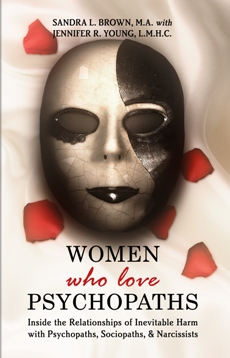
(**If we can support you in your recovery process, please let us know. The Institute is the largest provider of recovery-based services for survivors of pathological love relationships. Information about pathological love relationships is in our award-winning book, Women Who Love Psychopaths, and is also available in our retreats, 1:1s, or phone sessions. See the website for more information).
Living the Gentle Life Part V
August 16, 2011 by sandra
Filed under Sandra Says (Column)
Comments Off
Soul Tearing
The last few weeks we have been talking about the necessity of living a gentle life if you are recovering from a pathological relationship. The damage it does to a person is profound and many are often diagnosed with a chronic stress disorder OR Post Traumatic Stress Disorder (PTSD). These disorders respond best to a ‘gentle life’ that allows the body, mind, and spirit to rest from the overload of adrenaline and stress it has experienced in the pathological relationship. (Read our previous newsletters about this topic listed on our website.)
We have talked about physically how to ‘adjust’ your environment if you have a stress disorder and we also talked about the emotional effects—anxiety, depression, and other aftermath effects associated with PTSD. Today, we are going to talk about the spiritual effects.
Dangerous and pathological relationships violate at a deep soul level. That’s because it touches on the core building blocks of our concepts about relationships–Trust, Love, and Hope. Deception is evil and sick and when you realize ‘who/what’ you have been with, there is a violation that cuts to the deepest part of a person: their spirit. Because of this, I devoted a portion of the Women Who Love Psychopaths book to the subject of spiritual evil and it’s correlation to some of the symptoms associated with pathology. There’s an interesting chart in the chapter that connects psycho-spiritual evil.
Often these kinds of pathological relationships have already ‘played into’ your soul connection…leading you down the path of believing that your ‘connection’ was spiritual in nature. There were probably lots of promises of the ‘life together’ and all the ‘reasons God brought you two together.’ In the end, they were lies but before you knew they were lies, they were HOPES.
~ “Hope is the thing with wings, that perches in the soul.” ~ (Emily Dickinson)
So many pathological relationships have “an intense attachment” that feels like ‘connection’ or ‘passion’ when in reality it is just the intense game of the ‘pathological’ sucking you in and hoping you will confuse intensity with something healthy.
But Hope, Love, and Trust are all core spiritual values and when you have invested those core values and beliefs in someone and then the heinous deception is revealed that the ‘goal’ of the relationship was to manipulate you all along, something ‘rips’ inside of you. This ‘soul tearing’ brings a spiritual skeptisim, a distrust that permeates everything you EVER believed…sometimes even about God. It’s a disastrous wound to your ‘world view’ and how you see yourself, others, God, and the world at large.
These mortal wounds to your world view can last a long time because, in effect, they are the ways you have come to ‘believe’ about yourself (I can’t trust my intuition), others (everyone is evil), the world (it’s a sick place) and God (He didn’t protect me). This profound shift in your world view can increase the symptoms of PTSD–depression, anxiety, alienation, loneliness, isolation, and a fear or dread of the future.
So often the spiritual effects of the dangerous relationship are overlooked both by the victim and by the therapist. This ‘world view’ earth quake has shaken the foundation of your belief system. Without repair to the foundation from which you build your self concept, healing is limited to only symptom management. Spiritual healing of your world view is paramount to your overall recovery.
I have created a 15 minute audio (mp3) “Spiritual Effects’ that goes into more detail about healing your world view and the spiritual effects of pathological. I think the audio will greatly help your understanding of WHY this part of yourself MUST be healed as well and how the unhealed aspects can impact depression, anxiety, reaching out to others, and your future relationships. (LINK TO MP3)
Also, if you are in counseling, please allow your counselor to listen to the mp3 too. This will help them address these issues with you in counseling. This is an area so often ‘under treated’ by other counselors. I teach on this aspect a lot at professional conferences and therapists are eager to understand this aspect of spiritual side effects and it’s impact on chronic stress disorders.
(**If we can support you in your recovery process, please let us know. The Institute is the largest provider of recovery based services for survivors of pathological love relationships. Information about pathological love relationships is in our award winning book Women Who Love Psychopaths and is also available in our retreats, 1:1s, or phone sessions. See the website for more info.)
Living the Gentle Life Part IV
August 9, 2011 by sandra
Filed under Sandra Says (Column)
Comments Off
Creating a Gentle Life–’Ah Just Get a Life!’
People ever tell you that? Sometimes from the chronic stress and upheaval the pathological relationship causes, people can get very one-dimensional and hyper-focused on him/the relationship/or the problems. They stop doing the kinds of things in their life that could help them be LESS obsessed, depressed, or anxious. That’s because survivors tend to ‘lose themselves’ in the pathological relationship. It’s a testimony to the strength of pathology and the almost labyrinth-type maze of hypnotic lull that occurs in these relationships.
The crazier it gets, the more the survivor feels like she needs to ‘try to understand it’ or ‘try to make him understand what he’s doing’ or ‘do something that will help the relationship feel less pathological. This idea can create a 24/7 obsession…it can take up your whole life trying to balance the relationship, which you probably have figured out, is un-balanceable.
Getting lost in a very dark tunnel can draw people away from the actions, behaviors, thoughts, people, and resources that previously allowed them to live a happier and more balanced life. The pathological relationship is ALL consuming and soon any level of your own self care is abandoned for the insane focus on how to help him/or the relationship.
It isn’t long before others around you notice the myopic and single focused person you have become that can’t think about or talk about anything except the pathological relationship. This myopic view of your relationship has now blacked out any other part of your life. Consequently, people are bailing out of your life, emotional resources are dwindling, your life has become the size and shape of him.
Women in the most dire of all situations (especially in domestic violence for instance) are those who have lost physical and emotional resources and can find no way to get out. The less support a woman feels from others, the more likely she is to stay because it takes support go get out, to break up, or to not go back. So, by the act of myopia, her life and resources just dwindle away. One day someone says to her, “Man, you need to get a bigger life than THIS” and something really hits her about that statement. Like coming out of a deep freeze, the light bulb goes on–she notices her lack of a life and says, “What happened to me? Where is my LIFE?”
The last few weeks in the newsletter I have been talking about ‘Living the Gentle Life’ especially if you are someone who has lived in a pathological love relationship or has a chronic stress disorder or PTSD. A gentle life is a full life. One that includes the kinds of things that nurture you, that bring peace to you, are simultaneously in, and part, of your life. The gentle life is healing because to feel joy is to send the right kinds of brain chemistry to your brain that fights depression and anxiety and gives the sensation of well being. In order to heal you need to be a ‘Joy Hunter.’
The fact is, women go back (or pick poorly again) because they fail to build a life for themselves. They know how to ‘invest, invest, invest’ in him and their relationship with him but have no idea how to ‘invest’ and build her own life without him. Women who have healthy lives on the outside of the relationship, are those
more likely to get out and stay out.
Loneliness is one of the key risk factors why women go back. There are so many ways to get your needs met for friendship, fun, support, beauty, or whatever you love in life. Building a ‘life’ is the best prevention for relapse a woman can do.
But sadly, many will not do it. After 25 years of doing this work, I can pick out who will and won’t invest in themselves by building a life. Those that don’t are in the same boat ten years down the road. Either with this pathological person or another one just like him.
Those that do build a life are less likely to feel pressured to date or get so lonely that they pick up the phone and call him.
The Gentle Life isn’t even possible unless you have a life that is ready for transformation. Living with a pathological or picking another is just about as opposite of a gentle life as there is. Will you be one that rebuilds a fabulous life?
Joyce Brown who inspired our work and who happens to be my mother said “I gotta stop focusing on him and get a great life!” At 60 she went to college, at 70 she took up belly dancing, and after 70 she sailed her own boat to the Bahamas and traveled to Paris and beyond. She proved the point that getting a great life was in and of it self, learning to create a gentle life. Much healing to you!
We have created an mp3 about this topic called Get a Great Life. Click HERE to see product
(**If we can support you in your recovery process, please let us know. The Institute is the largest provider of recovery based services for survivors of pathological love relationships. Information about pathological love relationships is in our award winning book Women Who Love Psychopaths and is also available in our retreats, 1:1s, or phone sessions. See the website for more info.)
Living the Gentle Life—Part 3
August 2, 2011 by sandra
Filed under Sandra Says (Column)
Comments Off
The Emotional Effects
In the previous newsletter, I have been talking about recovering from a pathological love relationship. (You can read the previous newsletters on our website under Sandra Says.) The toll it takes on people often leaves them with symptoms of chronic stress. For extremely bad relationships, often the result is Post Traumatic Stress Disorder (PTSD)—a diagnosed anxiety disorder. The long-term stress from the pathological love relationship (with narcissists, abusive partners, socio/psychopaths) affects people emotionally, physically, sexually and spiritually.
I have been talking about what the body ‘does’ when it is under chronic stress and the results of this unrelenting stress. (The previous newsletters about this are on the magazine site under Sandra’s Current Article). The last newsletter discussed how to deal with the physical ramifications of stress, and I even created a unique relaxation audio for people with chronic stress or PTSD (which is available on the magazine site under Shopping/CDs, Audios.) I also talked about changing your physical environment to embrace the needs of a stress disorder.
Today, we are going to discuss emotional effects and how to create the Gentle Life for your emotional needs as well.
PTSD is an emotional disorder that falls in the category of anxiety disorders. Therefore, someone with chronic stress of any kind needs to learn the types of techniques that help reduce emotional anxiety. The problem is, by the time people ask for help with chronic stress or PTSD, they have often lived with it for a long time and the symptoms are then extreme.
The emotional effects of untreated PTSD can include tension, panic attacks, depression, anxiety, sleep disturbances, intrusive thoughts, nightmares, flashbacks, or hyper-startle reflex. All of these are distressing, and over time a combination of these symptoms can normally occur at the same time.
The relaxation technique is a way of managing the physical symptoms of PTSD. Relaxation techniques are not ‘optional’ in the recovery of chronic stress/PTSD. That’s because these techniques have a dual purpose. These same relaxation techniques also help manage the emotional symptoms as well as the physical. Learning correct breathing to ward off anxiety and panic attacks can be done through the relaxation techniques.
Likewise, these same techniques can help with sleep disruptions and tension. Chronic stress and PTSD are disorders that should be treated by a professional therapist. Especially with PTSD, the symptoms tend to increase over time if not treated. People make the mistake of waiting until it is totally unbearable, and then it takes time to ease the symptoms. People are often ‘hopeful’ it will just go away when the pathological relationship has ended or contact has ceased. These aren’t the worst relationships in the world for nothing! They are labeled as such, because they produce horrible side effects!
Unfortunately, PTSD is a chronic disorder meaning you are likely to have symptoms off and on for years, maybe a lifetime. This is all the more reason to learn how to manage the symptoms when you may need to. Intrusive thoughts are one of the most complained about symptoms.
This is when unwanted thoughts of the pathological person or relationship keep popping up in your head. No matter how many times you try ‘not’ to think about it, it keeps coming back. The problem with the imagery in your mind is that each time it pops in, it has the ability to trigger you. Your body responds to the trigger with adrenaline and starts the whole stress cycle over again. So managing the intrusive thoughts and flashbacks is imperative to emotionally regulating yourself and living the gentle life.
Living the gentle life means removing your self from personalities that are similar to the pathological relationship. We often tend to migrate BACK to the same kind of people and relationships we just left. These kinds of abusive people can cause an emotional avalanche. It is important that you understand the kind of traits in people that should be avoided if you have PTSD or high-level stress. These could be people who remind you of the pathological person, loud or aggressive people, or those who violate your boundaries or bother you in other ways. Stress and PTSD do mandate that you develop self-protective skills such as setting boundaries—learning to say no or leave environments that increase your symptoms. Learn to migrate instead, to people who are serene or leave you feeling relaxed and happy.
Creating your gentle physical environment will also help you emotionally. An environment that is soothing, calm, quiet, soft, and comfortable has the best chance of allowing an over-stimulated body to relax. Changing your physical environment for your emotional benefits, and adding the relaxation technique can greatly impact the amount of emotional symptoms you experience. Learning ‘emotional regulation skills’ for stress and PTSD is a must. If you are in need of the following:
• Pathological love relationship education
• Healing the aftermath symptoms of intrusive thoughts, obsessive thinking, flashbacks, anxiety, depression
• Learning to manage PTSD
The Institutes’ phone, retreat, and 1:1 programs are just the place to get your life back! We’ll be happy to help you find recover resources that are right for you.
Health Care – Beyond the Quick Fix
August 1, 2011 by dl
Filed under PTSD: Mind/Body Connection (Column)
Comments Off
Health care professionals and researchers report that traumatized women have more than their share of a variety of chronic diseases and health problems. Sadly, it is all too common that many of these health issues are either not addressed and/or focused on symptom relief. I think that there are at least two reasons for this.
For starters, there is a woefully limited perception and understanding in this country about the extent and impact of people with personality disorders. In the UK and Canada, there seems to be more awareness, perhaps due to the work of Robert Hare, who is based in British Columbia and has done a great deal of training in Canada and the UK. Therefore, most primary health care providers in the US do not have a clue about a) the existence and prevalence of successful psychopaths and therefore b) the impact of these relationships on a woman’s health. Understandably, these providers attribute stress and or genetics as causes for the women’s physical symptoms.
The second problem, IMO, is that the current paradigm of health care is symptom focused. Diagnostic tests, medications and other treatments are primarily “targeted” at symptom relief. All you have to do is watch TV for a few minutes and there it is: Advertisements for medications-prescriptions and over the counter drugs for colds and the flu, hypertension, allergies, headaches, insomnia, fatigue and low energy, acne, constipation, muscle aches and pains, it is endless.
Yes, we all want a quick fix. But all too often the fix itself is either ineffective and or laden with serious side effects. The alternative health industry sometimes falls into this category, and many of these options are heaven-sent. We now know about the use of Arnica for bruises, Valerian for sleep, and echinacea and high does of Vitamin D for building up the immune system. These alternatives are frequently more effective and less toxic than artificial chemicals, but the focus can remain on treating the symptom, not the underlying causes.
Why is there such an emphasis on symptom reduction? Perhaps because, coming from inside the current medical paradigm, there are very few answers to questions like “Why is my blood pressure so high?” or “Why do I have such bad heart disease?” While there are obviously genetic components, most genetic predispositions require the presence of certain environmental factors before a disease process is triggered.
Readers of this column know the real answer to these questions-because the woman with the symptoms is or has been in a relationship with a disordered person. And that her neurotransmitters, immune and endocrine systems are probably way out of balance. We know that when one or more of these systems is out of balance-(due to stress, diet, environmental factors such as metal allergies, and or genetics) that there is a very high likelihood that one, the other or both are also out of balance. These imbalances are now being considered the primary causes of everything from insomnia to autoimmune disease. Look for further discussion of this topic in my next column.
Most practitioners think inside, and there are exceptions-the current educational, diagnostic and treatment systems which are locked into the old paradigm. It is very, very difficult to find a way out or around that from the inside out. One cannot see what one does not see.
Additionally, to make matters worse, often one treatment leads to another so that the side effects of a surgery, radiation treatment, or a pharmacological intervention snowball. The cycle perpetuates itself. Rarely do you hear the question-what is driving this arthritis? The hypertension?
I think that we are experiencing the beginning of the end of the power of traditional medicine to improve our health. For women who are healing from disordered relationships the need for answers and solutions to health care problems, some of which are very serious-
- self-doubt about the reasons for health problems
- feelings of unworthiness rated to seeking care, and/or
- child-like dependency on health care providers
no longer serve your best interests.
What then? Knowledge is power. Read. Ask questions. The incredible rise in the last decade of alternative healthcare-integrative medicine, holistic care, demonstrates both the waning utility of the old paradigm and willingness to take responsibility for one’s own health care. I can think of no greater empowerment for women formally in disordered relationships than their taking charge of their emotional and physical health.