Teaching About Pathology
September 29, 2008 by sandra
Filed under Teaching About Pathology

Teaching About Pathology to Your Community
by Carol A. Lee Mooney, M.S., ICCJP
As a counselor/teacher for the adult probation department and a crisis counselor for the mental health department, I saw serious relationship problems amongst people particularly with addictions to alcohol, drugs, gambling, theft, and other self-destructive behaviors. Often associated with addictions is the added mental health issue related to ‘pathology’ which often dismantles healthy relationships and leaves in its wake, destruction.
But this common thread of relationship problems (which were not merely co-dependent, addictive, or abusive) was also woven throughout professional men and women’s personal relationships. Ooften overlooked is that white collar professionals can be targets of pathologicals just as anyone else can.
There is no immunity by career or education status that saves someone from falling into the most disordered of relationships. In fact, what I learned was those in professional positions are those ‘most likely’ to end up in pathological relationships. Why? The ‘why’ is the focus of this entire magazine.
I, too, like other educated and professional people was touched in my own life by pathological relationships through a marriage, through having children with a pathological, and through another significant relationship. All of these caused much pain, damage, and the need for specialized support through the aftermath.
Survivors of these types of pathological relationships, like myself, are those most impassioned with the message of ‘Public Psychopathy Education’ and those yearning to take the message to their communities! That’s exactly what I have done through my own coaching business ‘Coaching Alternatives to Lethal Men 78.’
My coaching business has enabled me to teach others about pathology in relationships through individual, group, and phone supportive care sessions. I have taken the message to my community through lectures, workshops, and into the schools with groups.
My purpose with The Institute is to help people like you get started in their own outreach to other survivors in their communities. On a professional level–therapists, counselors, probation officers, social workers, addictions professionals, etc. can become certified in this area of Pathological Love Relationships to add to their existing clinical focus in their practices.
On a peer level, individuals can become trained to lead support groups in churches, schools, or other community centers. These groups help individuals who have been devastated emotionally, physically, mentally, spiritually and financially from relationships they feel they are intensely attached to and can’t leave no matter what the behavior has been.
The Institute offers training for any one, at any level, so you can become involved in the solution of Pathological Love Relationships. This column ‘Teaching about Pathology to Your Community’ will discuss ways for reaching out to your community with the message of education about pathology. It will help you get involved in The Institute’s Educational Services to get trained for your community.
Education is the key to knowledge, freedom, and the road to healthy lives and relationships in the future! I look forward to bringing you educational ideas each month. See you next month!
(All articles are copyrighted and cannot be reproduced, however feel free to put a link to this page.)
Carol A. Lee Mooney, M.S., ICCJP is CEO and Founder of ‘Coaching Alternatives to Lethal Men 78, LLC’. She is an Internationally Certified Criminal Justice Addictions Professional and holds a Bachelor’s degree in both Psychology and Sociology, a Master’s Degree in Adult Education/Counseling, and is a Qualified Mental Health Professional through Northeast Texas MHMR.
She is certified in various Cognitive Behavioral Programs which include Moral Reconation Therapy, MRT-based programs, Anger Management, and Untangling Relationships. Carol has worked as a Crisis Counselor and been a speaker for the Victims Impact Panel through CSCD.
Currently, she is a certified Life Coach providing individual, phone, and group supportive care regarding Pathological Love Relationships and is a workshop and seminar speaker. Carol is a survivor having personally struggled with issues involving children of pathological men, dealing with pathological co-workers, and personal pathological relationships
Reality Bytes: A Survivor’s Journey
September 29, 2008 by sandra
Filed under Reality Bytes Column
![]()
Part VII
Right at the end of our court hearing, the Psychopath did one of his infamous maneuvers. He slipped one by an entire group of us. He asked the Judge to order his child visitation be held at a center where free monitors are provided for low income families. (Part of his tactical plan to avoid paying child support is to pretend he is poor—so much for a ‘doctor’s lifestyle!’)
“I just want to see my daughter. I miss her…,” said the talking head. As it continued, I watched people in the court room begin to float around in a puddle of sympathy as it accumulated deep on the floor. It was so pathetic because I knew if the people saw this devil in action, the pool of sympathy would turn hot molten lava and converge into his empty soul.
The paper he waved in front of the judge to secure the order had several addresses that listed all the centers in our county. We live in a large metropolitan area, so the addresses really meant nothing. Filled with confident conviction, he pointed to and named a particular center of interest that was listed on the sheet.
When the judge asked why he wanted that particular center, he confidently asserted himself, as if this selection was for the good of mankind and fairness to all: “It is convenient for everyone because it is the closest distance. It is only 12 miles away.”
It sounded reasonable, so no one objected. But no one thought to ask 12 miles in which direction? Distracted by the relief I felt about the visits being monitored, I wasn’t alert enough to question his motive. It all happened very fast.
One would think that after four years of the same deceitful and manipulative behavior I would be critical about every request. Every time. Hyper-vigilance (high harm avoidance) has an upside when dealing with a psychopath. But then again, you get diagnosed of being paranoid or delusional.
When I got home I saw that I got hood winked again. I felt shock when I looked on-line and discovered where the Psychopath just got the court (and us) to agree to have his visits.
I saw there was a quarter mile difference in distance to the next center on that list. It was in a much safer area that is famously known for its elegance and beauty. Instead, he picked one of the most dangerous neighborhoods in the city; probably one of the most dangerous neighborhoods in the country.
I printed a crime map for a half mile radius around the center for a one week period and saw there were 38 major crimes that occurred and were plotted out. This included homicide. Felony assault, armed robbery, grand theft auto, etc, etc., etc.
Making matters worse, I had to drag our little blonde-haired, blue-eyed girl on two buses and a train to get into that neighborhood and then two hours later make the trip in reverse to get home.
Once I dropped her off at the center, routinely I walked three blocks to sit in a restaurant to wait out the visit. It is always an interesting trip through the bar-protected, graffiti-decorated buildings that lined the streets.
Often in the background, I could hear and feel a loud throbbing base noise. It would pulsate my lungs right into the wall of my rib cage as I walked. As the cars got closer, the metal grating sounds of vibrating trunk lids become part of the migrainish rhythm.
People on the streets looked me up and down and smiled as if they knew a secret that I didn’t. Tension still blanketed the streets from the devastating race riots of years past. It was obvious—I stood out.
When it was time to go get my little girl, I would trek back to the center. One day, as I headed over a cross walk to get to the center, I noticed a car coming toward me. I kept walking figuring it would stop as cars do, yet I locked it into my peripheral vision.
I walked. It came closer. Next it zipped right into the cross walk in front of me, missing me by about a foot. The teen driver looked into my eyes with an expressionless, stone cold face. When she punched down the accelerator, I felt a rush of adrenaline turn my legs into jelly just as the car swerved out of my path.
As much as I wanted to scream in anger, the tears welled up in my eyes AGAIN.
I flashed back to the talking head in the court room and how he man managed to pull this one off. The man who tells the world he is worried about the “well being” of his child, just locked us into a weekly court order that places her and I smack in the middle of a war zone.
Part V
Why in God’s name would you want to date so soon after being with a dangerous man???
That was the thought crossing my mind as I listened to the women in our recovery-based conference call. They were interested in learning how to date again.
I wouldn’t do that, I thought. Not again. Not so soon.
I described to the women how my weight has been a safety blanket, protecting me from wanting to be with a man. Being with a man, for me, is like seeing a big plate of food, but having my mouth wired shut. I just don’t get to eat the food. My weight is the wire. It prevents me from indulging.
Until an ordinary trip to the grocery store tilted my illusion of control upside down.
This afternoon a friend drove me to the grocery store (I lost my car in the aftermath of the breakup). Tucked in my purse were my government-issued checks for milk, eggs, cheese and other items.
It has gotten so bad, from a material standpoint, that the last time I heard someone mention identity theft, I started hoping someone would actually steal mine! I thought I could tape my social security number on the outside of the trash can—it would save the thieves the hassle of picking through the stinky garbage looking for one.
I was cruising through the aisle, happy as a lark filing up my cart, knowing I did not have to walk home with the groceries. I looked up and there HE was. The guy from the Laundromat was standing in front of me.
I met him at the laudromat a couple weeks ago. He was very handsome. Oh so handsome! Embarrassed at my jammy pants and a sweat shirt and pushing my granny cart full of laundy, I made a dash for the door. I smiled and waved “Nice to meet you” as I fled by.
Flash forward to the grocery store. I smiled at him and said “Hello, how are you?”
He recognized me and we started talking. I told him my name.
He said “Oh, I will remember that, that’s my sister’s name.”
Then he told me his name.
I said, “Oh, that’s my brother’s name.”
We both started laughing.
As I felt that spark of connection, in the back of my mind, I heard, “DANGER Will Robinson, DANGER!” In my mind’s eye, I could see a robot standing behind him wilding swinging his arms!
We stood grocery cart to grocery cart talking about cream of broccoli soup and clam chowder in a sour dough bread bowl. Suddenly things felt very awkward and silly. The brief spark of connection had been driven away by fear.
He said, “I go to the laundromat on Saturdays, when do you go?”
I replied “When I run out of clothes.” I cast my eyes downward as the line fell flat.
Half comment and half question he blurted out: “You live close by?”
I shot back “Oh yeah,” then randomly threw in “I even use a granny cart to bring my clothes.”
(For a minute I realized I learned a trick from the psychopath, by playing with the meaning of words, because I use the granny cart for the exact opposite reason.) Without a car, the laundromat is too far for me to carry my clothes!!!
Saying goodbye was a funny, uncomfortable moment. I felt like we were in high school. I really thought he was going to ask me for my phone number. Instead, he described his vehicle, and said if you see it in the parking lot, you’ll know I’m there.
When I got to the line with my WIC checks for the milk and eggs, I thought oh crap. I went in a tail spin, praying my girlfriend would come up behind me in the line and not him. “God, do not let him come!” I thought. My face flushed like a hot red desert sun.
My friend did walk up behind me to join me in line. I sighed with relief.
While waiting for the cashier, I scanned the tabloids for quick fix dieting solutions. How fast could I take off 60 pounds?
Part IV
It was a rainbow day perfect day. I squinted at the sun as it peaked through the dark feathered clouds. I hoped the rain would take a nap for a while because it was time for my most favored activity— a trip to the Laundromat, yeah, yeah, yeah.
A mound of dirty clothes piled high above my granny cart—my newest set of wheels, gave away my agenda for the day.
Realizing it was laundry day, my ninety-year-old landlord volunteered her car. I gratefully accepted; the alternative was than hoofing it down the street like a homeless woman carrying all of her belongings in the rain.
Just then a magnificent cloak of vibrant colors magically spread across the sky. I thanked her for her offer and started our on foot with the cart. As the distance grew between us, I heard my landlord yell, “if it starts to rain and you need a ride call me!”
Judgment used to float around my head when I saw others walking around with one of these carts. It seemed they were either very old or homeless. Yet they were comfortable with their cart. They did not care about image. Man, how perception shifts when you get a chance to walk in another’s shoes, or push another’s cart…
I am now grateful to own this unassuming set of wheels. When I purchased it five years ago, my belly was big and round as it nurtured a very precious, beautiful little girl growing inside me.
I will never forget the blistery hot day. I was walking the one of the largest swap meets in the country. I purchased that blue granny cart to carry all the items I had bought for the “Good Doctor’s” office. I was going to be the doctor’s wife. Alas I thought!
HA! NOT.
I remember how that cart came in handy that day. As I pushed it around, I never guessed that one day it would become my only set of wheels. And that the “Good Doctor” wasn’t so good.
I admit, I still worry a tad about “image” as I walk down the street with the cart. However, I have come to appreciate an item I wouldn’t be caught dead with a few years ago.
It has become abundantly clear that I have something to give. Actually, it is that knowledge that keeps me going through the murky waters of this battle. I try to find humor. With laughter, the soul cleanses itself.
Part III
Hello dear friends, I was thinking about the early days and how things began with me and the psychopath. I love those who look at me with crunched foreheads and say, “so why did you get involved with someone like this?”
Well, back then I did not know what I know now. If I had, I would have never been with such a sick person. The issue was that he presented himself drastically different to me.
I remember our early days like it was yesterday-it felt so wonderful. He was so warm, affectionate and loving. I felt like the center of his universe.
There was one night in particular that is so opposite to what I am dealing with today. It was a beautiful moonlit fall evening on a chilly California Beach. Harmoniously, we swayed side-by-side at the shoreline in a mutual state of awe at one of God’s greatest creations: the ocean. I shivered from the cool sensation of the water rolling over my toes so he gallantly draped his leather bomber jacket around my shoulders. Oh, he was charming, gentle and self sacrificing.
His stunning powder blue eyes were hypnotic to me. Later that night, like a child I skipped down my driveway reliving the tingling sensation that came to me during our first kiss. It felt like a stream of butterflies flowed out of my soul into my belly. It was so dreamy. He was older, mature, attractive, a “doctor.” WOOHOO!
Between my moments of elation, I felt sorrow for him. He shared his story with me. He told me he was renting a room from a lady because he just moved back to the area. Some time ago, he said he married and moved away to another state. He wanted a family, but his wife had a miscarriage and refused to try again. He said he would have adopted a child, but she would not even do that. After 10 years of promises with him, she refused to fulfill his dream of being a father. How terrible I thought she must be while I consoled and honored his noble mission.
I thought what more could someone want? Here I am, so over the corporate rat race and completely missing having a family. I believed my chances to meet Mr. Right were slim to none. Just hitting my forties, the best thing to do I felt was to cover up my desire to have a loving man. The white picket fence, the babies, stay at home mom, etc. etc. So because I was making a lot of money and just bought a home, I assured myself things could be a lot worse.
My attitude changed when “he” seemed to have the same dreams as I did. It was a perfect overlap. He wanted a child. He wanted to be the pappa bear supporting his family and felt that moms were meant to stay home with the kids. By the time we made it through our wonderfully romantic holidays, I was just so taken in by him. I still feel him cupping my face with his hands telling me how much he loved me.
The family portrait he visually painted of us and our two children was hanging over the fireplace. He used to drive me around the beautiful tree-lined streets in an exclusive beach town to point out what houses we should consider to live in one day. Of course once he got his practice set up again.
Within five months of that blissful beach evening, he had proposed by sliding a very large diamond ring on my finger. In a few short weeks I found out I was having his baby which was only a few short days after I got a real glimpse into the man I promised to marry. A little too late, but what the heck, love could conquer anything, right? (to be continued…)
Part II
My friends so many things have happened since my first column. The wreckage of the aftermath has gained some height and momentum. I had a “my life flashed in front of my eyes” kind of experience that I will share with you.
It was around 3AM and I was in a very light sleep semi-aware of my surroundings. It was because I felt somewhat paranoid when I went to bed because I had spent part of my day educating a new professional about our family law/ custody case.
Perhaps it is his anti-government extremist group affiliations that make me a little restless at night. Or it could be something about my ex’s involvement with people who have two names.
Or, maybe it is the token diploma I found in the bedroom drawer that honored his completion of an extensive paramilitary training program. Or it could just be that he must win at any cost.
So as I lay there, I saw an indication there was a flashlight in the back yard. Its reflection flirted with my bedroom curtains. He finally went over the edge I thought. Then there was a loud banging on my glass door. A surge of fear went though my chest and limbs.
With the toughest, grumpiest, voice I could muster, I yelled “Who is it?” into the darkness. A man’s voice responded in kind: “it is ABC Finance Company. We have come to take your car.”
At first I felt relief that it was not “him.” But, the feeling of relief quickly melted away when I went outside to remove my personal items from my car.
This turned into a very sobering experience. Again I was forced to feel the impact of my daughter’s father coming into my life.
As I emptied out the car, it was like my life started flashing before my eyes, I started reliving the experience of signing the documentation when I lost my home.
I relived all of garage sales getting rid of my belongings. I cringed again about how those people scavenged through my stuff reminding me how little worth I had. They seemed compelled to beat up my perception of value on every single item.
I then flashed to an evening when I woke up in the middle of the night realizing the excellent credit I worked so hard for was going away– that began its spiral downward with a judgment for thousands of dollars placed on my report because “he” sued me for the diamond ring in small claims court.
Then I remembered the dream that night after that trial, his face was in my face laughing and laughing. I woke up just as frightened that night.
It seemed with every item I pulled out of the car, a new painful memory surrounded my consciousness.
When I drifted back in to the present moment, with the “repo” man it felt like I was back in line at the supermarket with those government checks to get free milk and eggs.
The cashier made an assumption that I was trying to get more than what was on the check, in an instant his voice bellowed over the store’s intercom summoning a manager there to further pick apart the transaction.
The line was building behind me and heavy sighs were coming out of the customers while my child, with an urgent and untamed desire to leave, sat on the floor screaming in protest.
That chilly early morning, as I turned away from the car to leave I realized I forgot something. I reached in and pulled my CD out of the car stereo. The irony is that it was Sandra Brown’s Dangerous Man CD.
How fitting it was in that instant to have the Sandra’s CD in my hand while my car was chained to a tow truck.
As I walked away with the CD in hand, fighting back the tears, I looked at the man and said, you know, a few short years ago I had a 150,000 thousand dollar job, a nice home, great credit and money in the bank. He just looked at me.
Part I
It’s 2:30AM on a Thursday night as I sit here developing my first message to you, dear reader. I am not accustomed to pounding my laptop keyboard in the middle of the night, but tonight I am making good use of the side effects from dealing with the aftermath of having a child with a psychopath. One of those side effects is the inability to sleep after a Strategic Traumatic Event (STE). An STE occurs when the psychopath in a custody battle performs a maneuver to knock the other parent emotionally off balance. It is designed to torment and to wear the other parent down.
As I am typing, in the background I hear CNN spilling sounds of the political battlefield of Obama vs. McCain into my living room. The battle for the White House is not even close to the war raging in some of our lives. The war we engage is with a pathological who has dropped his/her mask and unveiled the evil beneath.
Unfortunately for us, the mask is on a stick and the pathological is effective at sliding it back in place as needed. It is only when he/she realizes you are of no further value that the mask slips down and you get to see the real personality. In my experience, the pathological is a professional at “impression management,” a fancy term that means the psychopath will look and sound like Jesus Christ to others and even to you (until you believe it is Jesus Christ), while underneath it is really the devil manipulating your thoughts and perceptions.
During this journey, I have watched his face change from a loving, innocent, child-like portrait into a cold piece of stone. I have felt safe, secure and loved like never before. Unfortunately, they were these feelings of safety and love that blocked out the red flags – the times of confusion I should have paid attention to — the times I was uncertain of his acts or behaviors which were his real nature breaking through.
Now three years after the breakup, I am wondering if I might even die from the wrath of his hatred for me. I have felt the hair on the back of my neck stand up because of the piercing posture of his fiery eyes. Often his presence feels like that of an angry ghost attempting to carve a way into the depth of my soul.
The war I will present to you is about trying to protect the psyche of our innocent child who is at-risk. She too is a survivor of a psychopath and is being torn to pieces because she is caught in the path of his insatiable urge to “win” a custody battle, avoid child support, and destroy me. It seems his mission is to win at any cost.
He has no conscience and, worse yet, knows that I DO have one. He has no boundaries and, worse yet, neither do I when it comes to allowing him to trample on me. He has no reservation about pressing into me by hurting her physically and emotionally. He not only has no fear of getting caught, he gets excited about getting away with it.
The ordinary feelings that stop people from harming another human are devoid in him.
If you exist on this painful path, my heart goes out to you. I have been on this road for five years, lost almost everything, been to family court including dependency court nearly 40 times, been through two full ‘730 Custody Evaluations’, been investigated by Child Protective Services, been accused of a mental illness by a naive Ph.D. who fell for the ‘Jesus Christ image’ and read my reaction to the pathological’s abuse as a potential personality disorder in me, and I have been enduring and undoing my child’s behavior in reaction to his abuse. Last, but not least, I have gone through a raft of health issues, including multiple surgeries, brought on by the stress. All of these, though horrendous, are not unusual for a partner to experience in his/her relationship with a psychopath.
The column I write to you is one of reality. It is a real-time trip through the journey of a relationship with a pathological and the aftermath my child and I are navigating. I commit to give you the experience just as it is–not for me or my personal case–but for you.
I have searched and researched the country on the topic, taken classes about pathology, and established relationships with the best known minds in the field because I will do what it takes to be a survivor. I am a survivor and I am working through the stress of the most recent Strategic Traumatic Event (STE) which was a surprise visit by Child Protective Services triggered by his false allegation that I am abusing our child.
By pounding this keyboard for you tonight, I know I have become an expert. I am an expert in what the experience of a psychopath feels like, and what the damages can be. Discovery, awareness, and support by professionals is only in its infancy stages. I hope I can transfer what I have learned from this experience and research to you and save you some pain. Most of all, I hope to give you the tools that I am using to be a survivor and to protect my child. When one heals and shares that healing, we all heal.
(All articles are copyrighted and cannot be reproduced, however feel free to put a link to this page.)
* All content does not necessarily reflect the opinion of The Institute.
Navigating the Legal System
September 29, 2008 by sandra
Filed under Navigating the Legal System

Lying in Family Court
by Bill Eddy, Esquire, L.C.S.W.
Part 1
When I became a family law attorney/mediator after a dozen years as a therapist, one of the biggest surprises was the extent of lying in Family Court: lies about income, assets and even complete fabrications of child abuse and domestic violence. Why would people lie so much, I wondered? How did they get away with it? The following is my psychosocial analysis of what I believe has become an epidemic:
Men Lie
It was a sad phone call from a relatively new client. He informed me his father had just died. He had quit his job and was moving back east to wrap up his father’s affairs. He asked me to tell his wife’s attorney that he would not be able to pay child support for their three young children for a long time. (There was no support order yet.)
The next day, his wife’s attorney called me back and described how upset his wife was to learn of her father-in-law’s death. So upset, that she had called his father — and had a nice chat!
Women Lie
A mother involved in a custody battle told the court in dramatic detail about physical abuse at the hands of her husband. She even submitted reports of visits to doctors and emergency rooms for her bruises.
However, a court-ordered psychological evaluation determined the allegations were false. The court agreed and awarded custody to the father. A few weeks later the mother picked up the children from school and disappeared for a year. She was caught, sent to jail for parental kidnaping, and the children returned to the father.
Societal Increase in Lying
Surveys show that lying has increased over the past decade. In 1999 alone: the President was tried in Congress for perjury; a popular journalist in Boston was publicly fired for fabricating heart-rending stories; and a scientist was exposed for falsifying research on a high-profile safety issue.
We have become a society of individuals. Personal gain is more important than community values. In this mobile “information age,” we rely on strangers and are easily fooled. In business, politics, and the movies, winning is everything. Successful manipulation and deceit are admired. In court, lying is often rewarded and rarely punished.
No Penalty for Perjury
Divorce Courts rely heavily on “he said, she said” declarations, signed “under penalty of perjury.” However, a computer search of family law cases published by the appellate courts shows only one appellate case in California involving a penalty for perjury: People v. Berry (1991) 230 Cal. App. 3d 1449. The penalty? Probation.
Perjury is a criminal offense, punishable by fine or jail time, but it must be prosecuted by the District Attorney–who does not have the time. Family Court judges have the ability to sanction (fine) parties, but no time to truly determine that one party is lying. Instead, they may assume both parties are lying or just weigh their credibility.With no specific consequence, the risks of lying are low.
Personality Disorders and Patterns of Lying
Family Courts see everything: from small deceptions about income to the complete fabrication of abuse. The increase in lying seems to correspond with the rising number of people with personality disorders, as I described in my Spring 1998 newsletter. They often have internal distress, less empathy for others, a highly adversarial world view, an intense and manipulative nature, and a sense of victimization which they use to justify harming others. Studies show they have identifiable and predictable patterns of lying:
A party with a Borderline Personality Disorder may lie out of anger or even self-deception in an effort to maintain a bond with their child or spouse–or to retaliate for abandonment. Battles over custody and visitation are common.
One with a Narcissistic Personality Disorder may lie to boost themselves or to put other people down. They enjoy manipulating the truth and other people’s lives. They may experience excitement and a sense of power by successfully fooling the court and dominating the other party. An Antisocial Personality Disorder is characterized by deception, manipulation, and disrespect for authority. Commonly known as “con artists,” they are skilled at breaking the rules. They fabricate detailed events and use the courts to get revenge or money. Their lack of empathy makes them constant liars — and often violent.
A Histrionic Personality Disorder is often highly dramatic and demanding, with superficial charm and seductiveness. They are skilled at lying and self-deception. Fabrication is also common.
How Personality Disorders Drive Family Court Litigation
by Bill Eddy, Esquire, L.C.S.W.
Part 3
How Family Court Fits Personality Disorders
Family Court is perfectly suited to the fantasies of someone with a personality disorder: There is an all-powerful person (the judge) who will punish or control the other spouse. The focus of the court process is perceived as fixing blame — and many with personality disorders are experts at blame. There is a professional ally who will champion their cause (their attorney — or if no attorney, the judge). A case is properly prepared by gathering statements from allies — family, friends, and professionals. (Seeking to gain the allegiance of the children is automatic — they too are seen as either allies or enemies. A simple admonition will not stop this.) Generally, those with personality disorders are highly skilled at — and invested in — the adversarial process.
Those with personality disorders often have an intensity that convinces inexperienced professionals — counselors and attorneys — that what they say is true. Their charm, desperation, and drive can reach a high level in this very emotional, bonding process with the professional. Yet this intensity is a characteristic of a personality disorder, and is completely independent from the accuracy of their claims.
What Can Be Done
Judges, attorneys, and family court counselors need to be trained in identifying personality disorders and how to treat them. Mostly, a corrective on-going relationship is needed — preferably with a counselor. However, they usually must be ordered into this because their belief systems include a life-time of denial and avoidance of self-reflection.
Family Code Section 3190 allows the court to order up to one year of counseling for parents, if:
“(1) The dispute between the parents or between a parent and the child poses a substantial danger to the best interest of the child.
[or] (2)The counseling is in the best interest of the child.”
Therapists, in addition to being supportive, need to help clients challenge
their own thinking: about their own role in the dispute; about the accuracy of their view of the other party; and about their high expectations of the court. Further, therapists should never form clinical opinions or write declarations about parties they haven’t interviewed.
Likewise, attorneys need to also challenge their clients’ thinking and not accept their declarations at face value. More time should be spent educating them to focus on negotiating solutions, rather than escalating blame. The court should make greater use of sanctions under Family Code Section 271 for parties and attorneys who refuse to negotiate and unnecessarily escalate the conflict and costs of litigation.
The court must realize that the parties are often not equally at fault. One or both parties may have a personality disorder, but that does not necessarily mean both are offenders (violent, manipulative, or lying). A non-offending, dependent spouse may truly need the court’s assistance in dealing with the offender. The court should not be neutralized by mutual allegations without looking deeper. Otherwise, because of their personality style, the most offending party is often able to continue their offender behavior — either by matching the other’s true allegations for a neutral outcome, or by being the most skilled at briefly looking good and thereby receiving the court’s endorsement.
The court is in a unique position to motivate needed change in personal behavior. In highly contested cases, counseling or consequences should be ordered. Professionals and parties must work together to fully diagnose and treat each person’s underlying problems, rather than allowing the parties (and their advocates) to become absorbed in an endless adversarial process. Because their largest issues are internal, they will never be resolved in court.
———————————————————————————
William A. (”Bill”) Eddy is co-founder and president of High Conflict Institute, LLC, in Scottsdale, Arizona and Senior Family Mediator at the National Conflict Resolution Center in San Diego, California. He is a Certified Family Law Specialist in California with fifteen years’ experience representing clients in family court. Prior to becoming an attorney in 1992, he was a Licensed Clinical Social Worker with twelve years’ experience providing therapy to children, adults, couples and families in psychiatric hospitals and outpatient clinics.
He is the author of several books, including “High Conflict People in Legal Disputes” (Janis Publications, 2006), and “Splitting: Protecting Yourself While Divorcing a Borderline or Narcissist (Eggshells Press, 2004). Bill has become an international speaker on the subject of high-conflict personalities, providing seminars to attorneys, mediators, collaborative law professionals, judges, ombudspersons and others.
Part 2
Personality Disorders Appearing in Family Court
Probably the most prevalent personality disorder in family court is Borderline Personality Disorder (BPD) –
more commonly seen in women. BPD may be characterized by wide mood swings, intense anger even at benign events, idealization (such as of their spouse — or attorney) followed by devaluation (such as of their spouse — or attorney).
Also common is Narcissistic Personality Disorder (NPD) — more often seen in men. There is a great preoccupation with the self to the exclusion of others. This may be the vulnerable type, which can appear similar to BPD, causing distorted perceptions of victimization followed by intense anger (such as in domestic violence or murder, for example the San Diego case of Betty Broderick). Or this can be the invulnerable type, who is detached, believes he is very superior and feels automatically entitled to special treatment.
Histrionic Personality Disorder also appears in family court, and may have similarities to BPD but with less anger and more chaos. Anti-social Personality Disorder includes an extreme disregard for the rules of society and very little empathy. (A large part of the prison population may have Anti-social Personality Disorder. ** The Institute will be writing more about the Anti Social/socio-psychopath in next months article about Anti-Socials in the legal system.)
Dependent Personality Disorder is common, but usually is preoccupied with helplessness and passivity, and is rarely the aggressor in court — but often marries a more aggressive spouse, sometimes with a personality disorder.
Cognitive Distortions and False Statement
Because of their history of distress, those with personality disorders perceive the world as a much more threatening place than most people do. Therefore, their perceptions of other people’s behavior is often distorted — and in some cases delusional. Their world view is generally adversarial, so they often see all people as either allies or enemies in it. Their thinking is often dominated by cognitive distortions, such as: all-or-nothing thinking, emotional reasoning, personalization of benign events, minimization of the positive and maximization of the negative. They may form very inaccurate beliefs about the other person, but cling rigidly to those beliefs when they are challenged — because being challenged is usually perceived as a threat.
People with personality disorders also appear more likely to make false statements. Because of the thought process of a personality disorder, the person experiences interpersonal rejection or confrontation much more deeply than most people. Therefore the person has great difficulty healing and may remain stuck in the denial stage, the depression stage, or the anger stage of grief — avoiding acceptance by trying to change or control the other person.
Lying may be justified in their eyes — possibly to bring a reconciliation. (This can be quite convoluted, like the former wife who alleged child sexual abuse so that her ex-husband’s new wife would divorce him and he would return to her — or so she seemed to believe.) Or lying may be justified as a punishment in their eyes. Just as we have seen that angry spouse may kill the other spouse, it is not surprising that many angry spouses lie under oath. There is rarely any consequence for this, as family court judges often believe the truth cannot be known — or that both are lying.
Projection
Just as an active alcoholic or addict blames others for their substance abuse, those with personality disorders are often preoccupied with other people’s behavior while avoiding any examination of their own behavior. Just as a movie projector throws a large image on a screen from a hidden booth, those with personality disorders project their internal conflicts onto their daily interactions — usually without knowing it. All the world is a stage — including court.
It is not uncommon in family court declarations for one with a personality disorder to claim the other party has characteristics which are really their own (“he’s manipulative and falsely charming” or “she’s hiding information and delaying the process”), and do not fit the other party. Spousal abusers claim the other is being abusive. Liars claim the other is lying. (One man who knew he was diagnosed with a Narcissistic Personality Disorder claimed his wife also had an NPD simply because she liked to shop.)
William A. (”Bill”) Eddy is co-founder and president of High Conflict Institute, LLC, in Scottsdale, Arizona and Senior Family Mediator at the National Conflict Resolution Center in San Diego, California. He is a Certified Family Law Specialist in California with fifteen years’ experience representing clients in family court. Prior to becoming an attorney in 1992, he was a Licensed Clinical Social Worker with twelve years’ experience providing therapy to children, adults, couples and families in psychiatric hospitals and outpatient clinics.
He is the author of several books, including “High Conflict People in Legal Disputes” (Janis Publications, 2006), and “Splitting: Protecting Yourself While Divorcing a Borderline or Narcissist (Eggshells Press, 2004). Bill has become an international speaker on the subject of high-conflict personalities, providing seminars to attorneys, mediators, collaborative law professionals, judges, ombudspersons and others.
——————————————————————————
Part 1
I was first exposed to the concept of personality disorders in 1980 when I was in training as a therapist at the San Diego Child Guidance Clinic at Childrens Hospital. The DSM-III had just come out and Axis II of the five diagnostic categories required the therapist to diagnose the presence or absence of a personality disorder. (The current DSM-IV uses the same approach.) I quickly learned (often the hard way) that the presenting problems on Axis I (e.g. depression, substance abuse) were simply replaced by new ones, if an underlying personality disorder was not addressed in therapy.
Now that I have completed five years as a family law attorney, I have frequently witnessed the same underlying issues in hotly contested family court litigation — yet these remain undiagnosed and, therefore, misunderstood. As those with personality disorders generally view
relationships from a rigid and adversarial perspective, it is inevitable that a large number end up in the adversarial process of court. Since more flexible and cost-conscious people nowadays are resolving their divorces in mediation, attorney-assisted negotiation, or just by themselves, those cases remaining in litigation may be increasingly driven by personality disorders.
The Nature of a Personality Disorder
Someone with a personality disorder is usually a person experiencing chronic inner distress (for example fear of abandonment), which causes self-sabotaging behavior (such as seeking others who fear abandonment), which causes significant problems (such as rage at any
perceived hint of abandonment) — in their work lives and/or their personal lives. They may function quite well in one setting, but experience chaos and repeated problems in others. They look no different from anyone else, and often present as very attractive and intelligent people. However, it is usually after you spend some time together — or observe them in a crisis — that the underlying distress reaches the surface.
As interpersonal distress, fear of abandonment, and an excessive need for control are predominant symptoms of personality disorders, they place a tremendous burden on a marriage. Therefore, intense conflicts will eventually arise in their marriages and the divorce process
will also be a very conflictual process. In contrast to people who are simply distressed from going through a divorce (over 80% are recovering significantly after 2 years), people with personality disorders grew up very distressed. It is the long duration of their dysfunction (since adolescence or early adulthood) which meets the criteria of a personality disorder.
Usually they developed their personality style as a way of coping with childhood abuse, neglect or abandonment, an emotionally lacking household, or simply their biological predisposition. While this personality style may have been an effective adaptation in their “family of
origin,” in adulthood it is counter-productive. The person remains stuck repeating a narrow range of interpersonal behaviors to attempt to avoid this distress.
In the next segment we will discuss the different types of personality disorders and what it’s like to be in court with them.
(All articles are copyrighted and cannot be reproduced, however feel free to put a link to this page.)
Purchase Bill Eddy’s books:
High Conflict People in Legal Disputes
* All content does not necessarily reflect the opinion of The Institute.
Legal Information Services
September 28, 2008 by sandra
Filed under Legal Informational Services
Legal Information Services Insight & Strategies For Dealing with Pathologicals in the Legal System
The Institute is currently recruiting attorneys to accept our referrals who have experience in Domestic Violence and High Conflict cases. We are seeking attorneys for both legal representation and also consultation about High Conflict cases with other attorneys who may not understand the intricate use of manipulation by pathologicals.
If you are an attorney who has been trained in Best Practices regarding Domestic Violence or been active in High Conflict cases, please contact us so we can discuss how your might serve our clients. admin (at) saferelationships (dot) com.
California–LA Area
Law Office of C. Brian Martin
555 Pier Avenue, Ste, 4
Hermosa Beach, CA 90254
Phone 310-465-1949
Fax 310-3767085
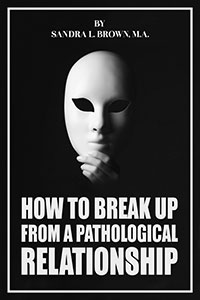
How to Break Up From a Pathological Relationship
Maintaining Mindfulness in the Midst of Obsession
![]() |
The Pathological Love Relationship causes intrusive thoughts and obsessions which are the number one complaint in recovering from the aftermath of these relationships. Being able to manage your thinking and reducing the obsessions about the relationship, in turn, reduce anxiety. This e-book teaches how the mind operates, what anxiety and pathological relationships does to the thinking process, and how Mindfulness can relieve your symptoms!Two CD’s include exercises you can do to increase Mindfulness and reduce intrusive thoughts and obsessions. And another Mindfulness Chimes that alerts you to ‘times’ when you should be Mindful. A therapeutic set! | ||||||||||||||||

|
|||||||||||||||||
What to Say After He’s Gone
![]() |
What to Say After He’s Gone by Dr. Kathie.T. Erwin |
||||||||||||||||
|
|||||||||||||||||
How to Avoid Dating Damaged & Destructive Women
![]() |
How to Avoid Dating Damaged Women by Pathology Expert Sandra L. Brown, M.A. |
||||||||||||||||
|
|||||||||||||||||
Self Defense For Women

Self Defense For Women
$47.00
Click HERE to read more
Once you pay, your download link will be provided. Make sure you download your product!
Facilitator’s Handbook
![]() |
How to Spot a Dangerous Man Educational & Support Group Facilitator’s Handbook. A guide book for running Dangerous Man support groups for teens & adults. | ||||||||||||||||||
|
|||||||||||||||||||
How to Start a Domestic Violence Ministry
![]() |
How to Start a Domestic Violence Ministry at Your Church or Faith-Based ProgramHas your organization discussed starting a domestic violence outreach or program for victims of domestic violence in your community? Here’s a way to not re-create the wheel and hit the ground running. Written by a church who started their own program, simply follow these easy to understand guidelines to create your own program! | ||||||||||||||||||
|
|||||||||||||||||||
How To Spot a Dangerous Man
September 28, 2008 by sandra
Filed under Print Books

How to Spot a Dangerous Man Before You Get Involved
What IS the Dangerous Man Book?
- 8 Categories of Dangerous Men
- Signs and Symptoms
- Red Flags
- Checklists
- Your Own Sabotaging Behaviors
- Why Women Date More Than One Dangerous Man
- The Profiles of the Women They Seek
Also included are recommend books and clinical references for those that might like more education on the victimization topic.
$14.95 each plus shipping/handling
Products are shipped on Tuesdays & Fridays first class mail.
Book will be signed by the author
Dangerous Man Companion Workbook
September 28, 2008 by sandra
Filed under Print Books

Companion Workbook:
How to Spot a Dangerous Man Before You Get Involved Workbook: A Survival Guide for Women
The workbook is a companion piece to the main book How to Spot a Dangerous Man and is also designed to be used with the workshops, as well. The workbook is a mini-counseling session in which you will dip deeply into your past from childhood through your teen years, and into your adulthood looking for information about your personalized patterns of selection in relationships. You can’t change what you don’t see!
Products are mailed out on Tuesday and Fridays first class mail.
$11.95 plus shipping/handling
Dangerous Man GIFT PACK
September 28, 2008 by sandra
Filed under Print Books

Dangerous Man Gift Pack
Buy the book and workbook together and save.
NOW ON SALE $25.00 plus shipping/handling.
Products shipped on Tuesdays & Fridays, first class mail.
Book will be signed by the author
Dangerous Man Three Pack
September 28, 2008 by sandra
Filed under Print Books
Buy 3 and save!
![]() |
1. Buy the main book ‘How to Spot a Dangerous Man’ (value $14.95/sale $13.00) |
![]() |
2. AND the ‘How to Spot a Dangerous Man’ workbook (value $14.95/sale $9.95) |
![]() |
3. AND get our ‘How To Break Up From a Pathological Relationship E-book (value $9.95) for HALF PRICE. Book + Workbook + E-book= $29.95 |
| So that’s the Book + Workbook + E-book= $29.95.(plus shipping and handling)
Products are mailed out on Tuesday and Fridays first class mail. Once payment is complete, you will be directed to the page where you can INSTANTLY download your “How to break up from a pathological relationship” e-book |